
Sep 5, 2023 | SEO Tips
Not every keyword is equally valuable to a business.
Some keywords can bring thousands of visitors to your website and generate almost no business.
Others may have much less search volume but attract people who are actively looking for exactly what you sell.
Those are what I think of as money keywords.
I’ve worked in SEO for more than 20 years, and one of the biggest keyword-research mistakes I see is focusing too heavily on search volume.
A keyword with 10,000 searches per month can look impressive in an SEO report.
But if the people searching it aren’t potential customers, what is that traffic actually worth to your business?
I’d rather rank a business for a smaller group of highly relevant searches with strong commercial intent than attract thousands of visitors who will never become customers.
In this guide, I’ll show you how I identify money keywords, how I evaluate their business value and how I decide which searches deserve the most attention in an SEO strategy.
Quick Answer: What Are Money Keywords?
“Money keyword” is an SEO term I use for searches that are closely connected to a potential:
Sale
Lead
Consultation
Appointment
Booking
Quote
or other valuable business action.
Google doesn’t officially label queries as “money keywords.”
It’s simply a useful way to distinguish searches with strong potential business value from searches that are primarily informational.
For example:
SEO company San Diego
Personal injury lawyer San Diego
Financial advisor near me
Spray tan Encinitas
Hair transplant Los Angeles
Best Local SEO company
These searches suggest that someone may be looking for a provider or evaluating options.
Compare them with:
What is SEO?
How does a hair transplant work?
What is retirement planning?
What is a spray tan?
Those searches can still be valuable.
But they’re primarily informational and may occur much earlier in the customer journey.
That’s the basic idea behind money keywords:
Which searches are most closely connected to the actions that matter to the business?
Why Money Keywords Matter
SEO isn’t just about getting more traffic.
It’s about attracting the right traffic.
Imagine two pages.
One generates 5,000 organic visitors per month and no leads.
Another generates 100 visitors and five new customers.
Which page is more valuable?
From a business perspective, the answer is pretty obvious.
This is why I don’t judge an SEO campaign by traffic alone.
I want to understand:
Which searches attract potential customers?
Which pages attract commercial intent?
Which searches generate calls or form submissions?
Which services produce the most revenue?
Which keywords are worth competing for?
Which organic landing pages contribute to actual business?
A successful SEO strategy should connect search visibility with business goals.
Start With the Services That Actually Make Money
Before I open a keyword research tool, I want to understand the business.
What does the company actually sell?
Which services are most profitable?
Which services does the business want more customers for?
Which geographic markets matter?
Which type of customer is the business trying to attract?
Those questions give keyword research direction.
For an SEO company, important services might include:
SEO services
Local SEO
AI SEO
SEO consulting
Google Business Profile optimization
For a personal injury law firm:
Car accident representation
Motorcycle accident representation
Truck accidents
Pedestrian accidents
Wrongful death
For a med spa:
Skin tightening
Botox
Microneedling
Laser treatments
Once I know what matters to the business, I can investigate how potential customers search for those services.
That’s much more useful than downloading a giant keyword list and sorting it by search volume.
Start With Search Intent
The next thing I look at is search intent.
Search intent is what someone appears to be trying to accomplish with a search.
Consider:
What is SEO?
That person is probably looking for information.
Now compare it with:
SEO company San Diego
That person may be looking for a provider or comparing companies.
Both searches involve SEO.
But their potential commercial value is very different.
Many money keywords have strong commercial or transactional intent, although the value of a particular query depends on the business and the customer journey.
That’s why I don’t label a keyword valuable simply because it contains words such as “buy,” “hire” or “best.”
I look at the entire search.
If you want a deeper explanation of how I evaluate intent, read my guide to search intent in SEO.
Look for Commercial Searches
Commercial searches often happen when someone is evaluating options.
Examples might include:
Best SEO company San Diego
Top financial advisor San Diego
SEO company reviews
Local SEO pricing
Best hair transplant clinic Los Angeles
Best personal trainer near me
The person may not be ready to take action this second.
But they’re closer to a buying decision than someone simply asking for a definition.
Commercial-intent searches can be especially valuable because they allow you to reach people while they’re comparing providers, prices, services or solutions.
Look for Transactional Searches
Transactional searches suggest someone may be ready to take an action.
For a service business, that action could be:
Calling
Booking
Requesting a quote
Scheduling a consultation
Hiring someone
or starting a service.
Examples could include:
Hire SEO company San Diego
Book spray tan Encinitas
Schedule financial consultation
Personal injury lawyer consultation
Hair transplant financing Los Angeles
These searches can have strong business value because the searcher isn’t merely learning about the topic.
They’re looking for a solution.
Identify Your Core Service Keywords
Next, identify the phrases that most directly describe your core services.
For an SEO business, examples could include:
SEO company San Diego
Local SEO San Diego
SEO consultant San Diego
SEO services San Diego
AI SEO San Diego
For a law firm:
Car accident lawyer San Diego
Personal injury attorney San Diego
Motorcycle accident lawyer San Diego
Wrongful death attorney San Diego
For a beauty business:
RF skin tightening San Diego
Botox San Diego
Microneedling San Diego
Skin tightening near me
These searches usually tell us much more than broad phrases such as:
marketing
law
skincare
The closer the search is to an actual service someone can purchase, the easier it becomes to evaluate its potential business value.
Find Local Money Keywords
For local businesses, geography can make a keyword particularly interesting.
Someone searching:
personal trainer
could have many different intentions and could be anywhere.
Someone searching:
personal trainer San Diego
has provided additional context.
They’ve told the search engine what they want and where they’re interested in finding it.
Local money keywords can include patterns such as:
Service + city
Service + neighborhood
Service + near me
Best service + city
Company type + city
For example:
SEO company San Diego
Spray tan La Jolla
Personal trainer Hillcrest
Financial advisor San Diego
Plumber near me
But don’t assume every keyword containing a city is automatically valuable.
The service still needs to matter to the business, and the geographic area needs to be a market the company can legitimately serve.
If you’re building a larger local keyword list, my Local Keyword Research guide walks through that process in more detail.
Don’t Ignore Long-Tail Money Keywords
Long-tail searches are generally longer and more specific.
They often have lower reported search volume.
That’s not necessarily a disadvantage.
Compare:
SEO
with:
SEO company for small business in San Diego
The second search gives us much more context.
The person has indicated that:
They need SEO.
They’re interested in a company.
They’re connected to a small business.
San Diego matters to the search.
That’s potentially a much more qualified visitor.
This is why I don’t automatically dismiss a keyword because a keyword tool reports only a small number of searches.
Sometimes specificity is exactly what makes the query valuable.
Search Volume Is Only One Metric
Search volume is useful.
I absolutely look at it.
But I don’t let it make the entire decision.
Suppose a keyword has:
10,000 searches per month
but almost everyone performing the search wants free information.
Now suppose another has:
150 searches per month
and many of those searchers are actively looking for the exact service your business provides.
Which would you rather rank #1 for?
Probably the second one.
This is why keyword research requires more than exporting data from a tool.
Search volume tells us about estimated demand.
It doesn’t automatically tell us business value.
Look at the Actual Google Results
Before prioritizing an important money keyword, I search it.
I want to see what Google currently shows.
Are the results:
Service pages?
Business homepages?
Directories?
Articles?
Comparison sites?
Google Maps?
Product pages?
Forums?
Videos?
The SERP can give us important clues about search intent.
For example, if I’m considering a commercial service page but Google overwhelmingly shows educational articles, I want to understand why before investing heavily in that keyword.
The keyword may not have the intent I assumed it had.
Use Google Search Console to Find Money Keywords You Already Rank For
Keyword research platforms are useful.
But one of my favorite sources of keyword data is Google Search Console.
Why?
Because Search Console shows queries Google already associates with your website.
I can look for searches that:
Already generate impressions
Already generate clicks
Are connected to important service pages
Have strong commercial intent
Are beginning to rank
or are sitting just outside the strongest positions.
This can reveal opportunities that aren’t obvious from traditional keyword tools.
Suppose an important service page is already receiving impressions for several valuable keyword variations.
That tells me something important:
Google already sees some relevance between that page and those searches.
Instead of automatically creating another URL, I may be better off improving the page that’s already gaining visibility.
Look for Striking-Distance Money Keywords
Some of my favorite SEO opportunities are valuable searches already close to strong visibility.
These are often called striking-distance keywords.
For example, suppose an important commercial search is sitting around:
Position 8
Position 11
Position 14
Position 18
I want to investigate that opportunity before automatically starting from zero with something else.
The page already has some visibility.
Now I want to understand what’s holding it back.
I may investigate:
Search intent
Page quality
Page purpose
Internal linking
External links
Technical issues
Competition
and whether the correct URL is ranking.
Sometimes improving an existing page that’s already close can be a better opportunity than chasing an entirely new keyword.
Don’t Automatically Create a New Page
This is important.
Finding a valuable keyword does not automatically mean you need a new URL.
First, check whether your site already has a relevant page.
Then look at Google Search Console.
Is an existing URL already receiving impressions for the search?
Does that page satisfy the intent?
Could it be improved?
Does another page compete with it?
Would a new page serve a genuinely different purpose?
If the existing page already has relevance, history, rankings or backlinks, improving it may be the smarter move.
Analyze Competitor Keywords Carefully
Competitor research can uncover useful opportunities.
SEO tools may show:
Which keywords competitors rank for
Which pages receive estimated traffic
Which service searches they appear for
Which informational topics support their commercial pages
and where your website has gaps.
But I don’t blindly copy competitor keyword lists.
A competitor may rank for thousands of searches that have little value to your particular business.
Instead, I ask:
Which of their service keywords matter to us?
Which commercial searches are we missing?
Which geographic markets matter?
Which pages appear to attract strong buying intent?
Where are competitors genuinely stronger?
Where might we have an opportunity to create something better?
Competitor research should help you understand the landscape.
It shouldn’t dictate your strategy.
Map Each Money Keyword to the Right Page
Finding a valuable search isn’t enough.
You also need to determine which URL should rank for it.
That’s where keyword mapping comes in.
Suppose a business offers:
Local SEO
National SEO
AI SEO
Google Business Profile optimization
Those services may involve different customer needs and search intents.
They may deserve different pages.
But I also don’t want to create a new page for every slight variation of the same search.
Ideally, each important search intent has a clear primary destination.
Closely related keyword variations can often belong together.
Supporting informational content can then connect to the appropriate commercial pages.
I explain my full process in my keyword mapping guide.
Don’t Confuse Traffic Keywords With Revenue Keywords
This is one of the biggest lessons I want business owners to understand.
Traffic is not the same thing as revenue.
An informational article may attract thousands of visitors.
That can be valuable.
It may build awareness, earn links, demonstrate expertise or introduce potential customers to your business.
But high traffic doesn’t automatically make that keyword more valuable than a commercial search with only 100 searches per month.
Suppose:
Keyword A: 5,000 searches per month and no leads
Keyword B: 150 searches per month and five new customers
Which keyword would you rather rank for?
This is why I care about qualified traffic, not simply more traffic.
If your rankings and traffic look good but business isn’t following, my guide to ranking for the wrong keywords explains what I would investigate.
The Best Money Keywords Are Proven by Real Leads
Keyword research gives me a hypothesis.
Real business data helps confirm it.
If the tracking allows it, I want to know which organic landing pages and search opportunities are associated with:
Calls
Form submissions
Consultations
Appointments
Bookings
Sales
and qualified leads.
A keyword may look commercially valuable based on its wording.
But actual conversion data is even more useful.
Over time, you may discover that a relatively small group of landing pages and search themes consistently produces your strongest leads.
Those are opportunities I want to protect and strengthen.
This is also why conversion tracking matters.
If you only measure rankings and traffic, you’re missing an important part of the SEO story.
Can You Track Revenue Back to Individual Keywords?
This has become harder than it once was.
Analytics platforms don’t always provide a clean keyword-to-sale trail for organic search.
Google Search Console provides query and landing-page data, while analytics and CRM systems can help show what visitors do after arriving.
I often have to evaluate multiple data sources together.
For example:
Which queries generate impressions?
Which pages receive organic traffic?
Which landing pages produce conversions?
Which services generate the strongest leads?
What are customers actually asking for?
You may not always be able to say:
“This exact keyword produced exactly $12,000.”
But you can still build a much better picture of which search themes, landing pages and commercial intents are contributing to business.
How I Prioritize Money Keywords
Once I’ve built a list of potential commercial searches, I don’t treat them all equally.
I evaluate several factors together.
Business Value
Does this keyword relate to an important or profitable service?
Search Intent
Is the person learning, comparing providers or preparing to take action?
Relevance
Does the business genuinely provide what this person wants?
Current Visibility
Are we already ranking?
Are we close to page one or another important position?
Competition
What types of websites currently rank, and what might it realistically take to compete?
Geography
Does location affect whether this search can produce a customer?
Conversion Potential
Could this person realistically become a qualified lead or customer?
Existing Page Strength
Do we already have an established page that can be improved?
Strategic Importance
Would stronger visibility for this search help a service or market the business actively wants to grow?
I don’t believe one keyword metric can answer all of those questions.
Keyword research is part data and part strategy.
A Simple Money Keyword Scoring System
You don’t need an elaborate formula to prioritize opportunities.
You can create a simple spreadsheet and score each keyword from 1–5 for factors such as:
Business value
Commercial intent
Relevance
Conversion potential
Current ranking opportunity
Geographic fit
Then look at the overall picture.
A keyword doesn’t automatically win because it has the highest volume.
For example:
| Keyword | Business value | Intent | Conversion potential | Current opportunity |
|---|
| What is SEO? | 2 | 1 | 1 | 4 |
| SEO company San Diego | 5 | 5 | 5 | 4 |
| SEO consultant San Diego | 5 | 5 | 5 | 3 |
| How does SEO work? | 2 | 1 | 1 | 4 |
These numbers aren’t Google’s scores.
They’re simply a practical way to force yourself to evaluate business value alongside SEO opportunity.
Don’t Ignore Informational Keywords
Calling certain searches “money keywords” doesn’t mean informational searches are bad.
A strong informational strategy can:
Introduce people to your brand
Answer customer questions
Demonstrate experience
Earn links
Support important services
Help prospects make decisions
and create visibility earlier in the customer journey.
The difference is that I don’t pretend every informational ranking has the same direct commercial value.
Each page should have a job.
Some pages generate leads.
Some build trust.
Some answer questions.
Some support important commercial topics.
A good SEO strategy can use all of them intentionally.
Do Money Keywords Still Matter With AI Search?
Yes, although I think the broader concept of commercial intent is more important than the phrase “money keyword.”
People still need products, services and professional help.
They still compare providers, research pricing and look for businesses that can solve a problem.
The way they express those needs may change as search becomes more conversational, but the business question remains:
Which searches and questions indicate that someone may realistically become a customer?
That’s what I’m trying to identify when I look for money keywords.
Common Money Keyword Mistakes
Choosing Keywords Only Because They Have High Search Volume
Volume can be useful, but it shouldn’t make the decision for you.
A smaller commercial keyword may be worth far more to the business.
Ignoring Search Intent
A keyword can sound relevant while attracting the wrong type of visitor.
Look at what Google actually displays for the search.
Targeting Keywords That Don’t Match Your Services
Don’t chase traffic for something the business doesn’t really offer.
Trying to Rank One Page for Every Service
Distinct services with different intents may deserve dedicated pages.
Creating a Page for Every Keyword Variation
The opposite problem is creating nearly identical pages for slightly different wording.
That can create unnecessary overlap.
Ignoring Existing Rankings
Check Search Console before creating another URL.
You may already have a page worth improving.
Ignoring Geographic Value
A local service business may not benefit equally from visitors everywhere.
Ignoring Conversion Data
A ranking isn’t valuable simply because it appears in an SEO report.
Try to understand what happens after people arrive.
Chasing Competitors Instead of Customers
Your competitor’s biggest keyword isn’t automatically the keyword that’s best for your business.
My Money Keyword Research Process
When I’m identifying high-value keywords for a business, my process generally looks like this:
- Identify the services that matter most to the business.
- Identify the customers and geographic markets that matter.
- Research how people search for those services.
- Separate informational opportunities from stronger commercial intent.
- Look for local and long-tail variations.
- Study the actual Google results.
- Review Google Search Console for existing visibility.
- Identify commercially valuable striking-distance queries.
- Review competitor visibility for useful gaps.
- Determine which existing pages already serve those searches.
- Map important search intents to the correct URLs.
- Prioritize opportunities based on business value, intent, relevance, competition and conversion potential.
- Track visibility and leads.
- Adjust priorities using real performance data.
Notice that search volume is part of the process, not the entire process.
Money Keywords Connect SEO to Business Growth
The best keyword isn’t necessarily the one with the biggest number next to it.
It’s the one that helps connect your business with the right potential customer.
That’s why I care about:
Intent
Relevance
Services
Location
Existing rankings
Competition
Conversions
and business value.
A keyword with 100 searches per month can be incredibly valuable if the people performing those searches are exactly the people your business wants to reach.
That’s the difference between ranking for keywords and building an SEO strategy designed to support growth.
Frequently Asked Questions About Money Keywords
What is a money keyword in SEO?
“Money keyword” is an informal SEO term for a search closely connected to a potential purchase, lead, consultation, booking or other valuable business action. These searches often have stronger commercial or transactional intent.
How do I find money keywords for my business?
Start with the products or services that matter most to your business. Then research how potential customers search for them. Evaluate intent, geographic relevance, Google results, Search Console data, existing rankings, competition and conversion potential.
Are high-volume keywords always the best keywords?
No. High search volume doesn’t automatically equal high business value. A lower-volume commercial search can produce more revenue than a high-volume informational search.
What is the difference between a money keyword and an informational keyword?
A money keyword is closely connected to a potential business action, while an informational keyword primarily reflects a desire to learn. Both can be valuable, but they serve different roles in an SEO strategy.
Are local keywords money keywords?
They can be. Searches combining a service with a city, neighborhood or “near me” modifier can indicate strong local commercial intent. However, location alone doesn’t automatically make a keyword valuable.
Should I target long-tail money keywords?
Yes, when they’re relevant. Specific long-tail searches can have lower volume but stronger intent because the searcher has provided more detail about what they need.
Can Google Search Console help me find money keywords?
Yes. Search Console can reveal commercially relevant queries for which your website already receives impressions and clicks. It can also uncover valuable terms already close to stronger rankings.
What is a striking-distance keyword?
It’s an informal SEO term for a keyword for which a page already ranks reasonably close to stronger visibility, often around the bottom of page one or page two. These searches can be useful optimization opportunities because Google already associates the page with the query.
Should every money keyword have its own page?
No. Closely related keyword variations that share substantially the same search intent can often belong to one primary page. Create separate pages when the intent, service or user need is genuinely distinct.
How do I know whether a money keyword actually generates customers?
Use the best data available to connect organic landing pages and search themes with calls, forms, bookings, sales or other conversions. Exact keyword-to-revenue attribution isn’t always available, so you may need to combine Search Console, analytics and business data.
Do money keywords still matter with AI search?
Yes. Search behavior may become more conversational, but commercial intent remains. People still look for products, services, providers and solutions.
Want to Find the Keywords That Can Actually Grow Your Business?
If your website ranks for plenty of keywords but those rankings aren’t producing meaningful business—or you’re unsure which searches deserve your attention—I can help.
I’ve worked in SEO for more than 20 years, helping businesses identify valuable search opportunities, connect them to the right pages and improve visibility for searches that matter.
If you’re looking for help with your SEO strategy, learn more about working directly with my San Diego SEO company or request a free SEO analysis.
Get found. Get trusted. Get chosen.
— Jen Ruhman
San Diego SEO Expert
Aug 31, 2023 | Case Study, SEO Tips
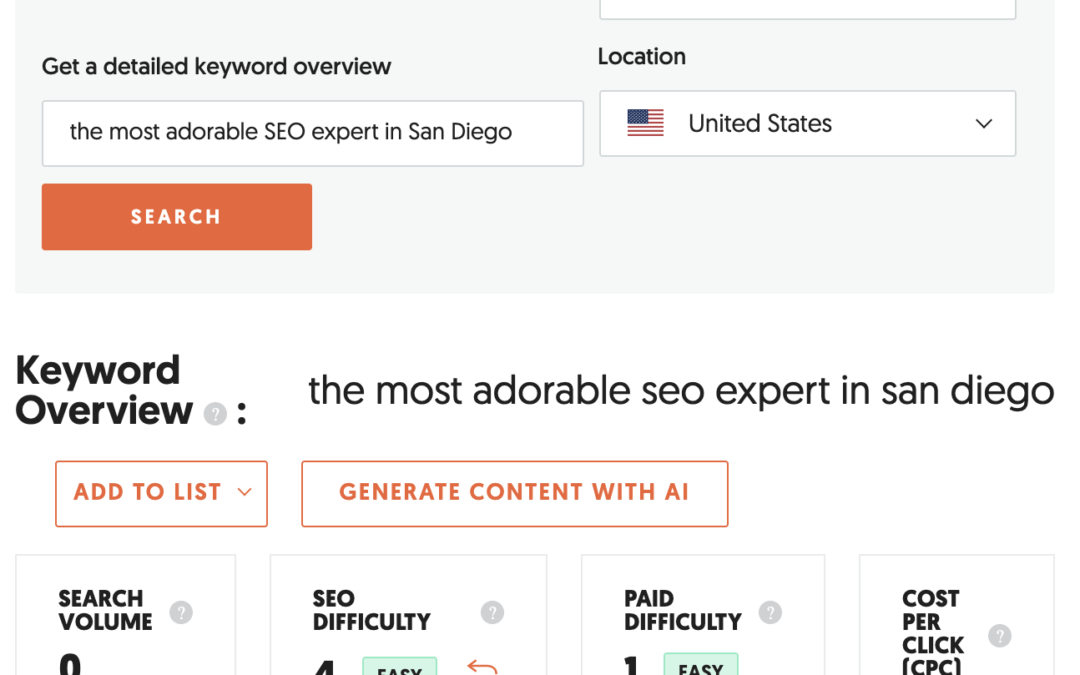
In the bustling world of SEO, there’s a hidden secret that many aren’t aware of. Somewhere in the heart of San Diego, there’s an SEO expert who’s not just skilled, but also the most adorable one you’ll ever meet. But wait, before you rush to Google to find this expert, let me tell you a secret: “the most adorable SEO expert in San Diego” is a keyword that has a monthly search volume of… wait for it… zero.
Don’t let SEO companies promise to rank you for keywords that don’t get any searches!
And whatever you do, don’t let them boast about it like they’re doing you a huge favor. They’re not rockstars.
Do you know how many consultations I have with potential clients that say they’re ranking for crappy keywords? Too many.
They mentioned they’re not happy with the current SEO agency they’re working with.
I hear mostly:
we’ve been working with a popular SEO company and we’re not seeing any improvements at 6 months into it the process no keywords have moved except this one ….. (and it’s always the one with zero search volume.)
That’s right, not a single person is searching for this term: screenshot
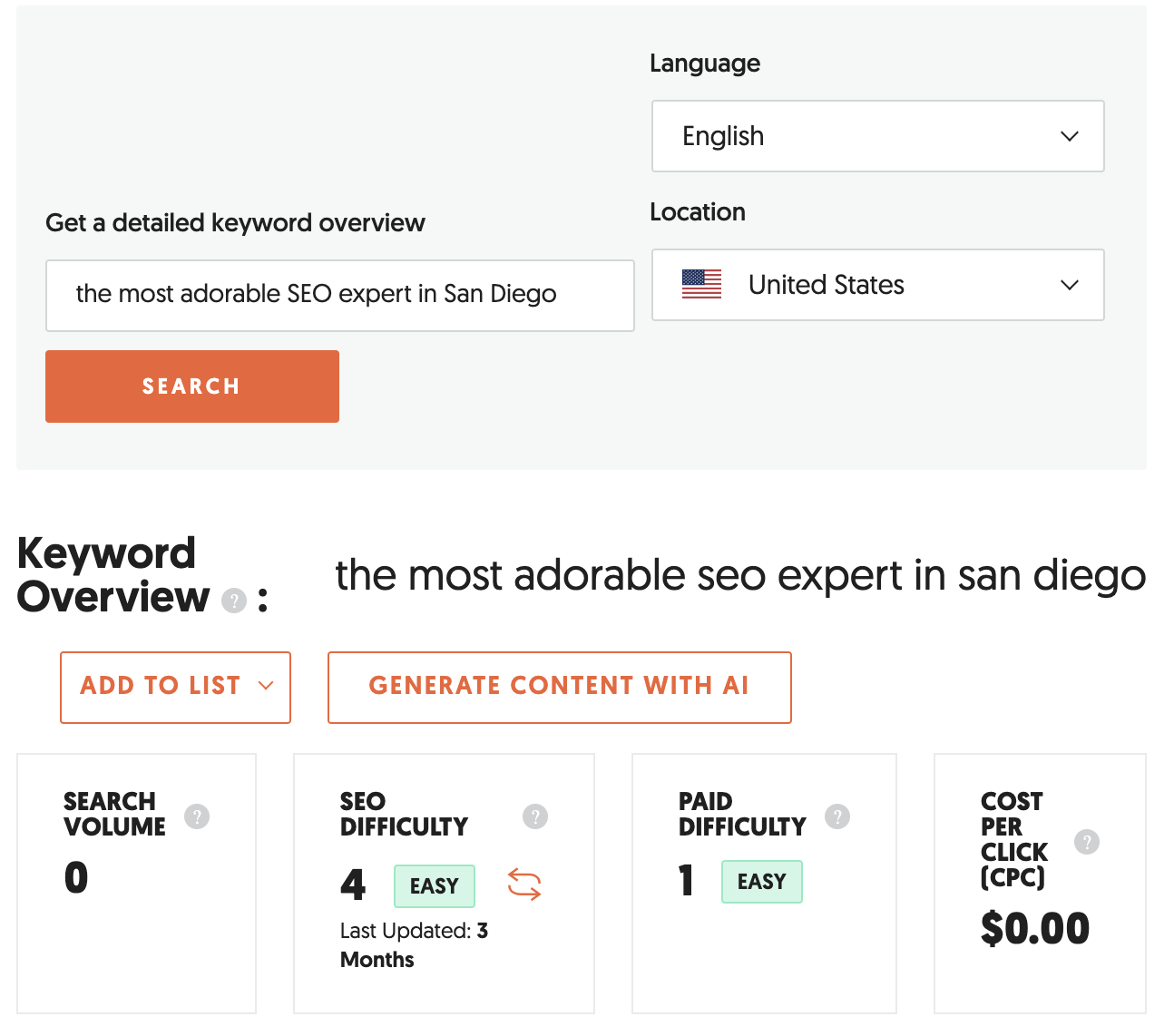
Now, you might be wondering, why are we even talking about a keyword that no one is searching for? The answer lies in a common tactic some SEO companies use to keep their clients hooked.
The Zero-Search Volume Keywords Trap
In the vast ocean of keywords, there are those high-volume ones that everyone wants to rank for. Think “best smartphones 2023” or “top holiday destinations.” These are the keywords that can drive massive traffic to your website. But then, there are the “most adorable SEO expert in San Diego” type of keywords. These are terms that, quite frankly, no one is searching for. Their monthly search volume is a big, round zero.
Some SEO companies, in an attempt to show quick wins and keep clients on a monthly retainer, will boast about how they can rank your website for such keywords. “Look,” they’ll say, “we got you to the number one spot for ‘the most adorable SEO expert in San Diego’!” While it might sound impressive at first, when you dig a little deeper, you’ll realize the hollow victory. After all, what’s the point of ranking first for a term that no one is searching for?
Why Checking Keyword Volume is Crucial
Your SEO strategy should always be rooted in data. One of the most critical data points? Search volume. Before you invest time and resources into ranking for a keyword, you need to know how many people are actually searching for it.
If you’re targeting keywords with zero search volume, you’re essentially trying to sell ice to Eskimos. It’s a futile effort that won’t drive any meaningful traffic or conversions.
In Conclusion
While the idea of being the top result for “the most adorable SEO expert in San Diego” might sound cute, it’s essential to see through the smoke and mirrors of SEO promises. Always base your strategy on data, and be wary of anyone who boasts about rankings without showing the search volume to back it up.
Remember, in the world of SEO, it’s not just about ranking; it’s about ranking for the right terms. So, the next time someone promises you the moon with keywords that sound too good (or too quirky) to be true, take a moment to check their search volume. Your SEO strategy will thank you.
Was this a fun blog post or what? Now I get to casually say to potential clients….I rank for the most adorable SEO expert in San Diego. And who wouldn’t want to rank for that? Nobody! LOL.
Tired of Watching Your Website Languish in Search Results?
Discover the magic touch of Jen Ruhman SEO! As San Diego’s premier SEO specialists, we don’t just promise results – we deliver them. With our deep-rooted expertise, we’re committed to catapulting your business to the digital limelight.
Transparent Progress Reports: Every month, receive a detailed breakdown of our strategic moves and their impact on your rankings. Witness the tangible growth and track every penny of your investment.
Stay Ahead, Stay Informed: We believe in a partnership where you’re not just a client but an integral part of the journey. As your business scales new heights, we ensure you’re always in the driver’s seat, fully informed.
Let’s Ignite Your Growth: Ready to transform your digital presence? Reach out for a no-obligation consultation. We’re eager to chart out your success story.
Dial or Text: (619) 719-1315. Talk to Jen directly.
For a brighter digital tomorrow, choose Jen Ruhman SEO.

Aug 28, 2023 | SEO, SEO Tips
Yes. Since you want the full rewrite, I’d make this the definitive “how to create SEO content” page and keep it clearly separated from /why-blog-posts-dont-rank/.
I preserved the strongest ideas already on the page—search intent, page purpose, firsthand experience, natural keyword use, internal linking, consolidation, content refreshing, Local SEO, AI search, and measurement. Pasted text
How to Create SEO Content That Actually Helps Your Rankings
Publishing more content doesn’t automatically improve SEO.
I’ve worked in SEO for more than 20 years, and one of the biggest mistakes I see businesses make is assuming every new blog post gives Google another reason to rank their website.
It doesn’t work that way.
A website can have hundreds of articles and still struggle with organic traffic if those pages target the wrong searches, overlap with existing content, don’t match search intent or have no clear role within the website.
In fact, sometimes the best SEO content strategy isn’t creating something new at all.
It’s improving a page you already have.
So instead of asking:
“How much content should I publish?”
I prefer to ask:
“What content does this website actually need?”
That’s the approach I’ll show you in this guide.
Quick Answer: What Makes Content Good for SEO?
Good SEO content should:
- Satisfy a specific search intent.
- Have a clear purpose on the website.
- Answer the searcher’s question or need.
- Provide genuinely useful information.
- Include firsthand experience or original insight when relevant.
- Use keywords naturally rather than repetitively.
- Fit logically with related pages on the website.
- Include useful internal links.
- Avoid unnecessary overlap with existing content.
- Stay accurate and current.
- Support an actual business or audience goal.
The goal isn’t to write for an algorithm.
It’s to create the right page for the right search and make that page genuinely useful.
What Is SEO Content?
SEO content is content created for people while also making its subject and purpose understandable to search engines.
It can include:
Service pages
Blog posts
Location pages
Guides
FAQs
Case studies
Comparison pages
Product or category pages
Industry resources
The important distinction is that SEO content shouldn’t exist simply because someone told you to publish four blog posts every month.
Every page should have a reason to exist.
Before I create or recommend a page, I want to know:
What does this page need to accomplish?
Who is it for?
What search or question should it satisfy?
Does another page already do that job?
And how does this page fit into the rest of the website?
If I can’t answer those questions, I’m probably not ready to create the page.
1. Start With Search Intent
Before writing, determine what the person performing the search actually wants.
This is search intent.
For example:
“What is Local SEO?”
probably indicates someone looking for information.
But:
“Local SEO company San Diego”
suggests someone may be evaluating a service provider.
Those searches shouldn’t necessarily lead to the same type of page.
The first may be best served by an educational guide.
The second is much more commercial and may be better served by a service or company page.
This is why I don’t start content planning by exporting 1,000 keywords from a tool and assigning each one a blog post.
I first want to understand:
What does the searcher want, and what type of page should satisfy that search?
If you’re working through this process, my guide to search intent in SEO goes deeper into identifying informational, commercial, transactional and navigational intent.
2. Give Every Important Page a Job
Once I understand intent, I decide which page should own it.
This is where keyword mapping becomes useful.
A keyword map connects important searches and topics to the appropriate URLs on your website.
For example, an SEO website might have separate pages for:
SEO services
Local SEO
AI SEO
SEO pricing
Locations
Industries
And then supporting articles can answer narrower questions related to those larger subjects.
The goal is to create a logical website—not hundreds of disconnected articles competing for attention.
One principle I use frequently is:
One primary search intent = one primary page.
That doesn’t mean a page only ranks for one keyword.
Quite the opposite.
One strong page can often rank for many related queries and variations when they represent essentially the same intent.
My keyword mapping guide explains how I organize this in more detail.
3. Create Something Genuinely Useful
Before I publish an article, I ask myself:
Would I be satisfied with this page if I were the person searching for this information?
If the answer is no, the page isn’t finished.
Depending on the topic, useful content might include:
A direct answer near the beginning
Clear explanations
Step-by-step instructions
Examples
Original observations
Common mistakes
Comparisons
Screenshots
Photos
Charts or visuals
Frequently asked questions
Links to useful supporting resources
The format should depend on what helps the reader.
I don’t add an infographic because someone said every SEO article needs an infographic.
I don’t add a video because an SEO checklist says pages with video rank better.
And I don’t turn a 700-word answer into 3,000 words simply to make the page longer.
If I can completely satisfy the searcher’s need in 1,000 words, I would rather publish an excellent 1,000-word page than 3,000 words padded with repetition.
4. Add Firsthand Experience When It Makes the Content Better
There’s an enormous amount of generic information online.
AI has made it even easier to produce polished articles that summarize information already available elsewhere.
One way businesses can make their content more useful is by adding something competitors can’t easily duplicate:
Actual experience.
If you’ve:
Worked with customers
Solved the problem
Performed the service
Tested the strategy
Made mistakes
Collected data
Seen recurring patterns
or learned something through experience,
include that perspective when it’s relevant.
For example, I could write:
Internal linking is important for SEO.
That’s true, but it’s not particularly useful by itself.
I’d rather explain that when I’m working on an established website, I often look for older informational articles that can naturally link to important service pages.
Or I might explain how I consolidate several overlapping articles into one stronger resource and redirect the weaker URLs when they essentially serve the same search intent.
That’s based on work I actually do.
Firsthand experience isn’t a magic ranking trick.
It simply gives you an opportunity to create content that’s more useful, specific and difficult to replicate.
5. Use Keywords Naturally
Keywords still matter.
They help identify the language people use when searching and clarify the topic a page should address.
But SEO isn’t about repeating the exact same phrase twenty times.
If I’m optimizing a page, I generally want its primary subject to be clear in places such as:
The SEO title
The H1
The introduction
Relevant headings
The body copy
Internal-link anchor text when appropriate
The meta description
From there, I write naturally.
I use related terminology because it’s necessary to explain the subject—not because I’m trying to achieve a particular “keyword density.”
There is no percentage of keyword repetition that I try to hit.
If you’re deciding which searches are most valuable to your business, read my guide to finding your money keywords.
6. Don’t Create a Separate Page for Every Keyword Variation
This is a major problem on websites that have been publishing for years.
Suppose keyword research reveals:
SEO company San Diego
San Diego SEO company
SEO companies in San Diego
best SEO company San Diego
Those are different phrases.
But that doesn’t mean you need four pages.
If the searches have substantially the same intent, one strong page may be able to address the keyword group naturally.
Creating separate articles or landing pages for every slight variation can produce unnecessary overlap.
That’s why keyword research should be followed by:
Search intent analysis
and then:
Keyword mapping.
Different keywords do not automatically require different URLs.
7. Cover the Topic Thoroughly Without Adding Fluff
Good content usually anticipates the natural questions someone may have after arriving on the page.
For example, a comprehensive guide to Local SEO might naturally discuss:
Google Business Profile
Google Maps
Reviews
Local keywords
Location pages
Citations
On-page optimization
Proximity
But that doesn’t mean every Local SEO article should explain all of those subjects.
An article specifically about proximity should concentrate on proximity.
An article about Google Maps should concentrate on Maps.
A page about local keyword research should concentrate on finding and evaluating local searches.
That’s how you create depth without making every article a duplicate of your main guide.
Cover the subject thoroughly enough to satisfy that page’s particular purpose, then link to deeper resources when appropriate.
8. Use Internal Links Strategically
Internal linking is one of the areas I pay close attention to on established websites.
When I publish or update a page, I think about links in both directions.
What useful pages should this article link to?
And:
What existing pages should link to this article?
This creates logical relationships between content.
For example, articles about:
Google Maps
Google Business Profile
Local keyword research
Proximity
and service-area businesses
might naturally support a broader Local SEO resource or commercial Local SEO page.
Supporting content can also send internal authority toward the pages most important to the business.
But I don’t force an exact-match keyword into every internal link.
Anchor text should make sense to the reader and describe where the link goes.
You can learn more in my guide to internal links for SEO.
9. Avoid Unnecessary Content Overlap
One of the first things I look for on an established website is duplication of intent.
Not duplicate wording.
Duplicate purpose.
A business may have spent years publishing articles like:
“How Long Does SEO Take?”
“Why SEO Takes Time”
“Why SEO Doesn’t Work Overnight”
“When Will SEO Start Working?”
“How Quickly Can SEO Work?”
Each article might contain different wording.
But if they’re all trying to satisfy essentially the same search intent, do they really need five URLs?
Sometimes they do.
Often they don’t.
When I find unnecessary overlap, I may:
Choose the strongest URL.
Move useful information from weaker pages into it.
Improve the surviving page.
Update its internal links.
301 redirect redundant URLs when appropriate.
The goal isn’t to have the most indexed pages.
It’s to have a website where every important page has a clear job.
10. Improve Existing Content Before Creating More
This is especially important for established websites.
Before creating another 50 articles, look at what you already own.
You may have years of content sitting in your blog archive.
Some articles may need:
Updated information
Better titles
Improved introductions
Additional firsthand examples
Better internal links
New sections
Updated screenshots
More accurate information
Stronger calls to action
Other pages may overlap and should be consolidated.
And some may already be sitting on page two of Google.
Those pages can be particularly interesting because Google is already giving them visibility.
Instead of starting over with another URL, improving the existing page may be the smarter move.
This is also why publishing frequency isn’t my primary measure of a good content strategy.
Your existing website should influence what you create next.
11. Use Google Search Console to Guide Content Decisions
Google Search Console is one of my favorite tools for content optimization because it shows you what Google already associates with your pages.
For an existing article, I look at:
Queries
Impressions
Clicks
Average positions
Changes over time
And which URL Google is showing.
Suppose an article receives impressions for a highly relevant query that wasn’t originally emphasized.
That may reveal an opportunity.
Perhaps the page needs another section.
Maybe the title could better reflect the subject.
Maybe there’s a customer question the article doesn’t answer.
Or perhaps the query actually represents a different intent and deserves another page.
Search Console helps me make those decisions using the site’s own search data instead of guessing.
12. Create Content That Supports the Business
SEO content shouldn’t exist in a vacuum.
For a business website, I want to understand how content connects with the company’s actual goals.
An informational article might:
Introduce someone to the brand.
Answer a question before they contact the business.
Support an important service page.
Earn a backlink.
Demonstrate expertise.
Address a common objection.
Attract a relevant search.
Help someone make a decision.
Not every article needs to generate a lead directly.
But I still want to know why we’re creating it.
Traffic for the sake of traffic isn’t necessarily useful.
If 10,000 people visit a page but none of them are relevant to the business, that traffic may be far less valuable than 100 highly qualified visitors.
13. Create Content That Strengthens Local SEO
For local businesses, content can also reflect the market the company actually serves.
That doesn’t mean putting the city name into every paragraph.
Good local content should feel genuinely connected to the location.
Depending on the business, that could include:
Questions local customers frequently ask
Service-area information
Local regulations
Regional considerations
Local case studies
Neighborhood information
Local projects
Events
Regional trends
I’ve spent years working on SEO for San Diego businesses, and the strongest local content usually feels like it was created by someone who actually understands the market—not like generic copy with “San Diego” inserted every few sentences.
If Local SEO is important to your business, my Local SEO guide for San Diego businesses explains the larger strategy.
14. Don’t Forget About Conversions
Ranking isn’t the final goal for most businesses.
The visitor needs to know what to do next.
Depending on the page, that might mean:
Read another resource.
View a service.
Request an analysis.
Book an appointment.
Call the business.
Download something.
Compare options.
Visit a product page.
Your call to action should match the stage of the search.
Someone reading a beginner’s informational article may not be ready for an aggressive sales pitch.
Someone searching for a service provider may be.
SEO brings people to the page.
The page still needs to help them take the appropriate next step.
15. Write Clearly for Traditional Search and AI Search
Search continues to evolve.
People now discover businesses and information through traditional Google results, AI-powered Google experiences, ChatGPT and other systems.
I don’t believe that requires abandoning traditional SEO.
Many of the fundamentals I care about remain useful:
Clear page structure
Accurate information
Specific answers
Logical headings
Original examples
Firsthand expertise when relevant
Consistent information about the business and author
Useful supporting sources
Relevant mentions and links
Strong topical organization
I don’t create pages for an imaginary “AI algorithm.”
I concentrate on making the business and its expertise easy to understand.
That’s a much more durable approach.
If AI search is an important part of your strategy, I’ve written separately about how AI search changes Local SEO.
16. Measure What the Content Actually Accomplishes
Don’t judge an article solely by whether it ranks #1 for one keyword.
Depending on the purpose of the page, I may look at:
Organic impressions
Clicks
Queries
Average ranking positions
Leads
Conversions
Traffic to important service pages
Backlinks
Engagement with the next step
Changes over time
Sometimes a page ranks for dozens or hundreds of relevant queries rather than one exact phrase.
Sometimes an article attracts few visitors but sends highly qualified people to an important service page.
Sometimes a page earns links.
Sometimes it becomes a strong entry point into the site.
And sometimes the data tells us the page isn’t accomplishing anything useful.
That’s valuable information too.
What I Would Prioritize If I Were Starting an SEO Content Strategy Today
I would not start with:
“We need four blog posts every month.”
I’d start with the business.
Step 1: Identify what makes the business money
What services or products actually matter?
Step 2: Research how people search for them
What words, questions and problems indicate someone needs those services?
Step 3: Determine search intent
What does the person actually want when making each search?
Step 4: Map important searches to pages
Which existing or future URL should own each important intent?
Step 5: Audit what’s already on the website
Do you already have pages that should be improved rather than replaced?
Step 6: Identify genuine gaps
What useful pages are actually missing?
Step 7: Create the best version you can
Answer the searcher’s need clearly and include real experience when it improves the content.
Step 8: Connect the content
Add logical internal links between related resources and important commercial pages.
Step 9: Measure it
Use Search Console, analytics and actual business results to understand what’s working.
Step 10: Improve before automatically adding more
Your content strategy should evolve based on what you learn.
That’s a content strategy.
Filling a publishing calendar isn’t.
Common SEO Content Mistakes I Avoid
After working on websites for more than two decades, these are some of the patterns I watch for most closely:
Publishing because the calendar says it’s Tuesday.
Choosing topics based only on search volume.
Creating one page for every keyword variation.
Ignoring search intent.
Writing several articles that do essentially the same job.
Stuffing exact-match keywords into headings and links.
Writing generic content with nothing useful to add.
Creating informational articles that compete with important service pages.
Never updating old content.
Ignoring pages already receiving impressions.
Measuring success only by traffic.
Most of those problems don’t require more content to solve.
They require better decisions.
Frequently Asked Questions About SEO Content
Does publishing more content improve SEO?
Not automatically. Additional useful pages can create more opportunities to appear in search, but publishing frequency by itself doesn’t guarantee better rankings. Every page should have a clear purpose and satisfy a useful search or audience need.
How often should I publish SEO content?
There isn’t one publishing schedule that’s right for every website. A business may get more value from publishing one excellent article and improving several existing pages than from publishing multiple weak articles every week.
How long should SEO content be?
There is no ideal SEO word count. A page should be long enough to satisfy its search intent and explain the subject properly without adding unnecessary material simply to reach a target length.
Should every blog post target a keyword?
Not necessarily. If organic search is one of the reasons you’re publishing the page, you should understand the topic and search intent you’re targeting. But case studies, original research, company updates and thought leadership can have value beyond ranking for a particular keyword.
Should I use AI to write SEO content?
AI can assist with parts of the content process, but the finished page still needs to be accurate, useful and appropriate for your audience. Human review, fact-checking, expertise, examples and editorial judgment remain important.
Can AI-generated content rank on Google?
The fact that AI was involved doesn’t automatically determine whether a page can rank. I focus on whether the final content is useful, accurate, relevant and appropriate for its purpose rather than treating AI as either an automatic advantage or automatic penalty.
Should I update old blog posts?
Yes, when the topic is still useful and the existing URL is worth preserving. Updating an established page can sometimes make more sense than publishing another article covering essentially the same subject.
What is keyword cannibalization?
Keyword cannibalization is commonly used to describe situations where multiple pages compete for substantially similar keywords or search intent. Having multiple pages rank for related searches isn’t automatically bad; the problem is when pages unnecessarily overlap and don’t have clearly differentiated purposes.
How do internal links help SEO content?
Internal links help visitors discover related information and help search engines understand relationships between pages. They can also connect supporting informational content with important service, product, category or location pages.
Is SEO content just blog content?
No. Service pages, location pages, product pages, comparison pages, guides, case studies and other resources can all be part of an SEO content strategy. In many businesses, commercial pages are far more important than the blog.
You Don’t Necessarily Need More Content
Sometimes you do.
But before publishing another article, I’d ask:
What does this page need to accomplish?
Does my website already have a page for this intent?
Will this make the website more useful?
How does it connect to the rest of my site?
Does it support something important to the business?
Those questions can prevent years of unnecessary content from accumulating.
I’ve worked in SEO for more than 20 years, and one of the biggest lessons I’ve learned is that a larger website isn’t automatically a stronger website.
I’d rather build a useful, organized library where every page earns its place.
If you’d like help determining what your website should create, improve, consolidate or optimize next, learn more about working directly with my San Diego SEO company or request a free SEO analysis.
Get found. Get trusted. Get chosen.
— Jen Ruhman
SEO Expert & Founder, Jen Ruhman SEO

Aug 21, 2023 | SEO Tips
Not all keywords work the same way.
Some searches are broad:
SEO
lawyer
dentist
Others are much more specific:
SEO company for small businesses in San Diego
car accident lawyer free consultation San Diego
personal trainer for women over 40 near me
These are commonly described as short-tail and long-tail keywords.
I’ve worked in SEO for more than 20 years, and one mistake I see businesses make is assuming the keyword with the highest search volume must be the best keyword to target.
It isn’t.
Another common mistake is assuming long-tail keywords are automatically better because they’re more specific.
That’s not always true either.
The better question is:
What does the person actually want, and how closely does that search connect with the page, service or business goal we’re trying to support?
Let’s look at the difference.
Quick Answer: Short-Tail vs. Long-Tail Keywords
Short-tail keywords are broad search terms that represent a large topic or category.
Long-tail keywords are more specific, less frequently searched queries that usually reveal more detail about what the searcher wants.
Short-tail keywords often have greater overall search demand and broader intent.
Long-tail searches individually tend to have lower search demand, but their specificity can make the searcher’s intent easier to understand.
The important distinction isn’t simply how many words are in the keyword.
It’s how broad or specific the search is.
What Are Keywords?
Keywords are the words and phrases people use when searching for information, products, services or businesses.
For example:
SEO
SEO company
SEO company San Diego
SEO company for small businesses in San Diego
All four are search queries related to SEO.
But they don’t tell us the same thing about the searcher.
As the query becomes more specific, we often learn more about what the person needs.
That’s one of the reasons understanding short-tail and long-tail searches can be useful when planning an SEO strategy.
What Are Short-Tail Keywords?
Short-tail keywords, sometimes called head terms, are broad searches representing a larger topic.
Examples include:
SEO
lawyer
dentist
running shoes
financial advisor
These searches don’t give us much context.
Someone searching:
SEO
could be looking for:
A definition of SEO
An SEO company
SEO software
SEO training
An SEO job
SEO news
or something else entirely.
The topic is obvious.
The intent isn’t.
That’s one of the biggest challenges with very broad keywords.
Short-Tail Keywords Aren’t Always One or Two Words
Short-tail keywords are often described as keywords containing one or two words.
That’s an easy way to explain the concept, but I don’t think word count is the best definition.
A query can contain several words and still represent a relatively broad topic.
Likewise, a short query can have very specific commercial intent.
For example:
SEO San Diego
is only three words, but it gives us more context than simply:
SEO
That’s why I think about short-tail and long-tail keywords primarily in terms of specificity and search demand, not an arbitrary word count.
Advantages of Short-Tail Keywords
Short-tail searches can still be valuable.
They Represent Important Topics
Broad terms can represent major products, services or subjects that are central to a business.
They Can Have Significant Search Demand
Some broad searches are performed frequently, creating substantial potential visibility.
That doesn’t automatically make them commercially valuable, but demand is still useful information.
They’re Useful Starting Points for Keyword Research
A broad term can help uncover:
Related services
Customer questions
More specific searches
Locations
Problems
and subtopics.
For example, starting with:
Local SEO
might lead you to discover searches involving:
Google Maps
Google Business Profile
Local keyword research
Proximity
Service-area businesses
Reviews
and location pages.
Disadvantages of Short-Tail Keywords
Broad searches also come with challenges.
Search Intent Can Be Unclear
The broader the search, the less information you may have about what the person actually wants.
Competition Can Be Strong
Popular broad terms may have many established websites competing for visibility.
The Traffic May Be Poorly Qualified
A large audience isn’t automatically the right audience.
Ranking for a broad term could generate traffic without generating meaningful business.
This is why I rarely select keywords based on search volume alone.
What Are Long-Tail Keywords?
Long-tail keywords are more specific and typically less frequently searched queries that reveal additional detail about the searcher’s need.
Examples might include:
SEO company for small businesses in San Diego
financial advisor for retirement planning San Diego
personal trainer for women over 40 near me
car accident lawyer free consultation San Diego
best running shoes for flat feet
These searches tell us considerably more than broad terms such as:
SEO
financial advisor
personal trainer
lawyer
running shoes
That additional specificity is what makes long-tail searches so useful.
Long-Tail Doesn’t Simply Mean “Lots of Words”
This is an important distinction.
People sometimes define a long-tail keyword as any keyword containing three, four or five words.
That’s too simplistic.
The concept of the “long tail” refers more broadly to the large number of less frequently searched queries beyond the smaller number of very popular searches.
So while long-tail queries are often longer, word count alone doesn’t determine whether something is long-tail.
Specificity and relative search demand matter more.
Advantages of Long-Tail Keywords
Search Intent Is Often Clearer
Specificity can give us more information about what someone wants.
Compare:
financial advisor
with:
financial advisor for retirement planning San Diego
The second query gives us considerably more context.
They Can Attract Highly Relevant Visitors
A specific query may closely match a particular service, product, problem or page.
Some Are Less Competitive
More specific, lower-demand searches can sometimes have less competition than broad head terms.
That’s not guaranteed, however. Commercially valuable long-tail searches can still be extremely competitive.
They Reveal Customer Needs
Long-tail searches can reveal:
Questions
Problems
Preferences
Locations
Customer types
Service needs
and buying considerations.
That makes them useful for both SEO and understanding your audience.
Disadvantages of Long-Tail Keywords
Long-tail keywords aren’t automatically perfect SEO opportunities.
Individual Search Demand Can Be Small
A specific phrase may only be searched occasionally.
Keyword Tools May Not Capture Them Well
Some highly specific searches have little or no reported search volume even though people do search for similar variations.
They’re Easy to Over-Target
A common SEO mistake is discovering 20 variations and creating 20 nearly identical pages.
You usually don’t need to do that.
Specific Doesn’t Automatically Mean Commercial
A long query can still be purely informational.
For example:
what does SEO stand for and how does it work
is very specific.
But the person is still primarily looking for information.
Short-Tail vs. Long-Tail Keywords
Here’s a simple comparison:
| Factor | Short-Tail Keywords | Long-Tail Keywords |
|---|
| Specificity | Broader | More specific |
| Search demand | Often higher | Often lower individually |
| Search intent | Can be ambiguous | Often clearer |
| Competition | Can be higher | Can be lower, but not always |
| Audience | Broader | More narrowly defined |
| Conversion potential | Depends on intent | Can be strong when intent is commercial |
Neither type is automatically better.
The right choice depends on what you’re trying to accomplish.
Search Intent Matters More Than Keyword Length
This is the most important point in this article.
A long keyword isn’t automatically valuable because it’s long.
And a short keyword isn’t automatically poor because it’s broad.
You need to understand what the person is trying to accomplish.
Compare:
what does SEO stand for and how does it work
with:
SEO company San Diego
The first query is longer and more specific.
But it’s primarily informational.
The second query is shorter.
Yet someone searching it may be looking for an SEO provider in San Diego.
That could make the shorter query much more commercially valuable to an SEO company.
This is why I don’t use keyword length as my primary decision-making factor.
Intent matters more.
If you’re unfamiliar with this concept, read my complete guide to search intent in SEO.
Do Long-Tail Keywords Convert Better?
They can.
But again, specificity isn’t the same thing as buying intent.
Consider:
financial advisor
versus:
financial advisor for retirement planning San Diego
The second search tells us:
The person wants a financial advisor.
Retirement planning matters.
San Diego matters.
That’s a potentially qualified commercial search.
Now consider:
what qualifications do you need to become a financial advisor
That’s also long and specific.
But the searcher probably isn’t looking to hire an advisor.
This is why conversion potential comes back to intent.
When I evaluate keywords based on their potential connection to leads, consultations and revenue, I think of those as money keywords.
I explain that process in my guide to finding money keywords.
How Long-Tail Keywords Can Help Local SEO
Long-tail searches can be particularly useful for local businesses because people often add context such as:
A service
A location
A neighborhood
A specific problem
A customer type
A desired feature
Examples might include:
SEO company for small businesses San Diego
personal trainer for beginners Hillcrest
financial advisor for retirement San Diego
spray tan before wedding La Jolla
These searches can reveal strong local relevance.
But don’t assume you need a separate page for every city, neighborhood or variation.
First determine whether the search represents a genuinely different intent or whether it belongs on an existing page.
For a deeper process, see my guide to local keyword research.
How to Use Short-Tail and Long-Tail Keywords Together
I don’t think businesses should choose one and ignore the other.
They serve different purposes.
Broad terms can help identify the major topics, services and categories relevant to the business.
Long-tail searches can help uncover the more specific needs within those topics.
For example, consider:
Local SEO
That’s a broad topic.
Related, more specific searches could include:
How to rank higher in Google Maps
How to do local keyword research
How proximity affects Local SEO
How to optimize a website for Local SEO
Those searches represent more specific needs within the broader subject.
This is one way a website can build useful depth around an important business topic without trying to force every query onto a single page.
Don’t Create a New Page for Every Long-Tail Keyword
One of the easiest ways to create unnecessary SEO overlap is to build a new page every time you discover another keyword variation.
For example:
SEO company San Diego
San Diego SEO company
SEO services San Diego
SEO agency San Diego
may not require four separate URLs.
If Google interprets the searches similarly and the intent is substantially the same, one strong page may be able to address the broader group.
That’s why my rule isn’t:
One keyword = one page.
It’s closer to:
One primary search intent = one primary page.
Then closely related variations can be incorporated naturally where appropriate.
My keyword mapping guide explains how I decide which searches should belong to which URLs.
Use Google Search Console to Discover Long-Tail Searches
One useful place to discover specific queries is Google Search Console.
Search Console can show you searches Google already associates with your website.
You may discover that an existing page receives impressions for dozens—or even hundreds—of variations you never explicitly targeted.
That can include:
Questions
Local variations
Service variations
Commercial searches
Specific problems
and other long-tail queries.
I find this especially useful because it can reveal opportunities to improve an existing page rather than creating something new.
For example, if an established page is already receiving impressions for several closely related searches, I want to investigate that URL before deciding another page is necessary.
How to Find Long-Tail Keywords
You don’t necessarily need an expensive SEO tool to start finding long-tail opportunities.
I look in several places.
Google Search Console
Look at the queries already generating impressions for relevant pages.
Google Search Results
Search a broad topic and study related searches, autocomplete suggestions, People Also Ask results and the pages already ranking.
Customer Questions
Pay attention to what real customers ask before hiring or buying.
These questions can reveal language that keyword tools miss.
Competitor Pages
Look at the specific topics and services competitors cover—but don’t blindly copy them.
Keyword Research Tools
Tools can help uncover variations, estimated search demand and related queries.
Use the data as guidance rather than treating every suggestion as a page you need to create.
Do Long-Tail Keywords Still Matter With AI Search?
Yes, but I wouldn’t obsess over exact wording.
People increasingly search using natural, conversational questions.
Whether someone types a traditional long-tail query into Google or asks an AI system a detailed question, the underlying principle is similar:
Specific language can reveal more about what the person actually needs.
That’s why I focus on the topic and search intent rather than trying to repeat every possible keyword variation.
Common Short-Tail and Long-Tail Keyword Mistakes
Choosing a Keyword Only Because It Has High Search Volume
High volume doesn’t automatically mean high business value.
Assuming Every Long-Tail Keyword Converts
A long-tail search can still be completely informational.
Defining Long-Tail Keywords Only by Word Count
Specificity and relative search demand are more meaningful than an arbitrary number of words.
Creating a New Page for Every Variation
Closely related queries frequently belong together.
Ignoring Existing Rankings
Check whether an existing page already has visibility before creating another URL.
Stuffing Exact Keywords Into Content
You don’t need to force the same exact phrase into every heading and paragraph.
Assuming Short-Tail Keywords Are Bad
Broad searches can still be useful and strategically important.
Assuming Long-Tail Keywords Are Easy
Specific searches can still be extremely competitive, especially when they’re commercially valuable.
Which Should You Target: Short-Tail or Long-Tail Keywords?
Usually, both.
But don’t choose keywords simply because they’re short or long.
Use broad searches to understand the major topics and services important to your business.
Use more specific searches to understand:
Customer questions
Problems
Services
Locations
Preferences
and needs.
Then evaluate the intent and business value behind those searches.
Finally, organize them so the appropriate page owns the appropriate intent.
That’s a much stronger SEO strategy than collecting hundreds of disconnected keywords in a spreadsheet.
Frequently Asked Questions About Short-Tail and Long-Tail Keywords
What is the difference between short-tail and long-tail keywords?
Short-tail keywords are broad searches representing larger topics, while long-tail keywords are more specific, less frequently searched queries. Long-tail searches often reveal more about what the searcher wants.
How many words make a long-tail keyword?
There isn’t a strict word count. Long-tail keywords are better understood by their specificity and lower individual search frequency rather than simply being phrases with three or more words.
Are long-tail keywords better for SEO?
Not automatically. Long-tail searches can be useful because their intent is often clearer, but the best keyword depends on the page, audience, competition, search intent and business goal.
Are long-tail keywords easier to rank for?
Sometimes, but not always. Lower-demand searches may have less competition, while commercially valuable long-tail searches can still be highly competitive.
Do long-tail keywords convert better?
They can when their specificity reflects stronger commercial or transactional intent. A long informational query, however, may have very little direct conversion potential.
Should I target short-tail keywords?
Yes, when they’re relevant to your business and strategy. Broad searches can represent important products, services or topics even when they have more competition or less obvious intent.
Should every long-tail keyword have its own page?
No. Closely related searches with substantially the same intent can often be addressed by one strong page. Creating separate URLs for every variation can create unnecessary overlap.
Are long-tail keywords useful for Local SEO?
Yes. Specific local searches can combine a service, location, problem or customer need, making them useful for understanding local search behavior.
How can I find long-tail keywords?
Google Search Console, Google search results, autocomplete, related searches, customer questions, competitor research and keyword research tools can all uncover long-tail opportunities.
Do long-tail keywords still matter with AI search?
Yes. People increasingly use detailed conversational queries, but the underlying principle remains the same: specific language can reveal more about the person’s need and intent.
Build Your Keyword Strategy Around Intent, Not Length
Short-tail and long-tail keywords both have a place in SEO.
The mistake is assuming one category is automatically better than the other.
I care much more about:
What is the person looking for?
How relevant is the search to the business?
What type of page should satisfy it?
Could this search realistically contribute to the business goal?
Do we already have a page that should rank for it?
Those questions are far more useful than simply counting the number of words in a keyword.
If you’d like help identifying the searches that matter to your business and building an SEO strategy around them, learn more about working directly with my San Diego SEO company or request a free SEO analysis.
Get found. Get trusted. Get chosen.
— Jen Ruhman
San Diego SEO Expert

Aug 18, 2023 | SEO Tips
Why Websites that Leverage SEO Perform Better Than Relying Solely on Social Media
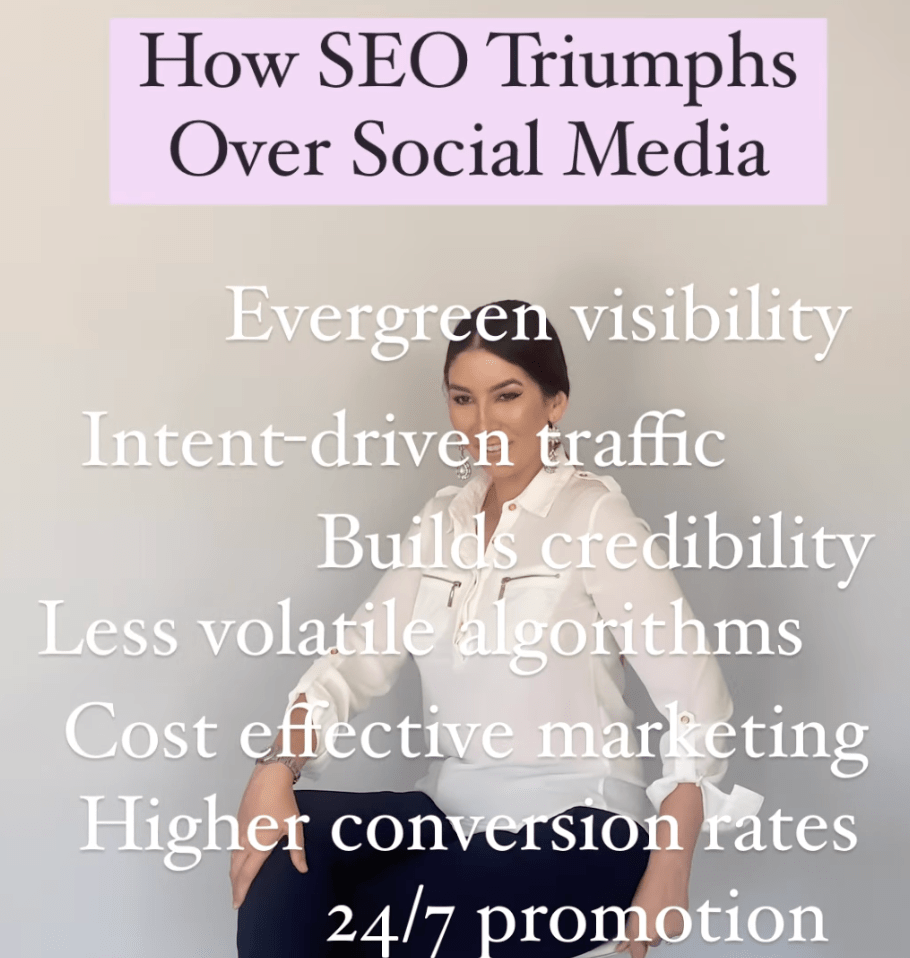
In the ever-evolving landscape of digital marketing, two strategies consistently stand out: Search Engine Optimization (SEO) and Social Media Marketing (SMM). Both have their unique strengths, but a growing body of evidence suggests that websites emphasizing SEO often surpass those that depend exclusively on social media. This comprehensive article delves into the reasons and data supporting this claim, offering insights from an SEO and digital marketing expert’s perspective.
1. Sustainability of Organic Traffic
SEO: Websites fine-tuned for search engines reap the rewards of enduring organic traffic. Once a site achieves a rank for particular keywords, it can sustain this position, drawing steady traffic without further effort. A BrightEdge study reveals that organic search steers 51% of all visitors to B2B and B2C sites, eclipsing all other digital channels. This consistent flow of visitors ensures a steady stream of potential customers, leading to sustainable business growth.
Social Media: Social media posts, on the other hand, have a transient lifespan. As fresh content emerges, older posts become obscured, diminishing their visibility and outreach. This means businesses have to continually produce and promote content to stay relevant, which can be resource-intensive.
2. User Intent and Conversion Rates
SEO: Individuals resorting to search engines typically possess a distinct intent, be it seeking information, purchasing a product, or finding a solution. This pronounced intent frequently leads to superior conversion rates. A Search Engine Journal report underscores that SEO leads boast a 14.6% closure rate. This high conversion rate can be attributed to the fact that these users are actively seeking solutions, making them more likely to engage with the content or make a purchase.
Social Media: While social media can drive significant traffic, these users are often casually browsing. Their primary intent might not be to make a purchase or seek a specific solution, leading to lower conversion rates compared to the high-intent traffic from search engines.
3. Independence from Platform Policies
SEO: SEO methodologies are crafted to cater to search engine algorithms. Though these algorithms experience updates, the foundational principles of SEO remain steadfast. This consistency ensures that businesses can maintain their online visibility with minimal disruptions, even when search engines introduce new features or criteria.
Social Media: Platforms like Facebook and Instagram are notorious for frequently tweaking their algorithms. These changes can drastically impact a brand’s visibility and engagement, often requiring businesses to adjust their strategies on the fly.
4. Broader Audience Reach
SEO: Search engines are universally employed tools. By honing in on SEO, businesses can tap into a vast and diverse audience. This includes individuals from different demographics, regions, and interests, ensuring a broad spectrum of potential customers.
Social Media: While social media platforms boast billions of users, not all individuals frequent every platform. Sole dependence on a handful of platforms can restrict a brand’s outreach, potentially missing out on a significant portion of their target audience.
5. Building Credibility and Trust
SEO: Websites that clinch high ranks on search engine results pages (SERPs) are often viewed as more credible. A Chitika study indicates that the topmost position on Google search results enjoys a 33% likelihood of being clicked. This trust is invaluable in the digital age, where consumers are bombarded with a plethora of options. A high search ranking can be the deciding factor that leads a potential customer to choose one brand over another.
Social Media: While a robust presence on social platforms can amplify brand awareness, it doesn’t inherently translate to credibility. Users often rely on reviews, testimonials, and third-party endorsements to gauge a brand’s trustworthiness on social platforms.
6. Cost-Effectiveness
SEO: SEO is often viewed as one of the most cost-effective digital marketing strategies. While it requires an initial investment in terms of content creation, website optimization, and backlink building, the long-term benefits often outweigh these costs. Once a website is optimized and ranks well, it can continue to attract traffic without significant ongoing expenses.
Social Media: In contrast, maintaining visibility on social media often requires continuous investment. With the decline in organic reach on platforms like Facebook, businesses are increasingly relying on paid promotions to reach their audience. Over time, these costs can add up, especially for small businesses with limited marketing budgets.
7. Less Volatility
SEO: One of the key strengths of SEO is its relative stability. While search engine algorithms do undergo updates, the core principles of good SEO remain consistent. This means that businesses can build their SEO strategy on a solid foundation, with only minor tweaks required to adapt to new updates.
Social Media: The world of social media is far more volatile. Trends come and go at a rapid pace, and what’s popular today might be forgotten tomorrow. For businesses, this means constantly staying updated with the latest trends and adjusting their strategies accordingly.
8. Data and Analytics
SEO: In the digital age, data is king. SEO provides businesses with a wealth of data and analytics about user behavior, keyword performance, and conversion rates. Platforms like Google Analytics offer detailed insights, allowing businesses to refine their strategies, identify areas of improvement, and capitalize on successful tactics.
Social Media: While social platforms do offer analytics, they often focus on metrics like engagement, reach, and likes. While these metrics are valuable, they don’t provide the same depth of insight as SEO analytics, especially when it comes to understanding user intent and conversion paths.
9. Mobile Search Growth
SEO: The rise of smartphones has led to a surge in mobile searches. Today, more people search on mobile devices than on desktops. This shift has made local SEO crucial for businesses. Optimizing for local search ensures that businesses can attract customers right when they’re looking for local solutions.
Social Media: While social media platforms are popular on mobile devices, they don’t offer the same local search capabilities as search engines. This means that businesses relying solely on social media might miss out on the growing segment of mobile search users.
10. Holistic User Experience
SEO: Modern SEO goes beyond just keywords. It encompasses a holistic approach that focuses on the overall user experience. This includes factors like website speed, mobile optimization, user-friendly navigation, and high-quality content. A well-optimized website ensures that users have a seamless experience, leading to higher engagement and conversions.
Social Media: On social media platforms, the user experience is largely dictated by the platform itself. While businesses can customize their profiles and content, they have limited control over factors like navigation, layout, and functionality.
Implementing SEO for Your Business
Grasping the significance of SEO is merely the beginning. Effective implementation necessitates a strategic approach:
- Keyword Research: Pinpoint keywords pertinent to your business and sector.
- On-Page Optimization: Ensure your website’s content, meta tags, and structure are optimized for the identified keywords.
- Off-Page Optimization: Construct high-quality backlinks to augment your site’s authority.
- Content Creation: Consistently produce high-quality, relevant content.
- Technical SEO: Confirm your website loads swiftly, is mobile-friendly, and possesses an XML sitemap for search engines.
For San Diego-based businesses seeking expert guidance, Jen Ruhman is a local SEO firm offering comprehensive monthly SEO services. With a profound grasp of SEO’s intricacies, they can assist your business in achieving and retaining elevated search engine rankings.
The Evolution of Search Engines and Their Impact on Businesses
Over the past two decades, search engines have undergone significant transformations. From rudimentary platforms that relied on basic keyword matching, they’ve evolved into sophisticated systems using artificial intelligence and machine learning to deliver highly relevant results.
Google, the dominant player in the search engine market, continually refines its algorithms to prioritize user experience. This means that websites that offer valuable content, are user-friendly, and have earned authority in their niche tend to rank higher. For businesses, understanding these nuances is crucial. A high rank on search engines can lead to increased visibility, driving more organic traffic to the website.
Moreover, as search engines have become more localized, businesses can now target potential customers in their vicinity more effectively. Local SEO strategies, such as optimizing for ‘near me’ searches and claiming Google My Business listings, have become indispensable for brick-and-mortar businesses.
The Role of Content in SEO
Content is often termed the ‘king’ in the digital marketing realm, and for a good reason. High-quality, relevant content is the cornerstone of effective SEO. Search engines prioritize websites that offer value to users. This means regularly updating your website with informative articles, blog posts, videos, and infographics can boost your SEO rankings.
However, it’s not just about quantity but quality. Every piece of content should be meticulously researched, well-written, and optimized for relevant keywords. Moreover, with voice search becoming increasingly popular, optimizing content for conversational queries is also essential.
The Limitations of Social Media Algorithms
While social media platforms offer businesses a direct line to their audience, they come with their set of challenges. The most significant being their ever-changing algorithms. Platforms like Facebook and Instagram have been reducing organic reach, pushing businesses towards paid promotions. This means that even if you have a substantial follower count, only a fraction might see your posts unless you invest in advertising.
Moreover, these platforms prioritize content that garners high engagement. For businesses, this means continually producing content that resonates with their audience, leading to likes, shares, and comments. While this can boost brand visibility in the short term, it’s not a sustainable strategy for long-term growth.
The Synergy Between SEO and Other Digital Marketing Strategies
While SEO is powerful on its own, when combined with other digital marketing strategies, it can lead to exponential growth. For instance, pay-per-click (PPC) advertising can offer immediate visibility on search engines, complementing the long-term benefits of SEO. Similarly, email marketing can help nurture leads generated through SEO, leading to higher conversion rates.
Moreover, data gathered through SEO analytics can offer insights into user behavior, preferences, and pain points. This data can be invaluable in refining other marketing strategies, be it content marketing, social media advertising, or affiliate marketing.
The Future of SEO
As technology continues to evolve, so will SEO. With the rise of virtual reality, augmented reality, and the Internet of Things (IoT), search will become more integrated into our daily lives. For businesses, staying updated with the latest SEO trends and adapting to these changes will be crucial. Whether it’s optimizing for voice search, creating immersive AR experiences, or leveraging AI for personalized content delivery, the future of SEO promises exciting opportunities for growth.
Conclusion
In the digital realm, where competition is fierce and every brand is vying for attention, having a robust online presence is crucial. While social media offers a platform for engagement and brand building, the sustainable, long-term benefits of SEO make it an indispensable tool for businesses. By focusing on SEO, businesses can ensure consistent traffic, build credibility, and achieve long-term online success. In a world where consumers are increasingly turning to search engines for solutions, ignoring SEO can be a costly mistake. On the other hand, while social media is a powerful tool for engagement and brand building, its transient nature and dependence on platform algorithms make it a less reliable source of consistent traffic. In conclusion, for businesses looking to build a strong online presence and drive sustainable growth, a balanced approach that leverages both SEO and social media is the key to success.
Want to give your business website a boost in search engine rankings?
Contact the SEO company San Diego Trusts. Located in the heart of San Diego, we’re passionate about everything SEO. From in-depth keyword analysis and strategic link building to fine-tuning your content and assessing your website, we’ve got you covered. With our finger on the pulse of the latest Google updates, we’re committed to offering you the insights required to enhance your website’s visibility and increase its traffic.
Embark on a journey towards a stronger online footprint with our expert guidance. We’re excited to be a chapter in your success story. Wondering if Jen Ruhman is the right match for your aspirations? Let’s chat! Give us a call at 619-719-1315 or dive into our website. We’re eager to explore the possibilities for your website together.

Jul 19, 2023 | SEO Tips
Why Content is Key for Optimizing Your Website with SEO
I recently had a client that was an interior designer and there was no text on her page, only images. My face dropped! In amazement I asked, has anyone ever found you on Google? Well of course not.
This is why I decided to write this blog post. I asked her if it was OK if I added text and she didn’t want any…so I asked her if she wanted Google to rank her site. She finally gave in to a small portion of the text. I think it nearly killed her. I explained that her site was visually stunning and great for people to enjoy but Google can’t see anything and it relies on text and code to understand your website. She later backed out of me going forward with more text. 🙁
And so this blog post was born.
The Power of SEO for Website Optimization
Search Engine Optimization (SEO) is the foundation of gaining organic traffic and visibility on Google. It involves a set of strategies and techniques that align with Google’s ranking algorithms, aiming to optimize websites and improve their chances of appearing higher in search results. While there are several factors that influence SEO, the quality of content stands out as one of the most crucial elements.
The Significance of Text over Images
When it comes to optimizing your website with SEO, the importance of text cannot be stressed enough. While visual elements such as images, videos, and infographics undoubtedly play a role in engaging users, text remains the backbone of any SEO strategy. Here’s why:
1. Search Engine Crawlers Prefer Text
Search engine crawlers are automated bots that browse the internet, analyzing and indexing web pages to understand their content. Textual content is the primary medium through which these crawlers can comprehend the purpose and relevance of a webpage. Rich and well-structured text with appropriate keywords helps search engines grasp the context and rank the page accordingly.
2. Keywords and Semantic Relevance
Keywords play a pivotal role in SEO, as users enter specific words or phrases into search engines to find relevant information. Having text-rich content allows website owners to incorporate relevant keywords strategically. Moreover, semantic relevance—the contextual relationship between words and phrases—assists search engines in understanding the content’s depth and accuracy.
3. Text is Shareable and Linkable
High-quality textual content is more shareable and linkable than images. When readers find valuable information in your content, they are more likely to share it on social media platforms or link back to it from their websites. Such backlinks are essential for SEO as they signify credibility and authority to search engines.
4. Accessibility and Mobile-Friendliness
Textual content is far more accessible than images. People with visual impairments rely on screen readers, which can easily parse through text. Additionally, text is compatible with different devices and screen sizes, making it mobile-friendly and catering to the rising number of mobile users.
Crafting SEO-Optimized Text for Outranking Competitors
To outrank the article you provided, we need to employ a strategic approach to creating SEO-optimized text. Here’s our plan to achieve top-notch content that dominates the search rankings:
1. In-Depth Research
Comprehensive research is the foundation of any great content. We will delve deep into the subject matter, exploring all facets and collecting valuable data. By gathering information from authoritative sources, our content will exude authority and credibility, boosting its chances of ranking higher.
2. Keyword Analysis
A thorough keyword analysis is essential for identifying the most relevant and high-impact keywords. By incorporating these keywords naturally throughout the content, we ensure that search engines recognize the topic’s focus and relevance.
3. Engaging and Informative Introduction
A captivating introduction sets the tone for the entire article. We will craft an engaging opening that piques readers’ interest and encourages them to continue reading. This also helps to reduce the bounce rate, a crucial SEO metric.
4. Structured and Scannable Content
A well-structured article with appropriate subheadings makes it easier for both users and search engine crawlers to navigate through the content. Scannable content improves user experience and encourages readers to spend more time on the page, another SEO ranking factor.
5. Rich Media Integration
While we emphasize the significance of text, we understand the value of complementing it with relevant and high-quality images, videos, and infographics. These media elements enhance the overall appeal of the content and increase its shareability.
6. Outbound and Internal Linking
Strategic outbound links to authoritative sources further establish credibility, while internal linking connects related content within your website, improving user experience and SEO.
7. Answering User Intent
Understanding user intent is vital for creating valuable content. By addressing the specific questions and concerns users may have, we can provide solutions and establish our website as a go-to resource.
8. Mobile Optimization
Ensuring that our content is mobile-friendly is non-negotiable. With an increasing number of users accessing the internet through mobile devices, mobile optimization directly impacts our SEO success.
In conclusion, to outrank the targeted article and secure a prominent position on Google, we must prioritize the quality and richness of textual content. By conducting thorough research, strategically using keywords, and crafting engaging and informative content, we can enhance our chances of dominating search rankings and attracting organic traffic.
Remember, SEO is an ongoing process, and staying up-to-date with evolving algorithms and user behavior is crucial. By maintaining the utmost commitment to producing valuable and SEO-optimized content, we can position our website as an authority in the industry and reap the rewards of improved organic visibility.
Looking back, I am relieved I didn’t get her as a client because it would have been an uphill battle.
Ready to optimize your website with my SEO services?
Look no further than Jen Ruhman SEO! As a reputable San Diego SEO company, we specialize in local SEO expertise, and we have the skills to elevate your website’s ranking on search engine results pages (SERPs). This translates to increased traffic, more leads, and higher conversions for your business.
By securing higher rankings, your business gains a competitive edge and attracts more potential customers. With our proficient team and time-tested techniques, we can help you achieve the desired results. Don’t miss out on the opportunity to maximize your online presence and let us empower your business with effective SEO strategies.