
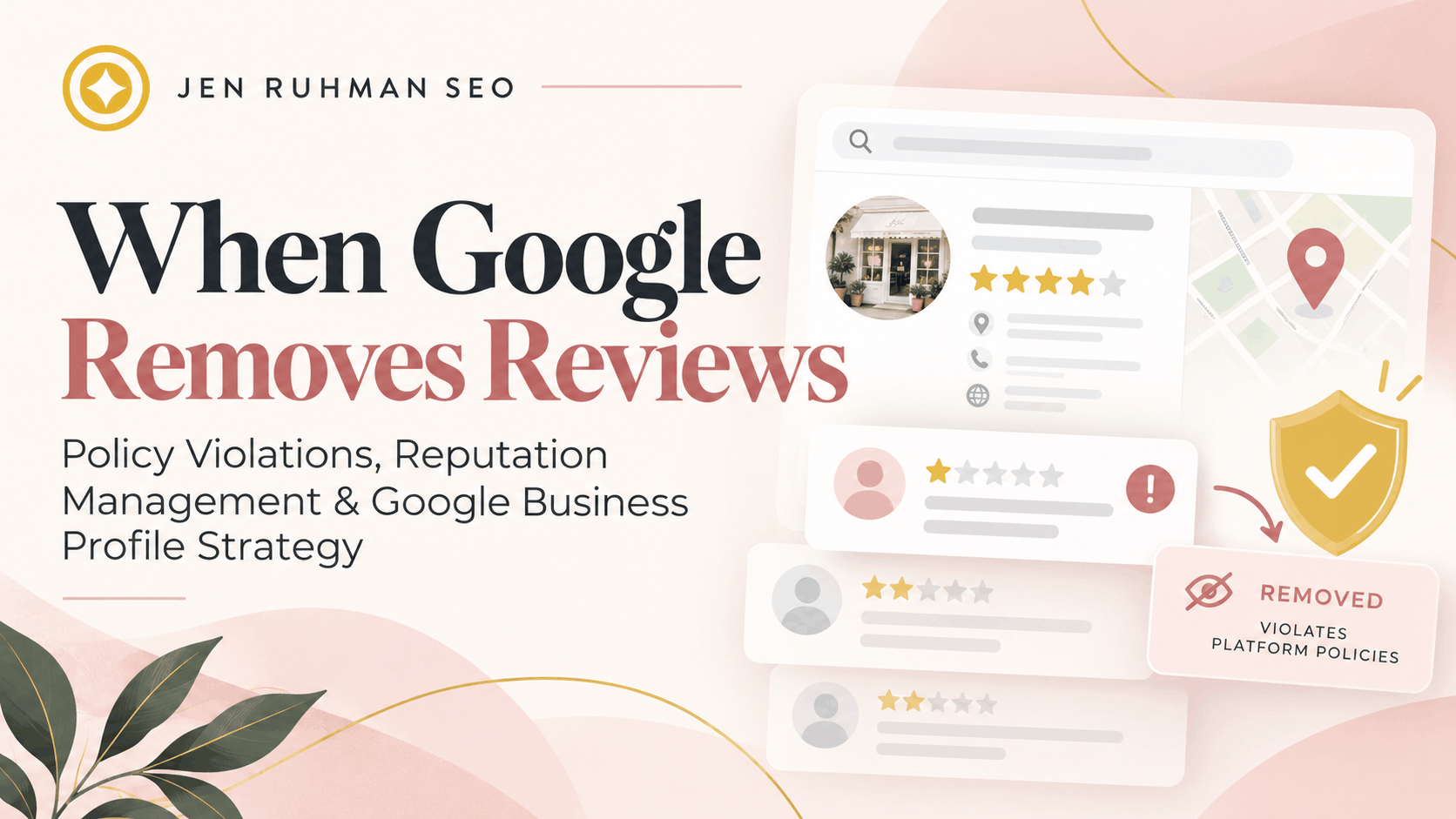
Bad Google reviews can be frustrating for any business owner.
But there is an important difference between a legitimate negative review and a review that violates Google’s policies.
Recently, I helped one of my SEO clients address problematic reviews that appeared on their Google Business Profile.
After reviewing the situation, I determined there were legitimate reasons to report the reviews based on Google’s content policies.
We followed the appropriate process.
Google reviewed the situation and removed the reviews because they violated its policies.
That distinction is extremely important.
The reviews were not removed simply because they were negative.
Businesses cannot delete reviews just because they disagree with them. Google ultimately decides whether content violates its rules and qualifies for removal.
This client experience is a good example of why managing a Google Business Profile requires more than collecting reviews and adding keywords. It also requires understanding Google’s rules, knowing when a review may legitimately violate them, and following the correct process.
Can a Business Remove a Bad Google Review?
Not directly.
Business owners do not have a delete button for reviews left by customers.
And that’s a good thing.
Imagine how little consumers would trust online reviews if every business could simply remove anything below five stars.
A legitimate customer can leave a negative opinion about their experience, even when the business owner disagrees with what was written.
But that doesn’t mean every review is automatically allowed to remain online.
Google has policies governing user-generated content, including reviews. When content violates those policies, it can qualify for removal.
When I evaluate questionable reviews for clients, I don’t begin by asking:
“Is this review hurting the business?”
I ask:
“Is there a legitimate Google policy violation here?”
Those are two very different questions.
What Happened With My Client’s Google Reviews?
My client discovered reviews on their Google Business Profile that raised legitimate concerns.
Rather than assuming every negative review could be challenged, I looked at the circumstances and evaluated whether the reviews appeared to conflict with Google’s policies.
There was enough of a basis to report them.
We used Google’s review reporting process and provided the issue for Google to evaluate.
Ultimately, Google removed the reviews because they violated its terms and policies.
That was an important win for the client, but it is also important to understand what happened.
I didn’t make negative reviews disappear.
I didn’t have access to a secret SEO tool that deletes reviews.
And I certainly could not force Google to make a decision.
Google made the final determination.
My role was understanding the situation, recognizing that there appeared to be legitimate policy violations, and helping the client navigate the process correctly.
What Types of Google Reviews May Be Eligible for Removal?
A one-star rating by itself isn’t enough.
Neither is an angry customer.
There has to be a legitimate reason for Google to determine that the content violates its policies.
Depending on the circumstances, problematic review content may involve issues such as:
- Fake engagement or reviews that do not represent a genuine experience
- Conflicts of interest
- Harassment or abusive content
- Off-topic content
- Impersonation
- Misleading or deceptive content
- Repetitive or spam-like behavior
- Other content prohibited under Google’s policies
The exact circumstances matter.
That’s why I don’t recommend reporting every review simply because the business doesn’t like it.
If you repeatedly treat legitimate customer criticism as spam, you’re not solving the actual reputation problem.
Instead, each questionable review should be evaluated individually.
Negative Reviews and Policy-Violating Reviews Are Not the Same Thing
This is probably the most important point in this article.
Suppose a real customer leaves this review:
“I waited longer than expected and wasn’t happy with the service.”
The business might disagree.
The owner may have a completely different version of events.
But if the person was actually a customer and the review represents their opinion about the experience, being negative doesn’t automatically make it removable.
Now compare that with a situation where there is evidence that the review may not reflect a genuine customer experience, involves a prohibited conflict, contains inappropriate content, or otherwise violates Google’s policies.
That’s different.
Google review removal is about policy violations—not protecting businesses from criticism.
This is also why maintaining a healthy review profile matters so much.
I’ve written more about the relationship between Google reviews, reputation and Local SEO. A strong reputation strategy isn’t about trying to create a perfect five-star profile. It’s about building an authentic picture of the business through real customer experiences.
Why Google Reviews Matter So Much to Local Businesses
Reviews can be one of the first things a potential customer sees when searching for a local business.
Think about how people actually search.
Someone needs an attorney and searches:
“accident attorney San Diego.”
Someone needs a dentist and searches:
“dentist near me.”
Someone needs help marketing their business and searches:
“SEO company San Diego.”
Before calling anyone, that person may compare:
- Star ratings
- Number of reviews
- Recent reviews
- Owner responses
- Photos
- Services
- Business information
- Websites
- Google Maps results
Your review profile becomes part of that buying decision.
That’s one reason reviews are an important component of a broader Local SEO strategy for San Diego businesses.
Local SEO isn’t just about getting a webpage to rank.
It’s about strengthening the overall search presence potential customers encounter when they’re actively looking for what you provide.
Google Business Profile Management Goes Beyond Rankings
A Google Business Profile can become one of a local company’s most valuable online assets.
But optimizing one isn’t simply a matter of adding keywords to a business description.
I look at things such as:
- Business categories
- Services
- Business information
- Service areas
- Photos
- Reviews
- Reputation
- Website connections
- Local relevance
- Competitor activity
- Overall accuracy
The website behind the profile matters too.
I explain this relationship in more detail in my guide to Google Business Profile and website SEO.
A strong local presence usually comes from multiple signals working together rather than one isolated optimization trick.
Why Understanding Google’s Rules Matters
Local SEO sometimes involves situations that aren’t obvious from a standard SEO checklist.
You may encounter:
A competitor using an inaccurate business name.
A duplicate Google Business Profile.
An incorrect category.
A suspicious review.
Unexpected changes to business information.
An old address.
A review that appears unrelated to an actual customer experience.
Knowing Google’s policies can help you determine whether something should be corrected, reported, appealed, or simply left alone.
That’s part of why experience matters.
There is a big difference between blindly clicking Report Review and understanding why a particular review may legitimately violate policy.
What I Did Not Promise My Client
I think this deserves its own section because there are companies that aggressively advertise review removal.
I did not tell my client:
“I guarantee I can remove your bad reviews.”
No reputable SEO professional should be able to guarantee Google’s decision.
Google controls its platform.
What I could do was examine the reviews, determine that there appeared to be legitimate policy concerns, use the appropriate reporting process, and allow Google to evaluate them.
In this particular case, Google agreed that the reviews violated its terms and removed them.
That’s a successful outcome.
But the reason for the success matters.
What Should You Do If You Think a Google Review Violates Policy?
Start by looking at the review objectively.
It’s natural to become defensive when someone criticizes your business, especially if you believe the review is unfair.
But unfair and policy-violating aren’t necessarily the same thing.
First, ask whether there is a specific reason the review may violate Google’s policies.
Document anything relevant to the situation.
Then use the proper Google reporting process.
If the review qualifies for additional review or appeal, follow the available process rather than repeatedly submitting random reports.
And remember:
Google makes the final decision.
If the review remains because it represents a legitimate customer opinion, your best strategy may be to write a calm, professional response and continue building positive experiences with real customers.
Don’t Try to Fight Every Negative Review
A business with dozens or hundreds of legitimate positive reviews can usually absorb an occasional negative review.
In fact, a completely perfect review profile isn’t necessary for people to trust a business.
What matters more is the broader pattern.
Do customers generally seem happy?
Does the business respond professionally?
Are the reviews recent?
Do they describe real experiences?
Does the company address concerns?
That tells potential customers much more than one unhappy review.
A sustainable reputation strategy should therefore include both:
Protecting the profile from content that legitimately violates policy
and
Consistently earning authentic reviews from real customers.
Google Reviews Are Also Part of the Bigger Search Picture
Google reviews don’t exist in isolation.
Your business may appear across:
Google Search.
Google Maps.
Your website.
Business directories.
Review platforms.
Social networks.
And increasingly, AI-powered search and recommendation systems.
That’s one reason I’ve been paying more attention to how reputation, entity information and local authority work together.
If you’re interested in that side of search, I explain it further in How AI Search Changes Local SEO.
The goal isn’t to manipulate an AI system into recommending a business.
It’s to build a clear, trustworthy and consistent online presence that gives search platforms accurate information about who the business is, what it does and what real customers say about it.
Can Removing a Bad Review Improve Your Google Maps Ranking?
This question deserves some nuance.
I would not report reviews as a Google Maps ranking tactic.
The purpose of Google’s removal process is to address content that violates its policies.
Reviews can be part of a business’s overall prominence and reputation, and consumers certainly use ratings and reviews when deciding which result to choose.
But the objective shouldn’t be:
“Let’s remove reviews so we rank higher.”
It should be:
“Let’s make sure the review profile accurately represents genuine customer experiences and complies with Google’s policies.”
That’s a healthier long-term approach to Local SEO.
What If the Review Doesn’t Violate Google’s Policies?
Then don’t try to manufacture a reason to remove it.
Respond professionally.
Avoid getting emotional.
Don’t disclose private customer information.
Address legitimate concerns where appropriate.
And continue asking happy customers for authentic feedback.
Sometimes the best reputation-management strategy isn’t removal.
It’s demonstrating to everyone reading the exchange that the business handles criticism professionally.
This Is Why I Look Beyond Rankings When I Manage Local SEO
SEO is frequently described as:
keywords + rankings + backlinks.
But when you’re working with real local businesses, there’s much more going on.
Google Business Profiles need monitoring.
Reviews need attention.
Business information needs to remain accurate.
Competitors change.
Search results change.
Websites change.
And now customers may discover businesses through traditional search, Google Maps and AI-powered search experiences.
That’s why my work as a San Diego SEO expert and SEO company focuses on the broader search presence of the business—not just a monthly ranking report.
The goal is to help the right people find, understand and trust the business when they’re ready to choose.
The Biggest Lesson From This Client Case
The takeaway isn’t:
“Bad review? Hire an SEO and make it disappear.”
It’s this:
A legitimate negative review and a policy-violating review are two very different things.
Business owners do have options when content violates Google’s rules.
In this client’s case, I identified reviews that had legitimate policy issues, we followed Google’s reporting process, and Google removed the reviews because they violated its terms.
That’s the outcome the review-removal system is designed for.
And because Google made the determination—not the business—it allowed the client’s profile to better reflect legitimate customer feedback.
Need Help With a Google Business Profile?
If you’re dealing with suspicious Google reviews, Google Maps visibility issues, an improperly optimized profile, or a broader Local SEO problem, I can take a look.
I work directly with businesses on Google Business Profile optimization, Local SEO, website SEO, Google Maps visibility and AI search strategy.
I cannot guarantee Google will remove a review.
But if you believe a review violates Google’s policies, I can help you evaluate what’s happening and determine whether there is a legitimate basis for reporting it.
Get a free SEO analysis or learn more about working with my SEO company in San Diego.
Jen Ruhman SEO
San Diego SEO Expert
619-719-1315