
When a new client contacts me about SEO, they often expect me to start with keywords.
They assume I am going to immediately ask:
What keywords do you want to rank for?
Who are your competitors?
How many blog posts do you want each month?
How many backlinks do you need?
Those questions may come later.
But they are not where I start.
After more than 20 years working in SEO, I have learned that a strong campaign begins with understanding the business before opening an SEO tool.
Before I recommend a new page, rewrite a title tag, build a content plan, or research keywords, I need to understand what the company is actually trying to accomplish.
Otherwise, it is easy to create an SEO campaign that looks busy without producing meaningful business growth.
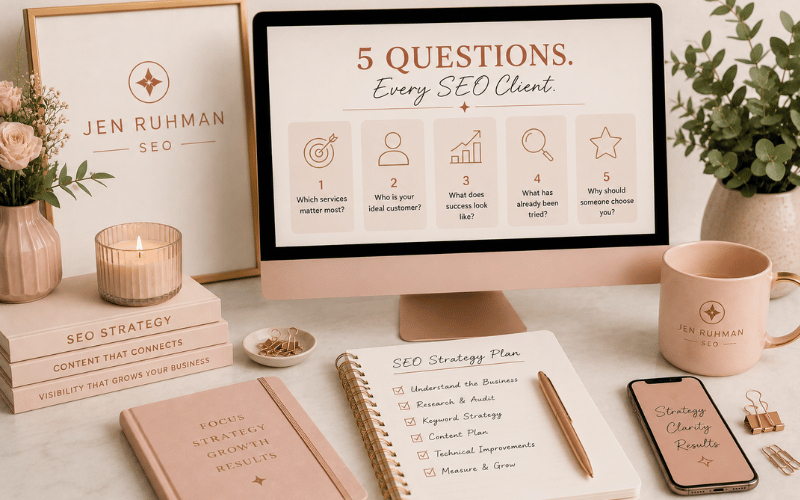
These are the five questions I ask every new SEO client—and why the answers shape almost every decision that follows.
1. Which Services or Products Matter Most to Your Business?
This is usually the first question I ask.
Not every service is equally valuable.
A business may offer ten services, but only two or three may generate most of its revenue.
Another service may be highly profitable but underpromoted.
Some services may generate plenty of inquiries but rarely turn into the type of customer the business actually wants.
If I do not understand those differences, I could spend months improving visibility for the wrong part of the business.
For example, imagine a medical practice offers several treatments.
One treatment may have high search volume but generate very few qualified patients.
Another may have lower search volume but lead to higher-value, longer-term relationships.
From an SEO perspective, the second opportunity may deserve more attention.
That is why I do not automatically prioritize the keyword with the largest search volume.
I prioritize the opportunity that best supports the business.
What I Want to Understand
When I ask about priority services, I am listening for things like:
- Which services generate the most revenue?
- Which services have the strongest margins?
- Which services does the business want to grow?
- Which services attract the best customers?
- Are there services the company no longer wants to emphasize?
- Are there seasonal priorities?
- Are there new services the business wants to introduce?
Those answers help me decide which pages deserve attention first.
Without that context, keyword research is just a list of numbers.
With it, keyword research becomes part of a business strategy.
2. Who Is Your Ideal Customer?
Many businesses tell me their ideal customer is:
“Everyone.”
Usually, that means we need more focus.
SEO works better when we understand exactly who the business wants to reach.
A local service company may want homeowners within a specific service area.
A financial advisor may want clients approaching retirement.
A medical practice may want patients searching for a particular treatment.
A national company may serve several customer types but need separate content for each one.
The clearer the audience becomes, the easier it is to build pages that speak directly to that person.
Why This Changes the SEO Strategy
Your ideal customer can influence:
- The keywords we target
- The questions we answer
- The locations we optimize for
- The language we use
- The trust signals we emphasize
- The services we prioritize
- The calls to action on the page
A website written for everyone often feels relevant to no one.
A website written for a clearly defined audience can immediately make a visitor think:
“This company understands exactly what I need.”
That is much more valuable than attracting traffic that never converts.
I Also Want to Understand the Wrong Customer
This is just as important.
Sometimes a business already receives plenty of leads.
They are simply the wrong leads.
Those inquiries may come from:
- People outside the service area
- Customers looking for services the company does not offer
- People searching primarily for the lowest price
- Informational searches with no buying intent
- Industries the business no longer serves
- Customers who are simply not a good fit
SEO should improve lead quality, not just lead quantity.
Understanding who the business does not want helps me avoid building visibility that wastes everyone’s time.
3. What Does a Successful SEO Campaign Look Like to You?
This question tells me how the client defines success.
Some businesses want:
- More phone calls
- More consultation requests
- More booked appointments
- More online purchases
- Greater visibility in a specific city
- Growth for a particular service
- Better Google Maps visibility
- More branded searches
- Stronger visibility across an entire topic
- Greater visibility in AI-powered search
A client may initially say:
“I want to rank #1 for this keyword.”
That may be a useful goal.
But ranking #1 for a keyword that produces no meaningful business is not much of a victory.
That is why I ask what success would actually look like.
Would the business be happy with:
Ten more qualified leads per month?
More booked consultations?
More revenue from a priority service?
Greater visibility in a target location?
The answer determines what I should measure.
Rankings Matter, but They Are Not the Final Goal
I absolutely monitor rankings.
They help me understand whether pages are gaining visibility.
But I also look at:
- Search impressions
- Organic clicks
- Qualified website traffic
- Contact-form submissions
- Phone calls
- Appointments
- Revenue
- Conversion rates
- Performance of important landing pages
A ranking report can look impressive while the business receives very little benefit.
My goal is not to make a dashboard look exciting.
My goal is to help the business grow.
4. What Has Already Been Tried?
Before I recommend anything, I want to understand the history of the website and the marketing behind it.
The current website may only tell part of the story.
Maybe the client previously worked with several SEO companies.
Maybe the business owner handled SEO internally.
Maybe the site went through a redesign.
Maybe hundreds of URLs changed.
Maybe a previous agency built questionable backlinks.
Maybe dozens of low-quality articles were published.
All of that context matters.
Questions I Usually Ask
I want to know:
- Have you worked with an SEO company before?
- What did they focus on?
- Did you see any improvement?
- Was the website redesigned?
- Have important URLs changed?
- Were pages deleted?
- Were backlinks purchased?
- Was content published at scale?
- Have you received a manual action or security warning?
- Do you have access to Google Search Console?
- Do you have access to Google Analytics?
- Which tactics seemed to help?
- Which tactics felt like a waste of money?
Those answers can completely change my recommendations.
For example, if traffic declined after a redesign, I may investigate:
- Lost pages
- Missing redirects
- Broken internal links
- Deleted content
- Changed metadata
If hundreds of blog posts were published but the important service pages still do not rank, the problem may be strategy rather than content volume.
If a business serves only San Diego but previous work focused heavily on national keywords, the website may need much stronger local relevance.
I Am Not Looking to Criticize Previous Work
My goal is not to point fingers.
SEO strategies evolve.
Business priorities change.
Websites change hands.
Search changes.
Sometimes previous work created a strong foundation.
Other times, it created problems that need to be cleaned up.
Either way, understanding the history helps me make better decisions moving forward.
It is also why I rarely recommend replacing a website before understanding what can be preserved.
You can read more about that in my guide to whether you really need a new website for SEO.
5. Why Should Someone Choose You Instead of a Competitor?
This may be the most important question I ask.
SEO can help people find the business.
But once they arrive, the website still needs to give them a reason to choose it.
If the page sounds exactly like every competitor, higher rankings may not translate into more leads.
I want to understand what makes the company genuinely different.
That may include:
- Decades of experience
- A specialized process
- Direct access to the owner
- Strong credentials
- Faster turnaround
- Local knowledge
- A unique treatment or service approach
- More personalized support
- Better customer service
- A narrow area of expertise
- Proven results
- A meaningful guarantee, when appropriate
Those differences should influence the content.
Generic Content Creates Generic Websites
I often see service pages that say:
We provide quality service.
Our team cares about customers.
We are experienced professionals.
Contact us today.
There is nothing inherently wrong with those statements.
They are simply too generic to differentiate the company.
The strongest website content explains:
- What the company does differently
- Who it serves best
- What the process looks like
- Why customers trust it
- What experience it brings
- What someone can expect when working with the company
That creates stronger marketing content and stronger SEO content.
It also introduces something generic AI-generated copy often lacks:
Real experience.
This Question Helps Me Find the Story
Every business has a story.
Sometimes the owner has been doing the work for 30 years.
Sometimes the company was founded because the owner saw a problem in the industry.
Sometimes the business serves a highly specialized audience.
Sometimes clients work directly with the owner rather than being handed off to a large account team.
Those details matter.
They transform a webpage from a collection of keywords into something credible, specific, and human.
Why I Ask Business Questions Before SEO Questions
These five questions may not sound especially technical.
That is the point.
SEO should not exist separately from the business.
It should support the business.
Before I decide which keywords to target, I need to understand:
Which services matter most?
Who are we trying to attract?
What does success look like?
What has already happened?
Why should someone choose this company?
Once I know those things, the technical work becomes much more focused.
That may include:
- Strengthening service pages
- Improving local SEO
- Creating location pages where appropriate
- Improving internal links
- Building topic clusters
- Updating existing content
- Consolidating competing pages
- Fixing technical issues
- Improving calls to action
- Strengthening trust signals
- Building relevant authority
- Improving Google and AI search visibility
But every recommendation should connect back to a business objective.
Otherwise, it is simply activity.
What Happens After I Ask These Questions?
Once I understand the business, I begin evaluating the website and the available data.
I may review:
- Website structure
- Search intent
- Existing rankings
- Google Search Console data
- Analytics
- Internal linking
- Content quality
- Technical health
- Local SEO signals
- Backlinks and authority
- Conversion opportunities
That is where the SEO audit begins.
I explain this process in more detail in my guide to what a strategic SEO audit should actually reveal.
From there, I build a prioritized roadmap.
Not every problem needs to be fixed immediately.
Not every keyword deserves a page.
Not every blog topic deserves to be published.
The strategy should begin with the improvements most likely to create meaningful progress.
The Answers Can Change Over Time
These questions are not only useful at the beginning of an SEO campaign.
I revisit them as the business evolves.
A company may:
- Add a new service
- Stop promoting an old one
- Expand its service area
- Change its ideal customer
- Enter a new market
- Discover a more profitable service
- Face new competition
The SEO strategy should change with the business.
That is why I do not believe in building a plan once and following it blindly forever.
A good strategy needs structure.
It also needs room to adapt.
Final Thoughts
The best SEO conversations do not begin with keywords.
They begin with the business.
Before I can help a company earn greater search visibility, I need to understand why that visibility matters and what should happen when the right person lands on the website.
That is why I ask these five questions:
1. Which services or products matter most?
2. Who is your ideal customer?
3. What does success look like?
4. What has already been tried?
5. Why should someone choose you?
Those answers guide almost everything that follows.
They help me prioritize the right pages.
Target the right audience.
Measure the right outcomes.
And build an SEO strategy around what the business actually needs.
SEO works best when it is not treated as a separate checklist.
It should support the company’s goals, customers, strengths, and long-term growth.
That is how I approach every campaign.
Frequently Asked Questions
What questions should an SEO consultant ask a new client?
An SEO consultant should understand the client’s priority services, ideal customers, business goals, previous SEO work, competitive strengths, service areas, and what success looks like before developing a strategy.
Why should SEO start with business goals?
SEO can generate visibility, but the value of that visibility depends on whether it attracts the right customers and supports profitable services. Business goals help determine which keywords, pages, locations, and opportunities deserve priority.
Should an SEO company ask which keywords I want to rank for?
Yes, but that should not be the only question. Keyword targets should be evaluated alongside search intent, competition, business value, customer quality, and whether the keyword supports an important service or goal.
Why does an SEO consultant need to know about previous SEO work?
Previous redesigns, deleted pages, backlinks, content campaigns, migrations, or agency work can affect the current website. Understanding that history helps avoid repeating mistakes and can reveal why traffic or rankings changed.
Why does an SEO company need to understand my ideal customer?
The ideal customer influences keyword targeting, search intent, location strategy, content, calls to action, and how the business should position itself online.
What happens after an SEO intake call?
After understanding the business, I review the website, search visibility, site structure, content, internal linking, technical issues, local SEO, authority, and conversion opportunities. From there, I prioritize the improvements that are most likely to create meaningful progress.
Ready to Talk About Your SEO Strategy?
A successful SEO campaign should be built around your business—not a generic list of monthly tasks.
If you’re looking for an SEO expert in San Diego who takes the time to understand your goals before recommending a strategy, I’d be happy to learn more about your business.
We can discuss:
What you want to grow.
Who you want to reach.
Where your website may be falling short.
Which opportunities deserve attention first.
Or call/text me at (619) 719-1315.
— Jen Ruhman
San Diego SEO Expert