How Small SEO Improvements Created Big Organic Growth: A Real Client Example

How Small SEO Improvements Created Big Organic Growth: A Real Client Example

seo case study

By Jen Ruhman, SEO Expert in San Diego

Most Business Owners Think SEO Is One Big Thing

One of the biggest misconceptions I hear from business owners is that successful SEO comes from finding one secret strategy.

Maybe it’s the perfect keyword.

Maybe it’s publishing one amazing blog post.

Maybe it’s getting a few backlinks.

Or maybe it’s surviving the next Google algorithm update.

After more than 20 years working in SEO, I can confidently tell you that’s almost never how it works.

The websites that consistently rank well don’t usually succeed because they discovered one magic trick.

They succeed because they make hundreds of smart decisions over time.

Every page becomes a little more helpful.

Every internal link strengthens another page.

Every piece of content has a purpose.

Every technical improvement makes the website a little easier for Google to understand.

Those improvements compound.

That’s what creates long-term organic growth.

One campaign that reinforced this philosophy for me was a fertility clinic I worked with throughout 2025. Our goal wasn’t to chase shortcuts or temporary ranking spikes. Instead, we focused on building a stronger website month after month.

Rather than asking, “What’s the fastest way to rank?”

We asked,

“What’s the next best improvement we can make?”

That simple shift in thinking changed everything.

If you’ve read my article about why publishing more blogs doesn’t always improve SEO, you’ll know I believe content is only one piece of a much larger strategy.

Likewise, building topical authority isn’t about writing hundreds of random articles. It’s about helping Google clearly understand what your website is an expert in.

Those ideas guided almost every decision I made during this campaign.

Small Improvements Add Up

One of my favorite things about SEO is that success usually isn’t dramatic.

It’s gradual.

Most people imagine rankings looking like this:

⬆️

Instead, they usually look more like a staircase.

One improvement creates a small gain.

That gain creates another opportunity.

Then another.

Eventually you look back six months later and realize how much progress has been made.

That’s exactly what happened here.

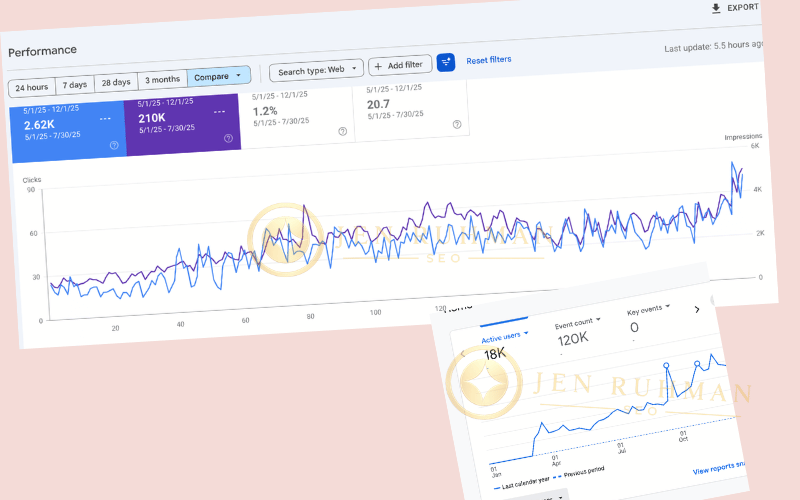
As we continued improving the website throughout the year, Google Search Console began showing something I always like seeing:

Steady increases in impressions.

Steady increases in clicks.

Not random spikes.

Not temporary success.

Consistent growth.

seo case study

One thing I appreciate about this graph is that it reflects trust.

Google doesn’t suddenly decide your website is amazing overnight.

Trust is earned.

The more consistently you improve a website, the easier it becomes for Google to recommend it.

That’s why I rarely obsess over rankings from one month to the next.

I’m looking for momentum.

And that’s exactly what we started seeing.

I Didn’t Start by Writing More Blog Posts

This surprises people.

Whenever a business contacts me, they often assume the first thing I’m going to recommend is writing more blog articles.

Sometimes that’s true.

But many times it isn’t.

Before I recommend creating anything new, I want to understand whether the existing website is already providing the best possible experience.

Can visitors quickly find what they’re need?

Are important pages easy to navigate?

Are service pages answering the questions customers actually have?

Is Google able to understand how the website is organized?

Only after answering those questions do I decide where new content fits into the strategy.

I’ve worked on websites with hundreds of blog posts that generated very little business.

I’ve also worked on websites with fewer than fifty carefully planned pages that consistently outperformed much larger competitors.

The difference wasn’t how much content existed.

It was the strategy behind it.

That’s why I always tell clients:

Publishing content is important.

Building an SEO strategy is even more important.

I Focused on Improving Existing Pages First

One of the biggest opportunities on almost every website is the content that’s already there.

It’s easy to become excited about creating something new.

It’s much less exciting to improve an article that was written two years ago.

But that’s often where some of the biggest gains happen.

Throughout this campaign, I reviewed existing pages with fresh eyes.

Instead of asking,

“How can we make this page longer?”

I asked questions like:

  • Is this answering the visitor’s question?
  • Is anything repetitive?
  • Are we making the page harder to understand?
  • Does every section deserve to stay?
  • Could this information be organized better?

Sometimes the answer was adding content.

Other times it was removing it.

Google isn’t awarding points for word count.

Google wants to recommend pages that genuinely help people.

That’s a very different mindset.

I often tell clients that every sentence should earn its place.

If it doesn’t make the page more useful, I question whether it belongs there at all.

One of the reasons this approach works so well is because it improves both SEO and user experience at the same time.

Visitors don’t have to dig through unnecessary information.

Google doesn’t have to guess what the page is about.

Everyone wins.

I Reorganized Headings Around Real Patient Questions

One thing I’ve noticed over the years is that many websites are written for search engines instead of people.

You’ll see headings that sound robotic because someone thought repeating the same keyword over and over would help rankings.

Fortunately, Google has become much better at understanding natural language.

People don’t search the way they did ten years ago.

Instead of typing a few disconnected keywords into Google, they’re asking complete questions.

They’re looking for answers.

That means the structure of a page matters just as much as the content itself.

Throughout this campaign, I spent time reorganizing headings so they reflected the questions prospective patients were actually asking.

Instead of thinking,

“How do I fit this keyword into a heading?”

I asked,

“If I were visiting this page, what question would I want answered next?”

That small change completely shifts how you write.

Clear headings make pages easier to scan.

They improve the user experience.

They also help Google understand the hierarchy of information on a page.

I often remind clients that people don’t read websites from top to bottom.

They skim first.

Good headings allow visitors to quickly decide whether a page contains the information they’re looking for.

If they stay longer because they immediately find relevant information, that’s a better experience for everyone.

Internal Linking Became One of the Most Important Parts of the Strategy

If I had to pick one SEO task that’s consistently overlooked, it would probably be internal linking.

It’s not glamorous.

Nobody talks about it on social media.

But it makes an enormous difference.

Most businesses publish a blog post, click Publish, and never think about it again.

I take a completely different approach.

Every new page becomes another opportunity to strengthen the rest of the website.

As the fertility clinic continued publishing educational content, I looked for opportunities to connect related topics together.

A page discussing fertility testing could naturally link to another page explaining treatment options.

An article answering a common patient question could support an important service page.

Those connections help visitors continue learning without having to search for the next piece of information themselves.

At the same time, they help Google understand how your website is organized and which pages are most important.

I often compare internal linking to a city’s road system.

Imagine if every building existed without roads connecting them.

You’d eventually find your destination, but it would be frustrating.

Websites work the same way.

Internal links create pathways.

They guide visitors naturally through your content while reinforcing relationships between pages.

If you’re interested in learning more about why this matters, I wrote another article explaining how internal linking improves SEO and why it’s one of the first things I evaluate during a website audit.

One of the biggest mistakes I see is businesses creating dozens of articles that never support each other.

That’s a missed opportunity.

Every page should help strengthen another page.

We Built Topic Clusters Instead of Publishing Random Content

This was probably the biggest shift throughout the campaign.

I wasn’t interested in creating content simply because we needed another blog post that month.

Every article had a job.

Every page needed a reason to exist.

Rather than covering unrelated subjects, we focused on answering the questions prospective fertility patients naturally ask throughout their journey.

One article led to another.

One question created the opportunity to answer the next question.

Over time, those individual pages became something much more valuable.

They became a complete resource.

This is what people are referring to when they talk about topical authority.

It’s one of my favorite concepts in modern SEO because it mirrors how people naturally learn.

When you’re researching an important decision, you rarely read one article and stop.

You continue exploring.

You ask another question.

Then another.

Google wants to recommend websites that can continue helping people throughout that process.

That’s why I spend far more time planning content than simply writing it.

Every page should strengthen another page.

Every topic should reinforce the overall expertise of the website.

If you’re curious about how this works, I recently published a guide explaining what topical authority is and why it’s becoming increasingly important for businesses that want to compete in Google and AI search.

One thing I tell clients all the time is this:

Publishing more content isn’t the goal.

Publishing content that supports a larger strategy is.

FAQ Sections Weren’t Added for Google—They Were Added for Patients

There’s a common misconception that FAQ sections exist purely for SEO.

That’s never been my philosophy.

I add FAQs because real people have real questions.

Throughout the campaign, I noticed patterns.

Patients were asking many of the same things before scheduling appointments.

Instead of burying those answers in long paragraphs, I created dedicated FAQ sections where they made sense.

The result was a better experience for visitors because they could quickly find the information they were looking for.

Whenever appropriate, I also implemented FAQ structured data to give search engines additional context about the content.

Notice I said additional context.

Not better rankings.

Structured data isn’t a magic ranking factor.

Think of it like labeling the chapters in a book.

The story hasn’t changed.

It’s simply easier to understand.

The same principle applies to schema markup.

It helps organize information.

That’s why I often recommend combining schema with helpful, well-structured content instead of treating it like an SEO shortcut.

In fact, if you’d like to learn more about structured data, I have another article that explains schema markup strategies for SEO in much more detail.


One Improvement Rarely Changes Everything

This campaign reminded me of something I’ve believed for years.

People love looking for the one thing that changed everything.

The reality is usually much less exciting.

There wasn’t one magical update.

There wasn’t one keyword that suddenly transformed the website.

There wasn’t one blog post that doubled the traffic overnight.

Instead, there were dozens of thoughtful improvements.

Each one made the website a little stronger.

Each one supported the others.

Those improvements compounded over time.

That’s why I always encourage business owners to think about SEO as an investment rather than a project.

You’re building an asset.

Every improvement makes the next improvement more valuable.

Eventually, those small gains become difficult for competitors to catch.

The Results

By the end of our work together, the website wasn’t just ranking for more keywords.

It was attracting more people.

More importantly, it was attracting the right people.

Throughout the campaign, we saw steady improvements in both Google Search Console and Google Analytics.

Organic impressions continued increasing.

Organic clicks followed.

Website traffic grew consistently over time.

seo case study

One thing I always tell clients is that I’m much more interested in seeing consistent upward trends than sudden spikes.

A viral article might create one great month.

A strong SEO strategy creates years of growth.

That’s exactly what I strive for.

One of the reasons I love SEO is because it’s cumulative.

Every improvement makes the next improvement a little more effective.

Every helpful page supports another.

Every internal link strengthens the website.

Every technical enhancement makes Google’s job a little easier.

Eventually those improvements compound into measurable growth.

That’s much more rewarding than chasing temporary wins.

What I Would Do Differently Today

One of the things I enjoy most about working in SEO is that I’m constantly learning.

Google changes.

Search behavior changes.

AI is changing the way people discover information.

Because of that, my process continues to evolve.

If I were starting this same campaign today, there are a few things I’d do even earlier.

I’d use AI as a research assistant to help organize information and identify content opportunities faster.

I would spend even more time building topical clusters from the very beginning instead of expanding them gradually.

I’d monitor visibility across AI search experiences—not just traditional Google rankings.

And I’d place an even stronger emphasis on entity relationships and structured content to help search engines and AI platforms better understand the website’s expertise.

One thing that wouldn’t change?

My philosophy.

I still believe the best SEO comes from helping real people.

Algorithms evolve.

Helpful websites continue winning.

The Biggest Lesson I Learned

If someone asked me what made the biggest difference during this campaign, my answer probably wouldn’t be what they’re expecting.

It wasn’t one keyword.

It wasn’t one backlink.

It wasn’t one blog post.

It wasn’t one technical fix.

It was the strategy.

Every decision supported another.

Content supported service pages.

Internal links supported topical authority.

Technical SEO supported user experience.

Structured data supported Google’s understanding of the website.

Nothing existed in isolation.

That’s how I approach every SEO campaign.

Because SEO isn’t really about rankings.

Rankings are simply the result of building a website that deserves to be found.

That’s the difference between chasing Google…

…and earning Google’s trust.

Frequently Asked Questions

How long does SEO take before you see results?

SEO is a long-term marketing strategy.

While some improvements can have an impact relatively quickly, the strongest results usually come from making consistent improvements over several months. Every website is different, which is why I focus on building sustainable growth rather than promising unrealistic timelines.

Can removing content actually improve SEO?

Absolutely.

One of the biggest misconceptions in SEO is that longer always means better.

If content is repetitive, confusing, or doesn’t answer the visitor’s question, simplifying the page often creates a much better user experience.

Quality almost always wins over quantity.

Is publishing more blog posts enough to improve rankings?

Publishing helpful content is an important part of SEO, but it’s only one piece of the puzzle.

Without a clear strategy, internal linking, technical optimization, and topical authority, even great articles can struggle to perform.

If you’d like to learn more about that philosophy, I recently wrote about why publishing more blogs doesn’t always improve SEO.

Why is internal linking so important?

Internal links help both visitors and search engines understand how your website is organized.

They’re one of the simplest ways to strengthen important pages while creating a better browsing experience.

I discuss this in more detail in my guide to internal linking for SEO.


Does AI replace SEO?

No.

AI has become an incredible tool for research, brainstorming, and improving efficiency.

I use it in my own workflow every day.

But AI doesn’t understand your business goals.

It doesn’t prioritize opportunities.

It doesn’t decide which pages deserve attention first.

Strategy still requires experience and human judgment.

That’s why I believe AI makes SEO professionals more effective—not obsolete.

You may also enjoy my article about why AI can’t replace SEO strategy.

Final Thoughts

One of the reasons I wanted to share this campaign wasn’t to highlight impressive graphs.

It was to show how real SEO actually works.

Most successful websites don’t grow because of one extraordinary decision.

They grow because someone consistently makes good decisions over time.

That’s what I enjoy most about my work.

Looking beyond today’s rankings.

Finding opportunities competitors overlook.

Building websites that become stronger every single month.

After more than 20 years working in SEO, that’s still what excites me.

Helping businesses build something that lasts.

About This Case Study

This article is based on SEO work I performed for Aphrodite Fertility throughout 2025. We are no longer working together, but the campaign provides a great example of how consistent, strategic SEO improvements can compound over time.

Curious What I’d Recommend for Your Website?

Every website has opportunities for improvement.

Sometimes they’re technical.

Sometimes they’re content-related.

Sometimes they’re as simple as reorganizing existing pages or strengthening internal links.

The challenge isn’t finding something to improve.

It’s knowing what to prioritize first.

That’s where experience makes a difference.

If you’re wondering why your website isn’t attracting more qualified leads—or you’d simply like a second opinion on your current SEO strategy—I’d be happy to review it.

Whether you’re a local business in San Diego or serve customers nationwide, my goal is always the same: build an SEO strategy that’s designed for long-term growth, not short-term tricks.

If that sounds like the kind of approach you’re looking for, I’d love to learn more about your business.

Schedule Your Free SEO Consultation

Free SEO consultation

Related Articles

If you found this case study helpful, here are a few other articles you might enjoy:

What Is Topical Authority? A Simple Guide for Business Owners

Why Publishing More Blogs Doesn’t Always Improve SEO

Why Some Websites Rank for Hundreds of Keywords (And Others Don’t)
How Google Decides Which Website Deserves Page One

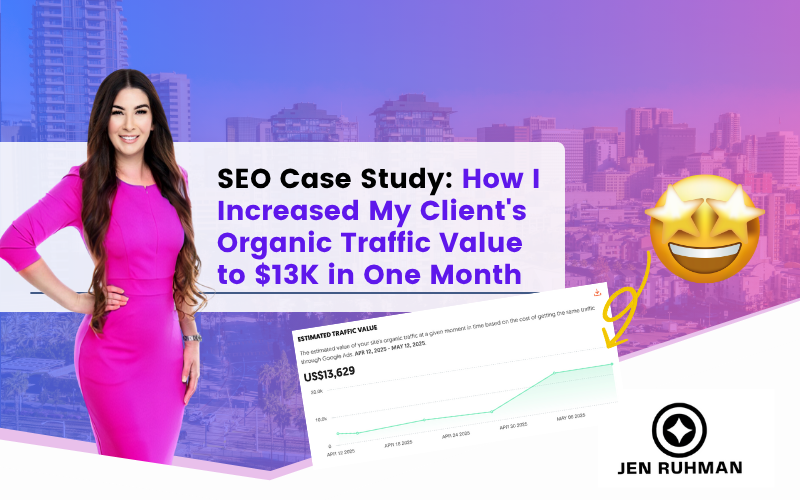
SEO Case Study: How I Increased My Client’s Organic Traffic Value to $13K in One Month

SEO Case Study: How I Increased My Client’s Organic Traffic Value to $13K in One Month

Hi, I’m Jen Ruhman, the owner of this SEO company in San Diego! I’ve helped many businesses grow online by boosting their SEO, and today, I want to share an exciting recent success. Last month, I managed to increase a client’s organic traffic value to over $13,000! Yes, that’s right—$13K in just 30 days. Let me walk you through how I did it, step-by-step.

SEO Case Study San Diego

Understanding the Initial Situation

When my client first came to me, their website had decent content, but their organic traffic was flat. They weren’t ranking highly for important keywords, and their competition was consistently outperforming them. They needed help—and fast.

I remember our initial call clearly. The owner was frustrated, saying, “Jen, I’ve tried everything myself, but nothing seems to work!” As an SEO expert, I knew exactly where to start.

First Things First: An SEO Audit

Before I start improving a site, I always perform a comprehensive SEO audit. This audit is like a health check-up for a website. It helps me find:

  • Technical SEO issues
  • Poorly optimized content
  • Missed keyword opportunities
  • Slow page loading speeds

I found several issues that we could fix quickly, including slow loading pages, missing meta tags, and weak keyword targeting. With these issues identified, I was ready to create a solid strategy.

Creating a Strong SEO Strategy

My approach is always focused and strategic. I never guess or assume. Instead, I look at data and let it guide my decisions. Here’s the strategy I created for my client:

Targeting the Right Keywords

Many businesses make the mistake of targeting highly competitive keywords right away. I knew better. Instead, I found less competitive but still relevant keywords—often called “low-hanging fruit.” These keywords are easier to rank for and quickly boost traffic.

I picked out around 15 key terms and phrases that had a good search volume but less competition. This helped my client see fast results.

Optimizing Existing Content

The client already had plenty of content, but it wasn’t optimized properly. I went through each important page, adding keywords naturally to titles, headings, and throughout the content.

For example, one of their blogs lacked focus. I rewrote the headings to include targeted keywords and reorganized the content for clarity. The results? That blog quickly shot up in Google’s rankings!

Improving Website Performance

Website speed matters—a lot. If your site loads slowly, visitors leave quickly. Google notices that and can lower your ranking. My client’s site took too long to load, so I optimized images, minimized unnecessary scripts, and utilized caching.

The impact was immediate. Users stayed longer on the site, and Google rewarded that improved experience by boosting the rankings.

The Secret Weapon: Quality Backlinks

Another major step I took was building quality backlinks. Backlinks (links from other websites to yours) tell Google that your content is valuable. But not all backlinks are equal.

How I Built High-Quality Backlinks

I reached out to trusted websites related to my client’s industry and proposed guest blogs and collaborations. I always aim for sites that have high authority. Within weeks, we secured several powerful backlinks. These backlinks were key in pushing my client’s website higher in the rankings.

Monitoring and Adjusting the Strategy

SEO isn’t a “set it and forget it” kind of thing. You have to monitor and adjust regularly. Throughout the month, I constantly checked analytics. I watched closely to see what worked and what didn’t. If something wasn’t performing well, I adjusted quickly.

This ongoing optimization helped maintain consistent growth throughout the month.

The Results: Over $13,000 in Organic Traffic Value

After just one month, we saw amazing results. My client’s organic traffic significantly increased. Not only did their site rank higher, but the actual monetary value of that traffic rose dramatically. According to analytics data, the traffic was now worth over $13,000 if we had bought the same traffic through paid ads!

My client was thrilled. They told me, “Jen, I honestly didn’t think we’d see results this quickly. Thank you for making this happen!”

What You Can Take Away from This

If you’re struggling with your SEO, take heart—there’s always a clear path forward. Here are some key takeaways from this case study:

  • Do a thorough audit: Find out what’s not working first.
  • Target achievable keywords: Go for terms you can quickly rank for.
  • Optimize existing content: Don’t ignore what you’ve already created.
  • Build quality backlinks: Focus on quality, not quantity.
  • Monitor and adjust: SEO requires ongoing attention and tweaks.

Need Help with Your SEO?

If your San Diego business needs help increasing organic traffic and visibility, I’m here for you. I love helping businesses like yours achieve SEO success.

Feel free to reach out for a consultation or any questions you might have. I’m always just a call or text away:

Call/Text me: (619) 719-1315

Together, let’s make your business shine online!

Elizabeth Dawson: Image SEO Case Study

Elizabeth Dawson: Image SEO Case Study

Thanks for checking out an image SEO case study I am doing for Elizabeth Dawson.

Now, If you know Elizabeth, she’s an amazing financial advisor and also an author here in San Diego.

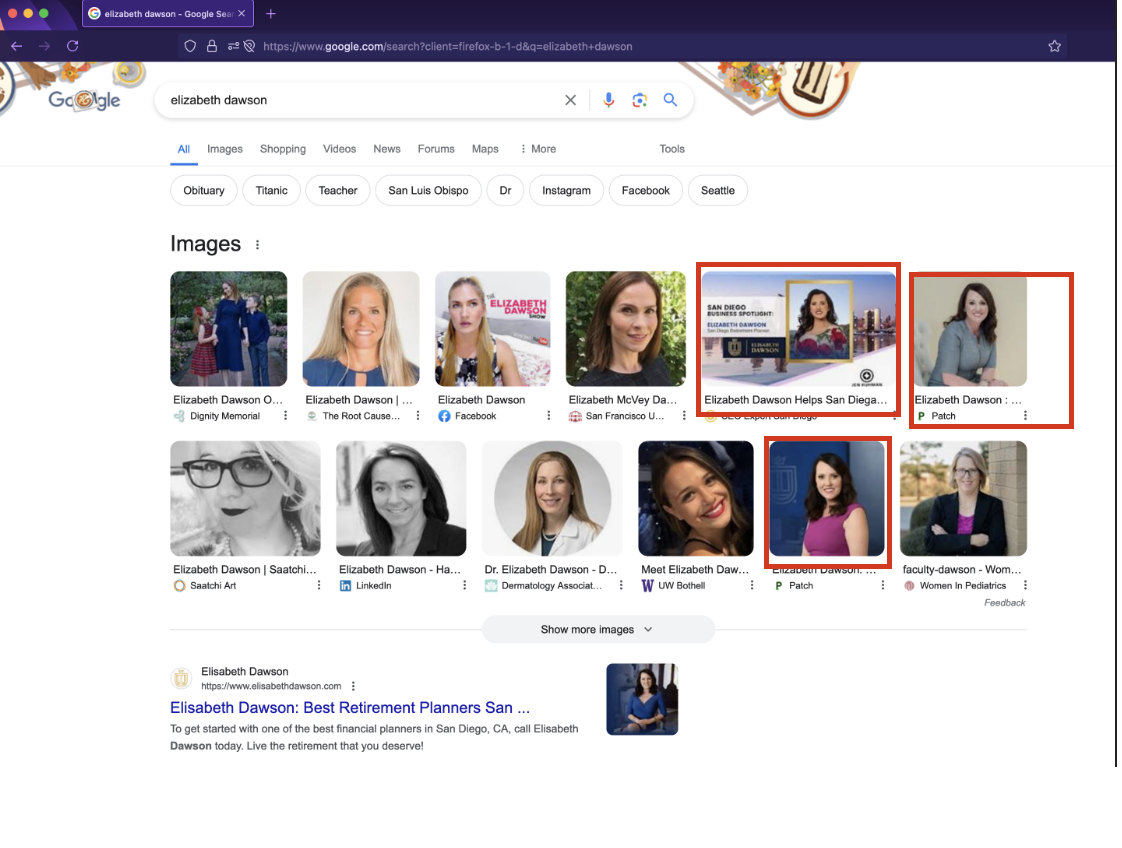
That being said, she wants to rank for the alternative spelling of her name “Elizabeth Dawon” with a ltter “z” in the name vs an “s”. As common as this name is, I took on the challenge. I discovered some great websites that will help rank her image (including my site here). It’s been roughly 20 days. Here’s what’s showing up in Google as of 6/27/24″

screenshots of Elizabeth Dawson

The top website showing highest rankings for this keyword was unfortunatly a memorial site. Not possible, skip.

Why would you want to rank in Google image search by the way? Credibility, Authority. Why not?

Elizabeth has some stunning photos that were professionally taken, ofcourse I’d want them to appear.

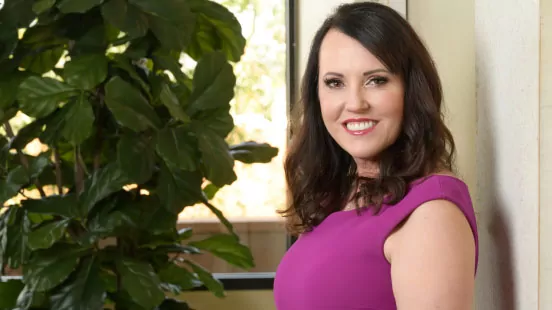
Look at this amazing photo of Elizabeth Dawsom :

Elizabeth Dawson - San Diego

Elizabeth Dawson

In today’s digital world, having your images rank at the top of Google Image Search can significantly enhance your online presence and brand visibility. This case study delves into the efforts made to rank images of Elizabeth Dawson, a prominent financial advisor in San Diego, despite the challenges posed by her common name.

Understanding the Basics of Google Image Search

To effectively rank images, it’s essential to understand how Google ranks them. Google uses various factors such as relevance, image quality, and the context provided by the surrounding text and metadata. Optimizing these elements is crucial for improving image rankings.

The Challenge with Common Names

Names like Elizabeth Dawson present unique challenges due to their commonality. Competing with numerous other images requires strategic planning and precise optimization. Overcoming this involves unique approaches to SEO that can set her images apart from the rest.

Initial Steps Taken

The first step involved selecting high-quality images of Elizabeth Dawson and optimizing them. This included naming the files appropriately with keywords and ensuring that each image was relevant to the content surrounding it.

Alt Tags and Descriptions

Alt tags play a vital role in image SEO. They provide context to search engines about the image content. For Elizabeth Dawson, alt tags such as “Elizabeth Dawson” “Elizabeth Dawson financial advisor San Diego” were used to enhance relevance.

Website Integration

Integrating images into her website with optimized H1 tags and strategic placement was another critical step. Ensuring that the images were placed in contextually relevant articles helped boost their SEO value.

Leveraging Web 2.0 Websites

Using Web 2.0 platforms like Medium, Issuu, and Behance helped distribute Elizabeth Dawson’s images across multiple high-authority sites. These platforms offer valuable backlinks and additional context, which can improve image rankings.

Elizabeth image SEO citations:
  1. https://issuu.com/jenruhmanseo/docs/elizabeth_dawson
  2. https://medium.com/@jenruhman/charting-your-course-to-retirement-bliss-consultations-with-san-diegos-elizabeth-dawson-6e8a6deea55c
  3. issuewire: https://www.issuewire.com/elizabeth-dawson-offers-free-wealth-discovery-calls-san-diego-retirement-planning-1801603706015348 (️ RANKING)
  4. flickr  https://www.flickr.com/photos/jenruhman/53785315783
  5. pinterest https://pin.it/2ELmREma5
  6. prlog: https://www.prlog.org/13024641-elizabeth-dawson-start-your-retirement-planning-journey-with-trusted-san-diego-advisor.html (️ RANKING)
  7. patch https://patch.com/california/santee/classifieds/announcements/452561/elizabeth-dawson-san-diego-s-trusted-financial-advisor-free-consultation (️ RANKING)
  8. x: https://x.com/SEOexpertSD/status/1800623698455703658/photo/1
  9. behance: https://www.behance.net/gallery/200803871/Elizabeth-Dawson/modules/1138493049
  10. https://www.saatchiart.com/u/2485043 (this site ranks a woman named “Elizabeth Dawson”
  11. https://www.threads.net/@seo.expert.sd/post/C8FtPB1yo8w
  12. https://www.goodreads.com/review/show/6578844453
  13. reddit: https://www.reddit.com/user/jenruhman/comments/ 1ddowxx/elizabeth_dawson_the_financial_guru_with_a_heart/ (️ RANKING)
  14. my website: https://jenruhman.com/elizabeth-dawson-helps-san-diegans-plan-for-a-secure-retirement/  (️ RANKING)
  15. https://medium.com/@jenruhman/elizabeth-dawson-retirement-by-design-get-your-free-chapter-c4076d66b24f 
  16. https://www.linkedin.com/pulse/elizabeth-dawson-retirement-design-get-wbodc/?trackingId=Wg26wu9rrr4Y7ab4qZLvqw%3D%3D
  17. https://www.elisabethdawson.com/elizabeth-dawson/

Patch was the first and fastest site to index her photo within 24 hours I’d say. Will it stay there I have no idea!

Classified Websites and Reddit

Posting images on classified websites and Reddit provided additional visibility. These platforms are often crawled by Google, and ranking on them can indirectly boost the primary image rankings.

Waiting for Google Indexing

One of the most challenging aspects of SEO is waiting for Google to index the efforts. Patience is key, as indexing can take time. Keeping track of which sites are still awaiting indexing helps manage expectations and plan future strategies.

Specific Website Efforts

Efforts on various websites included creating detailed profiles and articles featuring Elizabeth Dawson. Sites like PRLog and Patch showed notable success, ranking images effectively due to their high domain authority and relevance.

Case Studies of Successful Rankings

Analyzing platforms where success was achieved provided insights into effective strategies. For instance, PRLog and Patch offered strong domain authority and relevant content, which helped in ranking the images higher.

Challenges and Setbacks

Challenges included dealing with common name competition and slow indexing times. Addressing these issues involved refining alt tags, using more specific keywords, and continually updating content to maintain relevance.

Future Strategies

Maintaining and improving rankings requires ongoing effort. Future strategies include exploring new platforms, continually updating existing content, and monitoring Google Analytics to track progress.

Conclusion

Ranking images on Google Image Search, especially with common names, is a challenging but rewarding process. Through strategic optimization, patience, and continual effort, it’s possible to achieve and maintain high rankings, enhancing online visibility and brand presence.

Challenges and Setbacks

While our journey to rank Elizabeth Dawson’s images on Google has been largely successful, it hasn’t been without its challenges. The primary hurdle is the commonality of her name. Competing against numerous other Elizabeth Dawsons requires a unique approach to SEO. Slow indexing times by Google have also posed a challenge, as they delay the visibility of our efforts. To overcome these, we’ve had to refine our alt tags, employ more specific keywords, and continually update content to keep it relevant.

Future Strategies

Moving forward, we plan to maintain and improve our rankings through continuous effort and strategic planning. Here are some strategies we intend to implement:

  1. Exploring New Platforms: We will look for additional high-authority platforms to publish images and content about Elizabeth Dawson.
  2. Continual Content Updates: Regularly updating existing content to maintain its relevance and SEO value.
  3. Monitoring Google Analytics: Tracking our progress and adjusting our strategies based on analytics data.
  4. Engaging with Audiences: Utilizing social media and other channels to increase engagement and drive more traffic to our images.
  5. Networking with Influencers: Collaborating with influencers and other notable figures to enhance the visibility and credibility of Elizabeth Dawson’s images.

Conclusion

Ranking images on Google Image Search, especially for individuals with common names like Elizabeth Dawson, is a challenging yet rewarding endeavor. Through strategic optimization, patience, and continuous effort, we’ve managed to achieve and maintain high rankings. This process has significantly enhanced Elizabeth Dawson’s online presence and brand visibility.

FAQs

Why is it important to rank images on Google? Ranking images on Google increases visibility, driving more traffic to your website and enhancing your online presence.

How long does it take to see results? Results can vary, but it typically takes a few weeks to several months to see significant changes in image rankings.

What are the best practices for image SEO? Best practices include using relevant alt tags, high-quality images, proper file names, and integrating images within contextually relevant content.

Can I use the same strategies for different names? Yes, the strategies can be applied to different names, but they may need to be adjusted based on the competitiveness of the name.

What if my images still don’t rank? If images don’t rank, review your SEO practices, update alt tags and content, and consider using additional platforms to boost visibility.

What are the best practices for image SEO? Best practices for image SEO include using relevant and descriptive alt tags, ensuring high-quality images, properly naming image files with keywords, and placing images within contextually relevant content on high-authority sites.

Thank you so much for checking out this fun image SEO test. I may update it from time to time and especially if the client wishes to continue the efforts.

Is Your Website a Hidden Gem? Unleash Its Potential with SEO & Image Optimization

Imagine a flood of qualified visitors discovering your website organically, captivated by stunning visuals and eager to explore your offerings. That’s the combined power of SEO and strategic image optimization!

At Jen Ruhman SEO, we specialize in transforming hidden gems like yours into thriving online destinations, particularly for San Diego businesses. We achieve this through a two-pronged approach:

  • SEO: We meticulously optimize your website content and structure to rank higher in search results for relevant keywords. This ensures potential customers actively searching for products or services like yours discover your website with ease.
  • Image SEO: Eye-catching, high-quality images showcasing your products, services, and brand personality are crucial for grabbing attention online. We’ll optimize your website images for search engines and ensure fast loading times, creating a seamless user experience.

Ready to unlock the true potential of your online presence?

Schedule your free consultation today! Call or text us at (619) 719-1315 and let’s discuss how we can transform your website into a lead-generation machine.

Together, let’s turn website visitors into loyal customers!

BTW, since I mentioned Elizabeth, I need to note her disclaimer:

CA LIC #0C71264, #0G81294
Investment advice offered through Copia Wealth Management Advisors, Inc.
Copia Wealth Management Advisors, Inc. is a registered investment advisor.


The Most Adorable SEO Expert in San Diego : Funny Case Study

The Most Adorable SEO Expert in San Diego : Funny Case Study

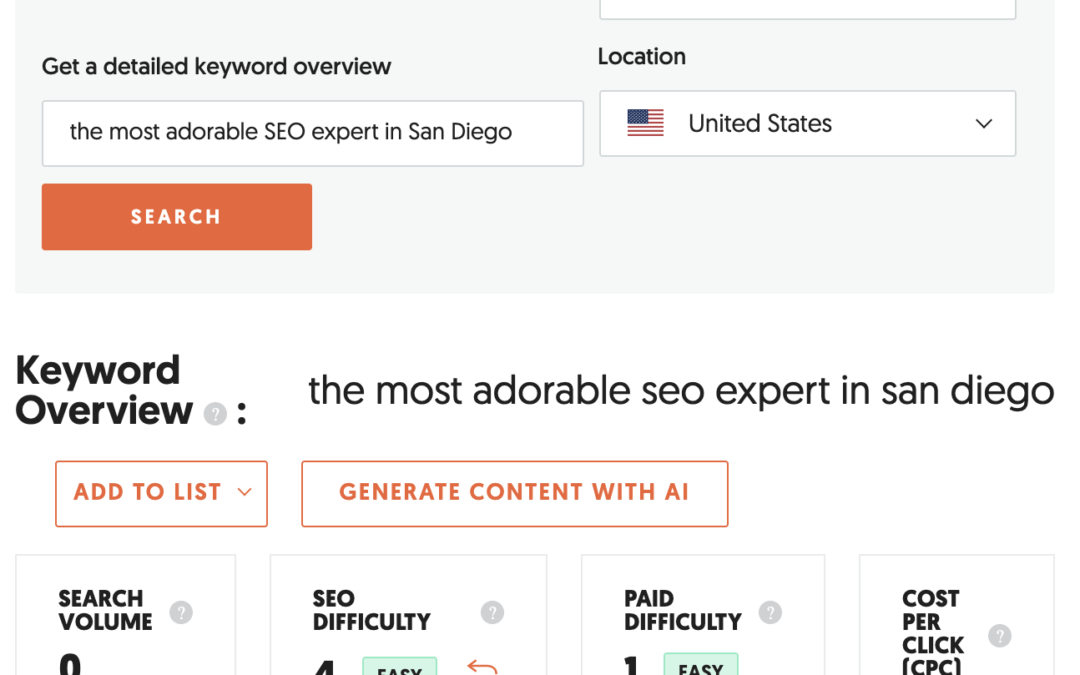
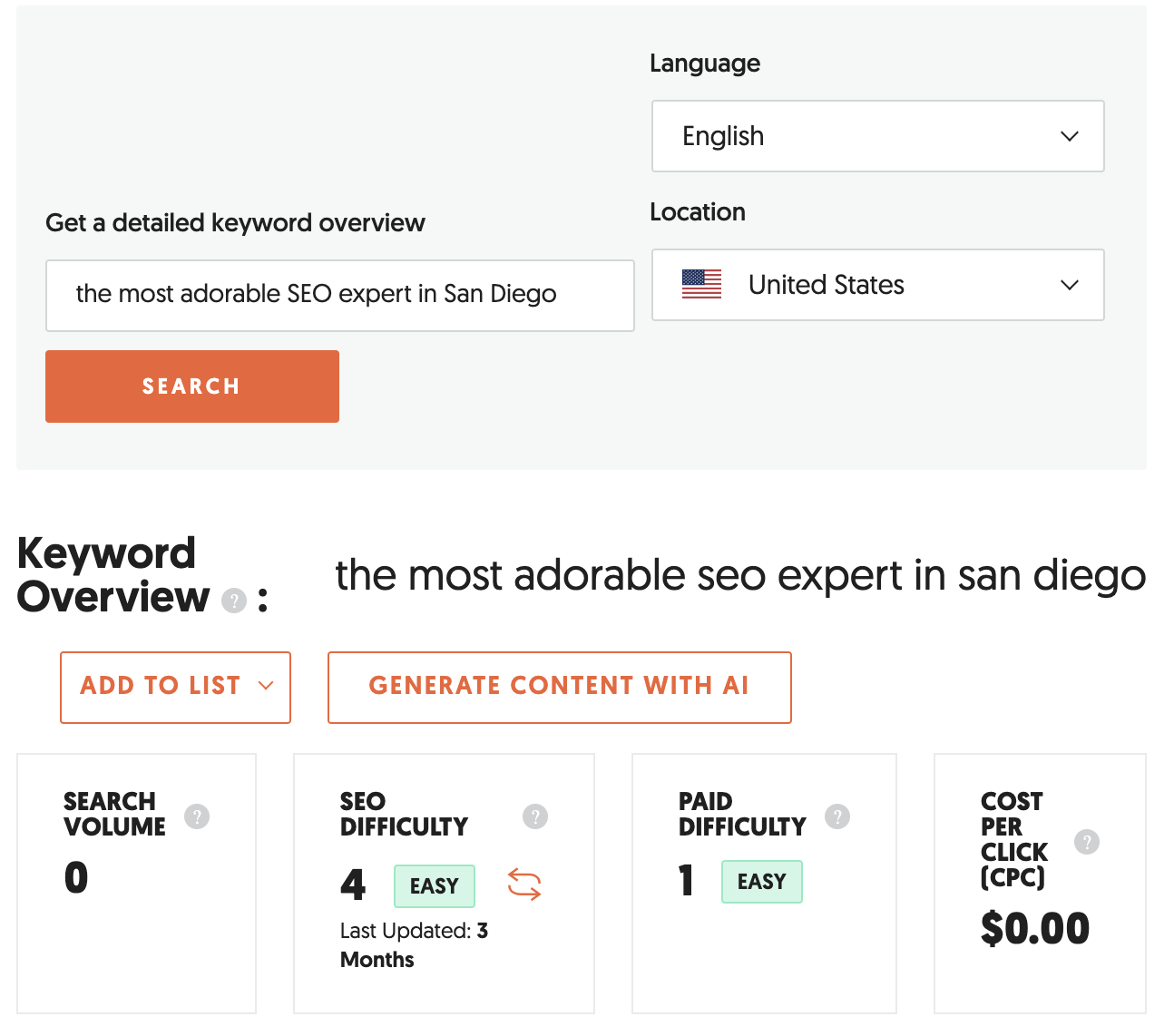
In the bustling world of SEO, there’s a hidden secret that many aren’t aware of. Somewhere in the heart of San Diego, there’s an SEO expert who’s not just skilled, but also the most adorable one you’ll ever meet. But wait, before you rush to Google to find this expert, let me tell you a secret: “the most adorable SEO expert in San Diego” is a keyword that has a monthly search volume of… wait for it… zero.

Don’t let SEO companies promise to rank you for keywords that don’t get any searches!

And whatever you do, don’t let them boast about it like they’re doing you a huge favor. They’re not rockstars.

Do you know how many consultations I have with potential clients that say they’re ranking for crappy keywords? Too many.

They mentioned they’re not happy with the current SEO agency they’re working with.

I hear mostly:

we’ve been working with a popular SEO company and we’re not seeing any improvements at 6 months into it the process no keywords have moved except this one ….. (and it’s always the one with zero search volume.)

That’s right, not a single person is searching for this term: screenshot

The Most Adorable SEO Expert in San Diego

Now, you might be wondering, why are we even talking about a keyword that no one is searching for? The answer lies in a common tactic some SEO companies use to keep their clients hooked.

The Zero-Search Volume Keywords Trap

In the vast ocean of keywords, there are those high-volume ones that everyone wants to rank for. Think “best smartphones 2023” or “top holiday destinations.” These are the keywords that can drive massive traffic to your website. But then, there are the “most adorable SEO expert in San Diego” type of keywords. These are terms that, quite frankly, no one is searching for. Their monthly search volume is a big, round zero.

Some SEO companies, in an attempt to show quick wins and keep clients on a monthly retainer, will boast about how they can rank your website for such keywords. “Look,” they’ll say, “we got you to the number one spot for ‘the most adorable SEO expert in San Diego’!” While it might sound impressive at first, when you dig a little deeper, you’ll realize the hollow victory. After all, what’s the point of ranking first for a term that no one is searching for?

Why Checking Keyword Volume is Crucial

Your SEO strategy should always be rooted in data. One of the most critical data points? Search volume. Before you invest time and resources into ranking for a keyword, you need to know how many people are actually searching for it.

If you’re targeting keywords with zero search volume, you’re essentially trying to sell ice to Eskimos. It’s a futile effort that won’t drive any meaningful traffic or conversions.

In Conclusion

While the idea of being the top result for “the most adorable SEO expert in San Diego” might sound cute, it’s essential to see through the smoke and mirrors of SEO promises. Always base your strategy on data, and be wary of anyone who boasts about rankings without showing the search volume to back it up.

Remember, in the world of SEO, it’s not just about ranking; it’s about ranking for the right terms. So, the next time someone promises you the moon with keywords that sound too good (or too quirky) to be true, take a moment to check their search volume. Your SEO strategy will thank you.

Was this a fun blog post or what? Now I get to casually say to potential clients….I rank for the most adorable SEO expert in San Diego. And who wouldn’t want to rank for that? Nobody! LOL.

Tired of Watching Your Website Languish in Search Results?

Discover the magic touch of Jen Ruhman SEO! As San Diego’s premier SEO specialists, we don’t just promise results – we deliver them. With our deep-rooted expertise, we’re committed to catapulting your business to the digital limelight.

Transparent Progress Reports: Every month, receive a detailed breakdown of our strategic moves and their impact on your rankings. Witness the tangible growth and track every penny of your investment.

Stay Ahead, Stay Informed: We believe in a partnership where you’re not just a client but an integral part of the journey. As your business scales new heights, we ensure you’re always in the driver’s seat, fully informed.

Let’s Ignite Your Growth: Ready to transform your digital presence? Reach out for a no-obligation consultation. We’re eager to chart out your success story.

Dial or Text: (619) 719-1315. Talk to Jen directly.

For a brighter digital tomorrow, choose Jen Ruhman SEO.

Why SEO is a Must-Have for Med Spas in San Diego

Why SEO is a Must-Have for Med Spas in San Diego

As the competition among Med Spas in San Diego continues to grow, it has become essential for these businesses to implement search engine optimization (SEO) strategies to remain competitive.

How many med spas are there in the US?
Medical aesthetics has grown into a $15 billion industry that employs 70,000 people. In 2022, there are 8,841 medical spas, up from 7,430 in 2021 and 5,431 in 2018. A single-location medical spa generates $121,632 in monthly revenue. Jan 24, 2023 americanmedspa.org
SEO is a powerful tool that can help Med Spas in San Diego to improve their online visibility, attract more customers, and ultimately increase their revenue. In this article, we will explore why SEO is a must-have for Med Spas in San Diego and how these businesses can optimize their websites for search engines.

Why SEO is a Must-Have for Med Spas in San Diego

Understanding SEO

Before we dive into the reasons why SEO is essential for Med Spas in San Diego, let’s first understand what SEO is. SEO refers to the process of optimizing a website to rank higher in search engine results pages (SERPs). The goal of SEO is to increase the quantity and quality of traffic to a website from organic search engine results.

Importance of SEO for Med Spas

For Med Spas in San Diego, SEO is essential because it helps them to attract potential customers who are looking for their services online. With the majority of consumers using search engines to find businesses in their local area, having a strong online presence is critical for Med Spas to remain competitive. By optimizing their websites for search engines, Med Spas in San Diego can increase their visibility online and attract more customers to their business.

SEO Strategies for Med Spas

To optimize their websites for search engines, Med Spas in San Diego must implement various SEO strategies. Here are some of the essential SEO strategies that Med Spas can use to improve their online visibility and attract more customers:

Keyword Research

Keyword research is the process of identifying the keywords and phrases that potential customers are using to find businesses like yours online. By conducting keyword research, Med Spas in San Diego can identify the most relevant and profitable keywords for their business and optimize their website content accordingly.

On-Page Optimization

On-page optimization refers to the process of optimizing the content and structure of a website’s individual pages to improve their visibility in search engines. This includes optimizing title tags, meta descriptions, header tags, and internal links.

Off-Page Optimization

Off-page optimization refers to the activities that are conducted outside of a website to improve its visibility in search engines. This includes link building, social media marketing, and online directory submissions.

Local SEO

Local SEO is the process of optimizing a website for local search results. This includes optimizing a website’s content for local keywords, submitting the business to online directories, and claiming and optimizing Google My Business listings.

Benefits of SEO for Med Spas in San Diego

Implementing SEO strategies can provide many benefits for Med Spas in San Diego. Here are some of the benefits of SEO for Med Spas:

Increased Online Visibility

By implementing SEO strategies, Med Spas in San Diego can increase their online visibility and attract more customers to their business. With more and more consumers using search engines to find local businesses, having a strong online presence can help Med Spas stand out from their competitors.

Attracting Local Customers

SEO strategies can help Med Spas attract local customers in San Diego who are searching for their services online. With local SEO, Med Spas can optimize their website and online directories to appear in local search results, making it easier for potential customers to find them.

Enhanced User Experience

SEO strategies such as on-page optimization can also improve the user experience of a Med Spa’s website. By optimizing the content and structure of a website’s individual pages, Med Spas can make it easier for users to navigate their website, find the information they need, and ultimately book an appointment.

Increased Revenue

By attracting more customers through improved online visibility and local search results, Med Spas in San Diego can ultimately increase their revenue. With more customers coming to their business, Med Spas can grow their customer base and generate more revenue over time.

Common SEO Mistakes to Avoid

While SEO can be a powerful tool for Med Spas in San Diego, there are also some common mistakes to avoid. Here are some of the most common SEO mistakes that Med Spas should avoid:

Keyword Stuffing

Keyword stuffing refers to the practice of using too many keywords in website content to manipulate search engine rankings. While it may seem like a quick way to improve rankings, keyword stuffing can actually harm a website’s SEO efforts.

Duplicate Content

Duplicate content refers to content that appears on multiple pages of a website or on different websites. Duplicate content can harm a website’s SEO efforts by confusing search engines and lowering the website’s rankings.

Ignoring Local SEO

Ignoring local SEO can also harm a Med Spa’s online visibility in local search results. By not optimizing their website and online directories for local search, Med Spas may miss out on potential customers who are searching for their services in San Diego.

Conclusion

In conclusion, SEO is a must-have for Med Spas in San Diego who want to remain competitive and attract more customers to their business. By implementing SEO strategies such as keyword research, on-page optimization, off-page optimization, and local SEO, Med Spas can improve their online visibility, attract local customers, enhance the user experience, and increase their revenue.

If you’re a Med Spa in San Diego looking to improve your SEO efforts, we encourage you to reach out to an experienced SEO agency who can help you develop a customized strategy for your business.

Are you looking for help with increasing your online visibility?

Jen Ruhman is an SEO expert in San Diego that offers professional optimization services to propel your website higher in search engine rankings, driving better quality traffic and improving ROI. Our team of experienced professionals are here to ensure maximum visibility for ideal target markets, leading to greater leads and sales potential.

Don’t spend any more time struggling on your own–let us help you get the top page rank you deserve! With our cutting-edge SEO tactics, we guarantee successful results so that you can reap the rewards from increased online presence.

Contact Jen Ruhman SEO now at (619) 719-1315 for a free consultation about how we can grow your business! Seize this opportunity right now and start seeing success today!

Mindful Marketing: The Importance of SEO for Psychiatrists

Mindful Marketing: The Importance of SEO for Psychiatrists

Maximizing Your Reach and Patient Base: How SEO Can Revolutionize Your Psychiatry Practice

At the intersection of digital marketing and mental health, SEO is a crucial factor that psychiatrists cannot afford to ignore. In the ever-evolving landscape of online marketing, psychiatrists need to stay ahead of the game and understand the importance of SEO in driving traffic to their websites. In this article, we will explore the concept of mindful marketing and the significance of SEO for psychiatrists in enhancing their online presence and reaching out to their target audience.

why SEO is important for psychiatrists

Forecasts of supply and demand for psychiatrists suggest that California will have a severe shortage of psychiatrists by 2028

Source: healthforce.ucsf.edu

To stay competitive, psychiatrists may need to consider implementing SEO strategies to improve their online visibility and attract new patients. By optimizing their website and online presence, psychiatrists can ensure that potential patients can easily find them when searching for mental health services in their area, ultimately helping to grow their practice and meet the growing demand for psychiatric care in California.

What is Mindful Marketing?

Mindful marketing is an approach to marketing that focuses on being present and attentive to the needs of your target audience. It is a practice of marketing that is empathetic, compassionate, and respectful of the individual’s needs. In the context of psychiatry, mindful marketing involves tailoring your marketing efforts to meet the unique needs of your target audience.

Why is SEO Important for Psychiatrists?

SEO, or search engine optimization, is the process of optimizing your website to improve its visibility and ranking in search engine results pages (SERPs). With more than 5 billion searches conducted on Google every day, having a high ranking on search engines is essential for psychiatrists to reach out to their target audience.

Here are some reasons why SEO is important for psychiatrists:

  1. Increased Visibility: By optimizing your website for SEO, you increase its visibility in search engine results pages. This helps you to reach out to a wider audience and attract more visitors to your website.
  2. Improved User Experience: SEO helps to improve the user experience on your website by making it more accessible, user-friendly, and mobile-responsive. This leads to higher engagement and better conversion rates.
  3. Better Brand Awareness: A high ranking on search engines can help to establish your brand as a trusted and authoritative source in the field of psychiatry. This can lead to more referrals and better business opportunities.
  4. Competitive Advantage: By investing in SEO, you can gain a competitive advantage over other psychiatrists who are not optimizing their websites for search engines. This can lead to increased market share and better profitability.

How to Improve SEO for Psychiatrists?

Improving SEO for psychiatrists requires a comprehensive approach that involves both on-page and off-page optimization strategies. Here are some strategies that psychiatrists can use to improve their SEO:

  1. Keyword Research: Conducting keyword research is the foundation of SEO. It involves identifying the most relevant and high-traffic keywords that are relevant to your practice. Once you have identified your target keywords, you can use them in your website’s content, meta descriptions, and title tags.
  2. Content Creation: Creating high-quality, relevant, and informative content is essential for SEO. By publishing blog posts, articles, and other forms of content that are optimized for your target keywords, you can attract more visitors to your website and establish yourself as an authority in your field.
  3. Local SEO: Local SEO involves optimizing your website for location-based searches. By creating local business listings on Google My Business, Yelp, and other local directories, you can improve your visibility for local search queries.
  4. Link Building: Link building involves acquiring backlinks from other authoritative websites in your niche. By building a network of high-quality backlinks, you can improve your website’s authority and ranking in search engine results pages.


In conclusion, SEO is a crucial factor in the success of digital marketing for psychiatrists. By adopting a mindful marketing approach and investing in SEO, psychiatrists can improve their online presence, reach out to their target audience, and establish themselves as trusted authorities in their field. By implementing the strategies outlined in this article, psychiatrists can improve their SEO and gain a competitive advantage in the digital marketing landscape.

Do you want to get the most out of your business venture online?

Jen Ruhman provides expert SEO services that can help you rank higher on search engine results pages, translating into more visibility and increased leads. Our team has a wealth of experience and is devoted to helping your company succeed online with cutting-edge techniques.

With us in your corner, you’ll be able to maximize web exposure for ideal target markets while opening up the potential for profitable growth opportunities. Reap all the benefits that come with a successful SEO campaign without expending too much effort!

Get started today by calling (619) 719-1315 for a FREE consultation about how we can help grow your business! Seize this awesome opportunity now!