
Mar 21, 2025 | SEO Tips
Updated for 2026
Quick Answer
How can a law firm improve its visibility in Google?
Law firm SEO involves improving your website, Google Business Profile, practice-area pages, local relevance, reviews, authority, and content so search engines can better understand your firm and connect your pages with people searching for legal services.
For attorneys, SEO is particularly competitive because valuable searches such as personal injury lawyer, criminal defense attorney, divorce lawyer, and employment lawyer can attract many firms competing for the same potential clients.
The strongest strategy is not simply adding more keywords to your website. It is building a trustworthy, authoritative online presence around the legal services and geographic markets your firm actually serves.
Why SEO Matters So Much for Lawyers
When someone suddenly needs an attorney, Google is often one of the first places they turn.
They may search for:
- car accident lawyer near me
- San Diego personal injury attorney
- DUI lawyer San Diego
- divorce attorney near me
- employment lawyer San Diego
- wrongful termination attorney
- criminal defense lawyer near me
These are not casual searches.
The person searching may have been injured, arrested, fired, served divorce papers, or faced another situation where finding the right attorney suddenly becomes extremely important.
That creates valuable search demand—and intense competition.
If your firm is not visible when those searches happen, another law firm probably is.
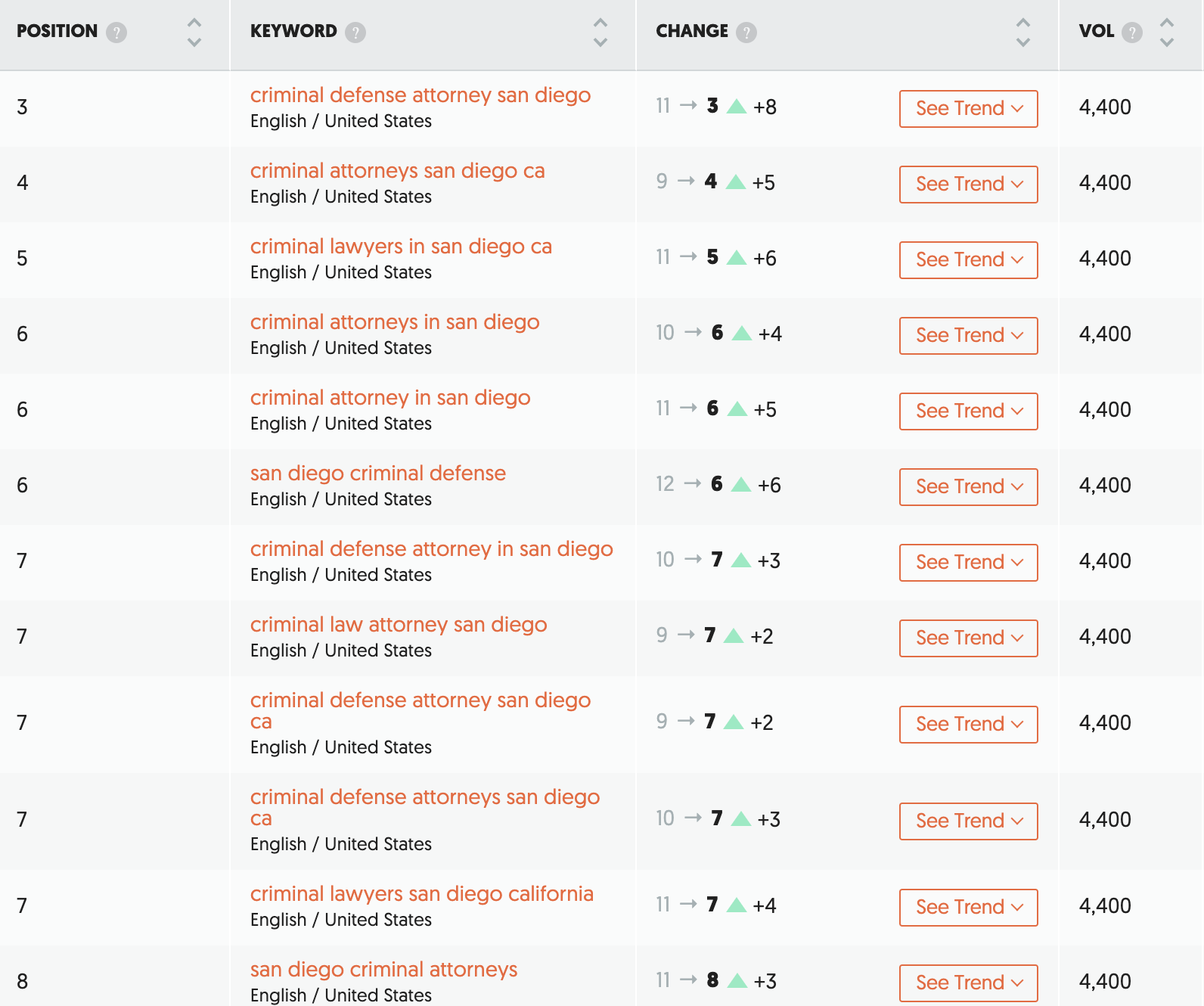
Example: real ranking progress from legal SEO work. Keep your existing screenshot here if the data is still current and accurate.
Why Legal SEO Is Different
I have worked on SEO in many industries, and legal search is one of the areas where authority and trust matter tremendously.
There is a good reason.
Legal information can affect major life decisions.
A poorly researched article about decorating your kitchen probably is not going to change someone’s life.
Incorrect information about statutes of limitation, criminal charges, employment rights, divorce, or what someone should do following a serious accident potentially could.
That is why I do not approach legal SEO as:
keyword + city + 1,500 words = rankings.
A law firm’s website should make it very clear:
- Who the attorneys are
- Their qualifications
- Where they are licensed
- Which areas of law they practice
- Where they practice
- How to contact the firm
- Who reviewed or wrote legal content
- When information was last updated
- Why someone should trust the information
For legal websites, credibility is part of SEO.
What Is Local SEO for Lawyers?
Local SEO helps law firms improve their visibility for searches connected to a geographic area.
For example:
personal injury lawyer San Diego
is different from:
what is a personal injury claim?
The first query has obvious local and commercial intent.
The second is primarily informational.
A good law firm SEO strategy understands that distinction.
Local SEO for attorneys can involve:
- Google Business Profile optimization
- Google Maps visibility
- Practice-area pages
- Location relevance
- Reviews
- Accurate business information
- Legal directories
- Local backlinks
- Attorney biographies
- Locally relevant content
- Technical SEO
- Website authority
You can learn more about how I approach Local SEO for businesses competing in geographic markets.
1. Optimize Your Google Business Profile
For a local law firm, your Google Business Profile can be one of your most important digital assets.
It is what can help your firm appear in Google Maps and Google’s local search results.
Make sure the profile is complete and accurate.
Pay particular attention to:
- Correct law firm name
- Address
- Phone number
- Website
- Business hours
- Appropriate primary category
- Relevant additional categories
- Services
- Photos
- Business description
- Reviews
Your category selection is particularly important because you want Google to understand what kind of legal practice you operate.
A personal injury firm and an estate planning firm should not necessarily be optimized identically.
Do Not Stuff Keywords Into Your Business Name
One tactic I do not recommend is adding keywords to your Google Business Profile name when those words are not actually part of the firm’s real-world business name.
Your profile should accurately represent the business.
Short-term tricks are not worth putting an important business asset at risk.
2. Target the Right Legal Search Intent
Keyword research for lawyers goes far beyond finding terms with high search volume.
I want to know what the person searching is actually trying to accomplish.
Consider the difference between:
What is wrongful termination?
and:
wrongful termination lawyer San Diego
The first person may simply be researching.
The second may be actively looking for an attorney.
Both searches can be useful, but they should usually be addressed by different types of pages.
Commercial Searches
- Personal injury lawyer San Diego
- San Diego car accident attorney
- Employment lawyer San Diego
- Criminal defense attorney San Diego
Informational Searches
- What should I do after a car accident?
- How long do I have to file a personal injury claim?
- What qualifies as wrongful termination?
- What happens after a DUI arrest?
Local Searches
- Lawyer near me
- Attorney near me
- Personal injury lawyer near me
Understanding intent helps prevent a common SEO mistake:
trying to make a blog post rank for a query that really deserves a service page.
3. Create Dedicated Practice-Area Pages
This is one of the biggest opportunities I find on law firm websites.
A firm may have one page that says:
We handle personal injury, car accidents, truck accidents, motorcycle accidents, wrongful death and premises liability.
That is useful information for a visitor.
But it may not be enough to build strong organic visibility for each individual service.
If those are significant practice areas, consider dedicated pages such as:
- Personal Injury Lawyer
- Car Accident Lawyer
- Truck Accident Lawyer
- Motorcycle Accident Lawyer
- Pedestrian Accident Lawyer
- Wrongful Death Lawyer
- Premises Liability Lawyer
Each page should exist because the firm genuinely provides that service—not simply because an SEO tool found another keyword.
What Should a Strong Practice-Area Page Include?
Depending on the subject, I may include:
- Clear explanation of the legal service
- Who the firm helps
- Common case types
- What clients should know
- Relevant legal considerations
- Frequently asked questions
- Attorney experience
- Local information where appropriate
- Related case results when permitted
- Clear next steps
- Contact information
The goal is not to make the page long.
The goal is to make it useful and credible.
4. Demonstrate Real Legal Experience
This is an area I would prioritize heavily for attorney websites in 2026.
Do not hide the attorneys behind generic marketing copy.
Show them.
Strong attorney biography pages can include information such as:
- Education
- Bar admissions
- Years practicing
- Practice areas
- Professional memberships
- Awards where legitimate
- Publications
- Speaking engagements
- Representative experience
- Community involvement
Legal articles should also make authorship clear when appropriate.
If an attorney wrote or reviewed an article, identify that person.
This helps users understand who is responsible for the information they are reading.
5. Build a Strong Review Strategy
Reviews matter for two reasons.
They can contribute to your local search presence, and perhaps even more importantly, prospective clients read them.
Someone choosing between three attorneys may look at:
- Overall rating
- Number of reviews
- How recent they are
- What clients say
- How the firm responds
Encourage genuine clients to leave feedback where appropriate and consistent with applicable professional and platform rules.
Make the process easy.
You can provide clients with a direct link to your Google review form rather than expecting them to search for your business manually.
Respond to Reviews Carefully
Law firms should be particularly thoughtful when responding to reviews because client confidentiality matters.
Do not reveal sensitive information just because a reviewer mentions it first.
A simple, professional response is often sufficient.
6. Build Accurate Legal and Local Citations
Your law firm should have consistent business information across important directories and platforms.
That may include:
- Avvo
- Justia
- FindLaw
- State and local bar-related profiles where applicable
- Chamber of commerce
- Yelp
- Bing Places
- Apple Business Connect
- Relevant local directories
- Industry-specific directories
I care much more about quality and relevance than submitting a law firm to hundreds of random directories.
Your firm’s:
Name
Address
Phone number
Website
should remain accurate and consistent.
I have also put together a larger resource on local citation sites for businesses if you want to understand citations in more detail.
7. Publish Helpful Legal Content
Blogging can work extremely well for law firms when the content addresses questions potential clients genuinely ask.
Personal Injury Content Ideas
- What Should I Do After a Car Accident in San Diego?
- How Long Do I Have to File a Personal Injury Claim in California?
- What Happens If the Other Driver Does Not Have Insurance?
Employment Law Content Ideas
- What Qualifies as Wrongful Termination in California?
- Can My Employer Fire Me While I Am on Medical Leave?
- What Should I Document Before Contacting an Employment Lawyer?
Family Law Content Ideas
- How Long Does Divorce Take in California?
- What Happens to a House During Divorce?
- How Is Child Custody Determined?
These articles can attract people earlier in the decision-making process while strengthening the website’s coverage around its actual areas of practice.
But do not publish content simply because you believe Google wants fresh content.
As I explain in my article about why more content is not always an SEO strategy, quality and strategic relevance matter much more than hitting an arbitrary publishing quota.
8. Strengthen Your Internal Linking
Internal links are especially valuable on large law firm websites.
Imagine you have a primary:
Car Accident Lawyer San Diego
service page.
You also have supporting articles discussing:
- What to do after an accident
- Uninsured motorists
- Hit-and-run accidents
- Common accident injuries
- Insurance claims
- Accident evidence
Those articles should not exist as isolated pieces of content.
Where appropriate, they should connect to the primary car accident service page and relevant related articles.
That is one of the ways I use internal linking for SEO to create clearer relationships between content.
Think of your website as a network rather than a collection of individual pages.
9. Earn Relevant Backlinks and Mentions
Legal SEO is competitive enough that content and on-page optimization may not be sufficient by themselves.
Authority matters.
Strong opportunities can include:
- Local media coverage
- Legal publications
- Professional associations
- Bar associations
- Community organizations
- Sponsorships
- Universities
- Expert commentary
- Original research or data
- Useful legal resources
- Digital PR
I would rather see a law firm earn one highly relevant, legitimate editorial mention than purchase dozens of questionable links from unrelated websites.
Backlink quality matters far more than simply making the number in an SEO tool go up.
10. Improve Website Speed and Mobile Experience
Think about the circumstances under which someone may search for an attorney.
They could be sitting at the scene of an accident.
They could have just been arrested or released.
They may have received a troubling letter from an employer.
They could be researching a divorce privately from their phone.
Your website needs to work well on mobile.
Check:
- Is the text easy to read?
- Is the phone number obvious?
- Can visitors tap to call?
- Are forms easy to complete?
- Does the website load reasonably quickly?
- Are intrusive popups blocking important information?
- Can users easily find the relevant practice area?
SEO traffic is not particularly valuable if the website makes it difficult for potential clients to contact the firm.
11. Prepare Your Law Firm for AI Search
Search is no longer limited to Google’s traditional list of blue links.
Potential clients can encounter legal information through:
- Google AI Overviews
- Google AI Mode
- ChatGPT
- Gemini
- Other AI-powered search and discovery tools
That does not mean law firms should abandon traditional SEO.
Quite the opposite.
The same fundamentals become increasingly important:
- Clear services
- Strong authorship
- Real expertise
- Helpful content
- Logical site structure
- External authority
- Accurate business information
- Brand recognition
I think of AI Search Optimization as an extension of strong SEO fundamentals rather than a replacement for them.
How to Measure Law Firm SEO
Do not judge an SEO campaign solely by whether one keyword moved from position #7 to #4.
I look at the broader picture.
Useful measurements can include:
- Organic impressions
- Organic clicks
- Qualified organic leads
- Calls
- Consultation requests
- Practice-area page visibility
- Google Maps visibility
- Non-branded searches
- Branded searches
- Conversion rate
- Rankings for commercially valuable queries
Google Search Console is one of my favorite tools because it shows what people actually searched before seeing or visiting your website.
Google Analytics can help show what visitors do after they arrive.
And Google Business Profile performance data can help you understand interactions coming from your local presence.
Common Law Firm SEO Mistakes I See
One Page for Every Practice Area
Google and potential clients need more than a paragraph about an important legal service.
Creating Too Many Near-Duplicate City Pages
Changing:
Personal Injury Lawyer San Diego
to:
Personal Injury Lawyer La Mesa
and then replacing the city name throughout otherwise identical copy is not a strong location strategy.
Publishing Generic AI Content
Legal content needs accuracy, experience, and oversight.
Publishing hundreds of generic articles simply because AI makes content production inexpensive can create more problems than it solves.
Ignoring Internal Linking
Great content does not help as much when it is disconnected from the commercial pages you are actually trying to rank.
Buying Questionable Backlinks
Cheap backlink packages can create an unnatural link profile without building meaningful authority.
Obsessing Over One Keyword
Search visibility is broader than a single ranking.
I want to see the entire practice area gaining visibility.
How Long Does SEO for Lawyers Take?
There is not a universal timeline.
It depends on:
- Your market
- Practice area
- Competition
- Current rankings
- Website history
- Existing authority
- Backlinks
- Content
- Technical condition
- Geographic target
- Competitor strength
A law firm starting from scratch in a highly competitive personal injury market faces a very different challenge from an established firm improving visibility for a less competitive specialty.
That is why I do not believe in promising:
“#1 rankings in 30 days.”
SEO is an investment in building sustainable visibility.
SEO for Lawyers: Final Thoughts
Law firm SEO is not about finding a trick that Google has not discovered yet.
It is about making your firm one of the strongest and most credible options available when someone searches for the legal services you provide.
That requires a combination of:
- Strong practice-area pages
- Local SEO
- Google Business Profile optimization
- Attorney expertise
- Helpful legal content
- Reviews
- Internal linking
- Backlinks and authority
- Technical SEO
- Great user experience
- Brand building
I have seen how powerful that combination can become when it is implemented strategically.
As the owner of an SEO company in San Diego, I work directly with businesses in highly competitive markets where getting the right search visibility can make a meaningful difference in lead generation.
If you would like to go deeper into my approach specifically for attorneys, read:
How I Build SEO Authority for San Diego Law Firms
Or if you would like me to evaluate your firm’s current search visibility:
GET A FREE SEO ANALYSIS
Call or text: (619) 719-1315
Thanks for reading,
Jen Ruhman
SEO Expert & Founder of Jen Ruhman SEO
Frequently Asked Questions About SEO for Lawyers
Does SEO work for law firms?
Yes. SEO can help law firms increase their visibility when potential clients search for attorneys, practice areas, and answers to legal questions. However, legal SEO can be extremely competitive, so results depend on the firm’s market, website, authority, content, local presence, competition, and overall strategy.
What is local SEO for lawyers?
Local SEO for lawyers focuses on improving visibility for geographically relevant searches such as “personal injury lawyer San Diego” or “divorce attorney near me.” It can include Google Business Profile optimization, reviews, local citations, practice-area pages, locally relevant content, backlinks, and website optimization.
Does a law firm need a separate page for every practice area?
Important practice areas generally benefit from dedicated pages when each service represents a genuinely distinct offering and search intent. A firm should not create pages merely to target every possible keyword variation, however. Each page should provide substantial value to potential clients.
How important are Google reviews for lawyers?
Reviews can be extremely important because prospective clients often compare law firms before contacting one. Reviews can also contribute to a firm’s local search presence. Law firms should develop an ethical review process while remaining mindful of client confidentiality and applicable professional rules.
Should lawyers publish blog posts for SEO?
Yes, when the articles answer genuine questions prospective clients are asking and support the firm’s areas of practice. Publishing large quantities of generic or overlapping articles simply to increase content volume is not a strong SEO strategy.
How long does law firm SEO take?
There is no fixed timeline. Results depend on competition, practice area, location, website history, authority, backlinks, technical condition, content quality, and the firm’s starting position. Highly competitive legal markets generally require more time and resources than less competitive markets.

Mar 21, 2025 | Advanced SEO, SEO Tips
Let’s talk about something that’s changed the SEO game in a big way—zero-click searches. I’ve seen it affect many of my clients here at my SEO company in San Diego, and if you’re running a business or managing a website, this trend could be affecting you too—without you even realizing it.
What Are Zero-Click Searches?
A Quick Definition
A zero-click search is when someone searches for something on Google… and doesn’t click anything.
Weird, right? But it makes sense when you think about how Google now shows answers right in the results. Whether it’s a definition, time zone, or even a calculator, people get their answer instantly—no need to click through to your website.
Related post: How Google Uses Knowledge Graphs to Rank Businesses
Why They’re on the Rise
Google wants to keep users on their platform longer. With rich results like featured snippets, local packs, and knowledge panels, it’s becoming easier for people to get what they need without leaving the search engine.
And with more people using mobile and voice search, they’re also more likely to grab a quick answer and move on.
Why Zero-Click Searches Matter for SEO
Fewer Clicks, Less Traffic
As an SEO, I care about ranking—but I also care about clicks. After all, what’s the point of ranking #1 if no one clicks?
With zero-click searches, a lot of the traffic we used to count on just… disappears. If you’ve noticed your impressions are high but your traffic is dropping, this could be why.
Related post: The Role of Semantic Entities in 2025 SEO Strategies
Google’s Role in This Shift
Let’s be honest: Google is trying to be everything for everyone. They want to answer questions, serve products, and give directions—all without you leaving their page. From an SEO standpoint, this means we have to get smarter and more strategic.
My Personal Experience with Zero-Click Search Trends
What I Noticed with My Clients
A few years ago, one of my local business clients asked why their rankings were strong, but website traffic was down. After digging in, I found the answer: people were seeing their business info—like hours, directions, and reviews—directly on the search results page.
They weren’t not looking—they just weren’t clicking.
Related post: Answer Engine Optimization (AEO) vs. Generative Engine Optimization (GEO): Key Differences
How I Pivoted My Strategy
Instead of fighting it, I adapted. I focused more on Google My Business, schema markup, and optimizing content for featured snippets. I made sure the brand stood out so even if people didn’t click right away, they remembered the name.
And guess what? It worked.
The Types of Content Affected Most
Quick Answers and Featured Snippets
Google loves showing quick answers. Think “What’s the capital of France?” or “How many ounces in a cup?” These show up in big boxes, often at the very top—no need to click through.
Local SEO and Maps Results
If you’re a local business, most people are seeing your info through Google Maps or the local pack. They get your phone number, address, even reviews—no website visit needed.
Weather, Time, and Calculators
Simple tools and data—like weather, conversions, or calculations—are big zero-click offenders. If you create content around these topics, prepare for a fight for attention.
Related post: Vector Search and SEO: Preparing for an Embedding-First Search World
How to Adapt Your SEO Strategy
Focus on Branded Search
When people know your brand, they’re more likely to click. That’s why I always push clients to build brand awareness—through social media, email, and yes, even good old-fashioned networking.
If someone searches “Jen Ruhman SEO” instead of just “SEO San Diego,” I know I’ve done my job.
Optimize for Featured Snippets
Try to win that zero-click box. Use clear formatting: answer questions directly, use bullet points, tables, and headers. Structure your blog posts to give Google exactly what it wants.
I’ve seen blog posts jump to the top spot just by tweaking a paragraph into Q&A format.
Create Deep, Engaging Content
If your content only gives surface-level answers, people won’t click. But if you go deeper—sharing unique insights, adding videos, case studies, or visuals—you’ll earn that click.
People still want trustworthy, high-quality content. Google may try to answer everything, but humans crave depth and connection.
Double Down on Local SEO
For local businesses, your Google Business Profile is your homepage. Fill it out completely. Post updates, get reviews, add photos. Make your profile too good to ignore.
Bonus tip: Add UTM tracking links to see how much traffic your GMB listing is actually bringing in.
Use Zero-Click to Your Advantage
Build Brand Visibility
Even if users don’t click, they’re still seeing your name. That impression can pay off later when they search again or look you up directly.
Think of it as a digital billboard—your chance to plant a seed.
Think Like a Searcher
Ask yourself: “What would I do?” If you wanted a quick answer, would you click? Probably not. But if something piqued your interest—like a unique blog title or an inviting meta description—you might.
Use that mindset to write better content, titles, and descriptions.
Tools That Help Track Zero-Click Performance
Google Search Console
Keep an eye on impressions vs. clicks. If impressions are climbing but clicks aren’t, you might be showing up in a lot of zero-click searches.
Semrush, Ahrefs, and Other Platforms
These tools show SERP features and help you understand if your keywords are triggering featured snippets, local packs, or knowledge panels.
That insight helps you decide whether to go after those keywords—or aim for ones more likely to get a click.
Don’t Panic – Adapt
SEO is Still Powerful
Zero-click doesn’t mean zero value. It just means we need to evolve with the way people search.
There’s still massive opportunity for growth—if you know how to play the game.
The Key is Strategy, Not Panic
Take a breath, look at your data, and be honest about what’s working. SEO isn’t dead—it’s just different.
And I’m here for it.
FAQs
What’s the main reason for zero-click searches increasing?
Because Google wants to keep users on its platform by showing answers directly in the results, especially for quick queries.
Can you still grow traffic with zero-click searches?
Absolutely. You just have to be more strategic—focus on branded search, valuable content, and optimizing for snippets.
How do featured snippets affect my SEO?
They can steal clicks—but they also boost visibility and authority. If you can win them, it’s still a net win.
What’s the difference between branded and non-branded traffic?
Branded traffic includes searches using your business name. It usually brings in warmer, more ready-to-convert users.
Should I still focus on ranking #1 in Google?
Yes, but with a smarter lens. Aim for positions that get clicks or visibility—like featured snippets, local packs, or branded search terms.
Final Thoughts
Zero-click searches have definitely shaken up the SEO world. But instead of fighting it, I’ve learned to work with it. By focusing on brand, optimizing for snippets, and making content too good to ignore, we can still win in this new landscape.
It’s not about clicks alone—it’s about visibility, strategy, and connection. And when you do that right, the results come.

Mar 11, 2025 | SEO Tips
As the owner of an SEO company in San Diego, I’ve seen firsthand how the right Call-to-Action (CTA) can make or break a website’s performance. It’s not just about getting visitors to your site—it’s about guiding them toward the next step. Whether it’s booking a call, signing up for a newsletter, or making a purchase, a well-crafted CTA turns passive readers into engaged customers.
Let’s dive into why CTAs are crucial for SEO content and how you can optimize them for better results.
What is a Call-to-Action (CTA)?
A CTA is a directive designed to encourage an immediate response from your audience. It’s usually a button, link, or phrase that prompts users to take a specific action, such as:
- “Book a Free Consultation”
- “Download Your Free Guide”
- “Shop Now”
- “Subscribe for Exclusive Updates”
In digital marketing, CTAs are the bridge between content consumption and conversion. Without them, even the best SEO strategies can fall flat.
How CTAs Impact SEO and User Engagement
1. Lower Bounce Rates and Higher Engagement
One of the biggest challenges in SEO is reducing bounce rates—when users leave your site without interacting further. A compelling CTA encourages users to stay engaged, leading them deeper into your content or to a specific landing page. Google takes engagement metrics into account, so the longer visitors stay on your site, the better it is for your rankings.
2. Increased Conversion Rates
Your website isn’t just a digital brochure—it should be a conversion machine. Whether your goal is lead generation or direct sales, a strong CTA guides users through the buyer’s journey. I’ve helped countless clients refine their CTAs, and a simple tweak—like changing “Learn More” to “Get Your Free SEO Audit”—has led to a 20% boost in conversions.
3. Improved Internal Linking Structure
CTAs are a great way to naturally incorporate internal links, which strengthen your website’s SEO. For example, a blog post about local SEO strategies could include a CTA like “Check out our Local SEO Services”, leading users to a dedicated service page. This not only enhances user experience but also distributes link equity throughout your site.
4. Enhances Mobile User Experience
With mobile traffic dominating search results, CTAs should be optimized for small screens. A well-placed button with clear text can make it easier for mobile users to take action without frustration. One of my biggest client wins was a mobile-optimized CTA that increased click-through rates by 30% just by making it larger and using high-contrast colors.
Best Practices for Crafting Effective CTAs
1. Use Action-Oriented Language
The best CTAs are direct and action-driven. Instead of a vague “Click Here,” go for “Get Your Free SEO Strategy Call” or “Claim Your 10% Discount.”
2. Create a Sense of Urgency
Adding urgency can increase conversions. Words like “Limited Time Offer” or “Join Before Spots Fill Up” encourage immediate action.
3. Make CTAs Visually Stand Out
A CTA should be easily noticeable. Use contrasting colors, bold fonts, and ample white space to ensure it doesn’t blend in with the rest of the content.
4. Test and Optimize Regularly
A/B testing different CTA variations is key. I once worked with a client who improved conversions by 40% just by changing the CTA color from blue to orange. Small details matter!
5. Personalize Where Possible
Using first-person phrases like “Start My Free Trial” instead of “Start Your Free Trial” has been shown to improve conversions, as it feels more personal to the user.
Common CTA Mistakes to Avoid
1. Using Too Many CTAs
Too many CTAs can overwhelm users and dilute the message. Stick to one or two clear actions per page.
2. Generic Language
“Click Here” or “Submit” doesn’t tell users why they should take action. Instead, use descriptive CTAs like “Download My Free SEO Checklist” to add value.
3. Poor Placement
Your CTA should be easy to find. Position it above the fold, within the content, and at the end of the page for maximum visibility.
4. Ignoring Mobile Optimization
A CTA that works well on desktop might not be as effective on mobile. Ensure buttons are large enough to tap and that the text remains legible.
FAQs
1. How many CTAs should I have on a page?
One or two per page is ideal. Too many can confuse visitors and reduce conversions.
2. Where is the best place to put a CTA?
The best placements are above the fold, within the content, and at the end of the page.
3. Should CTAs be different for desktop and mobile?
Yes! Mobile users need larger buttons and a simple, streamlined design.
4. What CTA color works best?
It depends on your brand, but high-contrast colors (like orange or green) often perform well.
5. How can I tell if my CTA is effective?
Track clicks, conversions, and engagement through analytics, and A/B test different variations to find what works best.
Supercharge Your SEO: The Untapped Power of Optimized CTAs
A well-optimized CTA is one of the most powerful tools in SEO. It guides visitors toward meaningful actions, improves engagement, and boosts conversion rates—all while enhancing your website’s overall SEO performance. Whether you’re running an e-commerce site, a blog, or a service-based business, mastering CTAs can take your digital presence to the next level. If you need help refining your website’s CTAs, let’s chat—I’d love to help you optimize for success!
Need help with your CTAs? Give me a call / text at: (619) 719-1315
Feb 23, 2025 | SEO Tips
Understanding Hyperlocal SEO and Its Impact on Rankings
Hyperlocal SEO is the ultimate strategy for small businesses in San Diego looking to dominate their local search rankings. By targeting highly specific neighborhoods, streets, and even landmarks, businesses can significantly increase their online visibility, driving more foot traffic and local leads.
Google’s algorithm prioritizes relevance, proximity, and prominence, meaning that businesses optimizing for hyperlocal content will naturally rank higher than competitors using broad keywords. For businesses like restaurants, clinics, law firms, and service providers, leveraging hyperlocal content can result in higher conversion rates and more engaged customers.
Key Benefits of Hyperlocal Content for San Diego Businesses
1. Higher Google My Business (GMB) Rankings
Optimized hyperlocal content directly improves your Google My Business profile rankings. By integrating neighborhood names, cross streets, and local attractions, businesses can appear in Google’s Local Pack, increasing visibility in map searches.
2. Increased Engagement from Local Customers
When users search for businesses in their immediate vicinity, hyperlocal content helps them find exactly what they need. Detailed location-based content builds trust and encourages customers to visit in person or contact the business directly.
3. Lower Competition, Higher Visibility
While broader keywords such as “best restaurant in San Diego” are highly competitive, more specific terms like “best sushi restaurant in La Jolla” or “affordable hair salon in North Park” allow businesses to rank faster and more effectively.
4. Enhanced Mobile Search Optimization
With over 60% of Google searches coming from mobile devices, hyperlocal SEO ensures businesses rank when customers use “near me” searches or location-based voice queries.
Best Practices for Creating Hyperlocal Content in San Diego
1. Optimize Your Google My Business Listing
- Ensure your business name, address, and phone number (NAP) are consistent across all online platforms.
- Add high-quality images showcasing your business and local surroundings.
- Regularly update business hours, posts, and customer responses.
2. Use Neighborhood-Specific Keywords
Instead of generic city-based keywords, incorporate localized terms such as:
- “Pet grooming in Little Italy, San Diego”
- “Auto repair near Balboa Park”
- “Best brunch spot in Hillcrest”
3. Create Location-Specific Blog Content
Writing blogs tailored to your community enhances relevance and search rankings. Some content ideas include:
- “Top 10 Coffee Shops in Gaslamp Quarter”
- “A Guide to the Best Hiking Trails in Mission Valley”
- “Why North Park is the Best Neighborhood for Foodies”
4. Leverage Local Backlinks
Building backlinks from San Diego-based websites such as local news outlets, business directories, and community blogs signals trust and authority to Google. Reach out for:
- Guest posting opportunities on local lifestyle and business sites.
- Collaborations with nearby businesses for cross-promotion.
- Citations in online directories like Yelp, TripAdvisor, and BBB.
5. Incorporate User-Generated Content (UGC)
Encourage customers to leave reviews and tag your business on social media. User reviews containing location-specific language contribute to organic keyword optimization and improve rankings.
6. Optimize for Voice Search
With the rise of voice-activated assistants like Siri and Google Assistant, natural language optimization is crucial. Use conversational phrases such as:
- “Where’s the best nail salon near me?”
- “Find a reliable plumber in Chula Vista”
- “What’s the best Mexican restaurant in Old Town?”
Case Study: Hyperlocal SEO Success in San Diego
Example: Local Restaurant Boosts Traffic by 75%
A San Diego-based Italian restaurant struggled with low online visibility. After implementing hyperlocal content strategies, including:
- Creating blog posts on “Best Pasta Spots in Downtown San Diego”
- Updating GMB with neighborhood-based keywords
- Engaging with local food bloggers for backlinks and features
The restaurant’s website traffic increased by 75% in three months, with a 40% increase in foot traffic.
Tools to Enhance Your Hyperlocal SEO Strategy
1. Google Search Console & Google My Business
Track local search performance and optimize your GMB profile for better rankings.
2. Moz Local & BrightLocal
Ensure NAP consistency across all online directories and business listings.
3. AnswerThePublic & Google Trends
Find hyperlocal keyword trends and answer common local search queries in your content.
4. Ahrefs & SEMrush
Analyze competitors’ local SEO strategies and identify new opportunities.
Final Thoughts
Hyperlocal SEO is the key to standing out in San Diego’s competitive digital landscape. Whether you run a restaurant in the Gaslamp Quarter, a boutique in La Jolla, or a law firm in Hillcrest, leveraging hyperlocal content strategies will drive more traffic, leads, and conversions.
Get Found by More San Diego Customers Today
As a leading local SEO agency in San Diego, we specialize in helping businesses improve their online presence and rank higher on Google. Whether you’re a startup or an established company, we’ll develop a custom SEO strategy that drives real results and connects you with more local customers.
Feb 20, 2025 | SEO Tips
Introduction to Mobile-First Indexing
If you run a business in San Diego, your website is probably one of your most valuable marketing tools. But what if I told you that Google isn’t ranking your website based on your desktop version anymore? That’s right—Google now prioritizes mobile versions of websites for indexing and ranking.
This shift, known as mobile-first indexing, means your mobile website version is now the primary factor determining where you appear in search results. If your site isn’t mobile-friendly, it could be affecting your traffic, leads, and revenue.
Let’s dive into what mobile-first indexing means for your San Diego business and how you can optimize your website for this major change.
Understanding Mobile-First Indexing
What is Mobile-First Indexing?
Mobile-first indexing means that Google primarily uses the mobile version of your website for indexing and ranking. This change reflects the fact that most people now browse the internet using mobile devices rather than desktops.
How It Differs from Traditional Indexing
Before mobile-first indexing, Google’s crawlers would evaluate your desktop site first. Now, Google prioritizes how your site looks and functions on mobile. If your mobile site is incomplete or poorly optimized, your rankings could suffer.
When Did Mobile-First Indexing Start?
Google started rolling out mobile-first indexing in 2018 and made it the default for all new websites by 2019. Today, mobile-first indexing applies to almost every website on the internet.
Why Mobile-First Indexing Matters for San Diego Businesses
San Diego’s Mobile-First Consumers
San Diego is a tech-savvy city with a strong mobile-user base. Whether locals are searching for restaurants, service providers, or retail stores, they’re using their smartphones to do it.
Impact on Local SEO Rankings
If your site isn’t optimized for mobile, Google may push your rankings below competitors who have mobile-friendly sites. That means fewer leads, calls, and visits to your business.
The Connection Between Mobile-Friendliness and Traffic
A mobile-friendly site keeps users engaged longer. If your site loads slowly or has navigation issues, users will leave, and Google will take note—dropping your rankings accordingly.
Key Factors Google Considers for Mobile-First Indexing
- Mobile Usability & Responsive Design – Your site must adjust seamlessly to different screen sizes.
- Page Load Speed & Core Web Vitals – Fast-loading pages rank better.
- Content Consistency – Your mobile site should match your desktop site’s content.
- Mobile-Friendly Navigation – Menus, buttons, and forms should be easy to use on smaller screens.
How Mobile-First Indexing Affects SEO
Google’s Ranking Factors for Mobile-First Indexing
- Fast-loading pages (under 3 seconds)
- Text that’s readable without zooming
- No intrusive pop-ups
- Touch-friendly buttons and links
How to Check If Your Site is Mobile-First Indexed
Use Google Search Console to see how Google crawls and indexes your site. Look under “Coverage” and “Mobile Usability” reports for insights.
How to Optimize Your San Diego Business Website for Mobile-First Indexing
- Ensure a Responsive Website – A fully responsive design is non-negotiable.
- Improve Page Speed & Core Web Vitals – Use Google PageSpeed Insights to analyze and optimize.
- Optimize Mobile Content – Short, clear, and easy-to-read text wins.
- Mobile-Friendly Navigation – Make sure menus, buttons, and CTAs are tap-friendly.
- Structured Data & Meta Tags Optimization – Helps search engines understand your content better.
Local SEO and Mobile-First Indexing
The Importance of Google My Business for Mobile Users
Your Google My Business (GMB) profile is crucial for local search. Ensure your information is updated.
Mobile-First and “Near Me” Searches
Most “near me” searches happen on mobile. If you’re not optimized for mobile, you’re missing customers actively searching for your services.
How to Optimize for Voice Search
With the rise of voice search, focus on natural language keywords like “best coffee shop near Gaslamp Quarter.”
If your website isn’t mobile-optimized, you’re losing out on traffic, leads, and customers. San Diego businesses must prioritize mobile-first indexing to stay competitive. Google is prioritizing mobile-friendly sites, and if yours isn’t up to par, your rankings—and revenue—could suffer.
The good news? Optimizing for mobile-first indexing isn’t complicated when you have an expert on your side.
Get Found by More San Diego Customers Today
As a local SEO company in San Diego, I specialize in helping San Diego businesses rank higher in Google. Whether you’re a local startup or an established company, I’ll craft a custom SEO strategy that drives real results.
Want More Customers? Let’s Talk!
✔ No contracts—just affordable SEO services
✔ 100% San Diego-based SEO expert
✔ Get higher rankings, more traffic, and more sales
Call/Text: (619) 719-1315
Let’s grow your San Diego business with local SEO!
FAQs
How do I check if my site is mobile-first indexed?
Use Google Search Console to see how Google indexes your site.
What happens if my site isn’t mobile-friendly?
You may experience lower rankings and decreased traffic.
How does mobile-first indexing impact ranking in San Diego local searches?
Mobile-friendly sites rank higher, especially for local “near me” searches.
Do I need a separate mobile site for better ranking?
No, a responsive website is preferred.
What tools can I use to test my site’s mobile usability?
Google’s Mobile-Friendly Test and PageSpeed Insights are great options.
Feb 19, 2025 | SEO Tips
Running a business in San Diego? Your customers are searching for your services online. But if your website isn’t ranking, you’re missing out on sales. That’s where local SEO comes in. By optimizing your site for local search, you can outrank competitors, get more traffic, and increase revenue.
At Jen Ruhman SEO, I help San Diego businesses dominate local search results. Let’s dive into how you can attract more customers with a powerful local SEO strategy.
Why Local SEO Matters for San Diego Businesses
Did you know 46% of all Google searches are looking for local information? If your business isn’t showing up, you’re losing potential customers to competitors who are ranking in Google’s Local Pack.
Key Benefits of Local SEO:
✔️ More website traffic from customers in your area
✔️ Increased foot traffic for brick-and-mortar businesses
✔️ Higher rankings in Google Maps and search results
✔️ More phone calls, leads, and sales
Step 1: Optimize Your Google Business Profile
Your Google Business Profile (GBP) is the #1 ranking factor for local search. If you haven’t claimed and optimized your listing, you’re missing out on free visibility.
How to Optimize Your Google Business Profile:
✅ Claim your business on Google Business Profile
✅ Add accurate NAP details (Name, Address, Phone)
✅ Choose relevant business categories
✅ Upload high-quality photos and videos
✅ Encourage customer reviews and respond to them
Step 2: Target the Right Local Keywords
To rank for San Diego searches, your website must include localized keywords. These are the terms your customers type into Google when looking for your services.
Best Local SEO Keywords for San Diego Businesses:
[Your service] in San Diego (e.g., “SEO expert in San Diego”)
[Your service] near me (e.g., “best coffee shop near me”)
[Your industry] + San Diego (e.g., “real estate agent San Diego”)
Neighborhood-based keywords (e.g., “dog trainer in La Jolla”)
Step 3: Build High-Quality Local Citations
Citations are mentions of your business on directories like Yelp, Yellow Pages, and the Better Business Bureau. These listings boost credibility and rankings in local search.
Best Local Citation Sites for San Diego Businesses:
✔️ Yelp
✔️ BBB (Better Business Bureau)
✔️ San Diego Chamber of Commerce
✔️ Yellow Pages
✔️ Foursquare
Step 4: Optimize Your Website for Local SEO
Google prioritizes well-optimized, fast-loading websites. If your site isn’t SEO-friendly, you won’t rank in search results.
Website Optimization Checklist:
Use local keywords in page titles, headings, and content
Create location-specific landing pages
Add schema markup for local SEO
Optimize for mobile-friendly browsing
Improve page speed for better user experience
Step 5: Get More 5-Star Reviews
Google rewards businesses with positive reviews. The more high-quality reviews you have, the better your chances of ranking in the Google Local Pack.
How to Get More Google Reviews:
✅ Ask satisfied customers to leave a review
✅ Send follow-up emails with a review link
✅ Offer incentives like discounts for honest feedback
✅ Respond to all reviews (both positive and negative)
Step 6: Create Local Content to Rank Higher
Blogging is a powerful SEO strategy. Businesses with blogs get 97% more backlinks, which helps increase rankings and traffic.
Local Content Ideas for San Diego SEO:
✔️ “Best Things to Do in San Diego This Weekend”
✔️ “Top 10 [Your Industry] Companies in San Diego”
✔️ “How to Choose the Best [Your Service] in San Diego”
✔️ “San Diego Business Spotlight: [Your Business]”
Step 7: Earn Backlinks from Local Sites
Backlinks (links from other websites to yours) are a top Google ranking factor. The more high-quality local backlinks you have, the higher your website ranks.
How to Get Local Backlinks:
Partner with local bloggers and influencers
Get featured in San Diego news websites
Sponsor community events and charities
Write guest posts for local business blogs
Step 8: Track Your SEO Performance
SEO success doesn’t happen overnight. Tracking your progress helps you adjust strategies and stay ahead of competitors.
Best SEO Tools to Track Rankings:
Google Search Console – Track search rankings
Google Analytics – Monitor traffic and conversions
Moz Local – Check local SEO performance
SEMrush/Ahrefs/ UberSuggest – Analyze competitors and keywords
Get Found by More San Diego Customers Today
As a local SEO company in San Diego, I specialize in helping San Diego businesses rank higher in Google. Whether you’re a local startup or an established company, I’ll craft a custom SEO strategy that drives real results.
Want More Customers? Let’s Talk!
No contracts, just affordable SEO services
100% San Diego-based SEO expert
Get higher rankings, more traffic, and more sales
Call/Text: (619) 719-1315
Let’s grow your San Diego business with local SEO!