Jun 6, 2023 | SEO Tips
Location landing pages play a crucial role in improving local SEO (Search Engine Optimization). These pages are designed to target specific geographic areas and provide relevant information to users searching for local businesses or services.
Here are some ways location landing pages can enhance local SEO:
- Targeted Optimization: Location landing pages allow businesses to optimize their content for specific geographical keywords. By including relevant location-based keywords in the page title, headings, meta tags, and content, search engines can better understand the page’s relevance to local searches.
- Improved Local Relevance: Search engines, like Google, prioritize local results for location-specific queries. By creating dedicated landing pages for each target location, businesses can increase their visibility in local search results. These pages provide search engines with valuable information about the business’s location, services, and relevance to the local community.
- Increased Organic Traffic: Well-optimized location landing pages can attract organic traffic from users searching for businesses or services in specific areas. When a page ranks higher in local search results, it is more likely to receive clicks and visits from users interested in local solutions, leading to increased organic traffic to the website.
- Enhanced User Experience: Location landing pages can be tailored to provide a better user experience by offering location-specific information and addressing local needs and preferences. Including details such as the business’s address, contact information, hours of operation, directions, testimonials, and localized content helps users find the relevant information quickly and encourages them to engage with the business.
- Niche Targeting: Businesses operating in multiple locations can create separate landing pages for each location to target specific niches or demographics. This approach allows them to customize their messaging and content to cater to the unique needs and interests of each location’s target audience, thus increasing the chances of attracting and converting local customers.
- Citations and Backlinks: Location landing pages can be used as a source for generating citations and backlinks. Citations are mentions of the business’s name, address, and phone number (NAP) on external websites, which can positively impact local SEO. Having dedicated location pages makes it easier for other websites and directories to link to the specific page related to a particular location, thus enhancing the website’s overall authority and credibility.
- Mobile Optimization: Local searches are often conducted on mobile devices, especially when users are on the go and looking for nearby businesses. Optimizing location landing pages for mobile devices ensures that users have a positive mobile browsing experience, increasing the chances of engagement, conversions, and positive user signals that search engines consider when ranking websites.
Overall, location landing pages provide businesses with a powerful tool to improve their local SEO efforts. By tailoring content, targeting specific keywords, and providing a better user experience, businesses can increase their visibility in local search results, drive organic traffic, and ultimately attract more local customers.
Are you a business in San Diego looking to dominate the local search results?
Boost your online presence with Jen Ruhman, the leading SEO company in San Diego specializing in local SEO services! Our experts will optimize your website, create targeted content, and drive organic traffic to your business. Take the first step towards local search success and call us now at (619) 719-1315. Let’s elevate your online visibility and attract more local customers today!

May 26, 2023 | PR, SEO Tips
Search Engine Optimization (SEO) is a vital component of modern public relations, offering numerous benefits for brands and businesses. By leveraging SEO strategies, organizations can boost their online visibility, establish a positive brand reputation, effectively distribute content, strengthen media relations, make data-driven decisions, and seamlessly integrate their PR efforts with digital marketing. As search engines increasingly shape the way information is discovered and consumed, understanding and implementing SEO practices has become essential for successful public relations in today’s digital landscape.
SEO (Search Engine Optimization) is important to public relations for several reasons:
- Increased Online Visibility: SEO helps improve the visibility of a company’s website, blog posts, and other digital assets in search engine results. When people search for relevant keywords or topics related to the company, optimized content is more likely to appear higher in search rankings. This increased visibility can lead to greater exposure for the company and its PR efforts.
- Brand Reputation Management: In the digital age, online reputation plays a crucial role in public relations. SEO techniques can help manage and improve a company’s online reputation by ensuring that positive content appears prominently in search results. By optimizing press releases, news articles, and other PR materials, companies can control the narrative and influence public perception.
- Targeted Audience Reach: SEO allows companies to target specific keywords and demographics, ensuring that their PR messages reach the right audience. By understanding the keywords and search terms commonly used by the target audience, PR professionals can optimize their content accordingly. This helps in delivering relevant information to the intended audience, increasing the chances of engagement and conversions.
- Integration of PR and Content Marketing: PR and content marketing go hand in hand, and SEO helps bridge the gap between the two. SEO techniques, such as keyword research and optimization, can be applied to PR content, such as press releases and news articles. This integration ensures that PR efforts align with content marketing strategies, resulting in cohesive messaging and a more comprehensive online presence.
- Measurement and Analytics: SEO provides valuable data and insights into the effectiveness of PR efforts. Through tools like Google Analytics, PR professionals can track website traffic, keyword rankings, and user behavior. These analytics help measure the impact of PR campaigns, identify areas of improvement, and make data-driven decisions to optimize future strategies.
- Long-term Visibility and Sustainability: Unlike traditional PR efforts, which may have a limited lifespan, optimized content has the potential for long-term visibility. Once a webpage or article ranks well in search results, it can continue to drive organic traffic and exposure over time. This sustained visibility ensures that PR messages remain accessible to the target audience even after the initial campaign has ended.
In conclusion, incorporating SEO into public relations strategies is essential for improving online visibility, managing brand reputation, reaching targeted audiences, integrating PR with content marketing, measuring effectiveness, and maintaining long-term visibility. By leveraging SEO techniques, PR professionals can enhance their campaigns and maximize the impact of their efforts in the digital landscape.
Looking to enhance your online presence and elevate the visibility of your website?
Look no further than Jen Ruhman, the trusted SEO company based in San Diego! Our specialty lies in crafting optimized press releases that not only capture attention but also boost your search engine rankings.
With our profound expertise in SEO and press release distribution, we will assist you in reaching a broader audience and generating valuable backlinks to enhance your website’s authority. Our customized strategies are meticulously designed to maximize your online exposure and drive targeted traffic to your business.
Don’t miss the opportunity to outshine your competitors. Contact us today at (619) 719-1315 to discuss your SEO requirements and take advantage of our optimized San Diego press release services. Together, let’s propel your brand to new heights and achieve remarkable SEO success.

May 11, 2023 | Case Study, SEO Tips
As the competition among Med Spas in San Diego continues to grow, it has become essential for these businesses to implement search engine optimization (SEO) strategies to remain competitive.
How many med spas are there in the US?
Medical aesthetics has grown into a $15 billion industry that employs 70,000 people. In 2022, there are 8,841 medical spas, up from 7,430 in 2021 and 5,431 in 2018. A single-location medical spa generates $121,632 in monthly revenue. Jan 24, 2023 americanmedspa.org
SEO is a powerful tool that can help Med Spas in San Diego to improve their online visibility, attract more customers, and ultimately increase their revenue. In this article, we will explore why SEO is a must-have for Med Spas in San Diego and how these businesses can optimize their websites for search engines.
Understanding SEO
Before we dive into the reasons why SEO is essential for Med Spas in San Diego, let’s first understand what SEO is. SEO refers to the process of optimizing a website to rank higher in search engine results pages (SERPs). The goal of SEO is to increase the quantity and quality of traffic to a website from organic search engine results.
Importance of SEO for Med Spas
For Med Spas in San Diego, SEO is essential because it helps them to attract potential customers who are looking for their services online. With the majority of consumers using search engines to find businesses in their local area, having a strong online presence is critical for Med Spas to remain competitive. By optimizing their websites for search engines, Med Spas in San Diego can increase their visibility online and attract more customers to their business.
SEO Strategies for Med Spas
To optimize their websites for search engines, Med Spas in San Diego must implement various SEO strategies. Here are some of the essential SEO strategies that Med Spas can use to improve their online visibility and attract more customers:
Keyword Research
Keyword research is the process of identifying the keywords and phrases that potential customers are using to find businesses like yours online. By conducting keyword research, Med Spas in San Diego can identify the most relevant and profitable keywords for their business and optimize their website content accordingly.
On-Page Optimization
On-page optimization refers to the process of optimizing the content and structure of a website’s individual pages to improve their visibility in search engines. This includes optimizing title tags, meta descriptions, header tags, and internal links.
Off-Page Optimization
Off-page optimization refers to the activities that are conducted outside of a website to improve its visibility in search engines. This includes link building, social media marketing, and online directory submissions.
Local SEO
Local SEO is the process of optimizing a website for local search results. This includes optimizing a website’s content for local keywords, submitting the business to online directories, and claiming and optimizing Google My Business listings.
Benefits of SEO for Med Spas in San Diego
Implementing SEO strategies can provide many benefits for Med Spas in San Diego. Here are some of the benefits of SEO for Med Spas:
Increased Online Visibility
By implementing SEO strategies, Med Spas in San Diego can increase their online visibility and attract more customers to their business. With more and more consumers using search engines to find local businesses, having a strong online presence can help Med Spas stand out from their competitors.
Attracting Local Customers
SEO strategies can help Med Spas attract local customers in San Diego who are searching for their services online. With local SEO, Med Spas can optimize their website and online directories to appear in local search results, making it easier for potential customers to find them.
Enhanced User Experience
SEO strategies such as on-page optimization can also improve the user experience of a Med Spa’s website. By optimizing the content and structure of a website’s individual pages, Med Spas can make it easier for users to navigate their website, find the information they need, and ultimately book an appointment.
Increased Revenue
By attracting more customers through improved online visibility and local search results, Med Spas in San Diego can ultimately increase their revenue. With more customers coming to their business, Med Spas can grow their customer base and generate more revenue over time.
Common SEO Mistakes to Avoid
While SEO can be a powerful tool for Med Spas in San Diego, there are also some common mistakes to avoid. Here are some of the most common SEO mistakes that Med Spas should avoid:
Keyword Stuffing
Keyword stuffing refers to the practice of using too many keywords in website content to manipulate search engine rankings. While it may seem like a quick way to improve rankings, keyword stuffing can actually harm a website’s SEO efforts.
Duplicate Content
Duplicate content refers to content that appears on multiple pages of a website or on different websites. Duplicate content can harm a website’s SEO efforts by confusing search engines and lowering the website’s rankings.
Ignoring Local SEO
Ignoring local SEO can also harm a Med Spa’s online visibility in local search results. By not optimizing their website and online directories for local search, Med Spas may miss out on potential customers who are searching for their services in San Diego.
Conclusion
In conclusion, SEO is a must-have for Med Spas in San Diego who want to remain competitive and attract more customers to their business. By implementing SEO strategies such as keyword research, on-page optimization, off-page optimization, and local SEO, Med Spas can improve their online visibility, attract local customers, enhance the user experience, and increase their revenue.
If you’re a Med Spa in San Diego looking to improve your SEO efforts, we encourage you to reach out to an experienced SEO agency who can help you develop a customized strategy for your business.
Are you looking for help with increasing your online visibility?
Jen Ruhman is an SEO expert in San Diego that offers professional optimization services to propel your website higher in search engine rankings, driving better quality traffic and improving ROI. Our team of experienced professionals are here to ensure maximum visibility for ideal target markets, leading to greater leads and sales potential.
Don’t spend any more time struggling on your own–let us help you get the top page rank you deserve! With our cutting-edge SEO tactics, we guarantee successful results so that you can reap the rewards from increased online presence.
Contact Jen Ruhman SEO now at (619) 719-1315 for a free consultation about how we can grow your business! Seize this opportunity right now and start seeing success today!

May 10, 2023 | Case Study, SEO Tips
Maximizing Your Reach and Patient Base: How SEO Can Revolutionize Your Psychiatry Practice
At the intersection of digital marketing and mental health, SEO is a crucial factor that psychiatrists cannot afford to ignore. In the ever-evolving landscape of online marketing, psychiatrists need to stay ahead of the game and understand the importance of SEO in driving traffic to their websites. In this article, we will explore the concept of mindful marketing and the significance of SEO for psychiatrists in enhancing their online presence and reaching out to their target audience.

Forecasts of supply and demand for psychiatrists suggest that California will have a severe shortage of psychiatrists by 2028
Source: healthforce.ucsf.edu
To stay competitive, psychiatrists may need to consider implementing SEO strategies to improve their online visibility and attract new patients. By optimizing their website and online presence, psychiatrists can ensure that potential patients can easily find them when searching for mental health services in their area, ultimately helping to grow their practice and meet the growing demand for psychiatric care in California.
What is Mindful Marketing?
Mindful marketing is an approach to marketing that focuses on being present and attentive to the needs of your target audience. It is a practice of marketing that is empathetic, compassionate, and respectful of the individual’s needs. In the context of psychiatry, mindful marketing involves tailoring your marketing efforts to meet the unique needs of your target audience.
Why is SEO Important for Psychiatrists?
SEO, or search engine optimization, is the process of optimizing your website to improve its visibility and ranking in search engine results pages (SERPs). With more than 5 billion searches conducted on Google every day, having a high ranking on search engines is essential for psychiatrists to reach out to their target audience.
Here are some reasons why SEO is important for psychiatrists:
- Increased Visibility: By optimizing your website for SEO, you increase its visibility in search engine results pages. This helps you to reach out to a wider audience and attract more visitors to your website.
- Improved User Experience: SEO helps to improve the user experience on your website by making it more accessible, user-friendly, and mobile-responsive. This leads to higher engagement and better conversion rates.
- Better Brand Awareness: A high ranking on search engines can help to establish your brand as a trusted and authoritative source in the field of psychiatry. This can lead to more referrals and better business opportunities.
- Competitive Advantage: By investing in SEO, you can gain a competitive advantage over other psychiatrists who are not optimizing their websites for search engines. This can lead to increased market share and better profitability.
How to Improve SEO for Psychiatrists?
Improving SEO for psychiatrists requires a comprehensive approach that involves both on-page and off-page optimization strategies. Here are some strategies that psychiatrists can use to improve their SEO:
- Keyword Research: Conducting keyword research is the foundation of SEO. It involves identifying the most relevant and high-traffic keywords that are relevant to your practice. Once you have identified your target keywords, you can use them in your website’s content, meta descriptions, and title tags.
- Content Creation: Creating high-quality, relevant, and informative content is essential for SEO. By publishing blog posts, articles, and other forms of content that are optimized for your target keywords, you can attract more visitors to your website and establish yourself as an authority in your field.
- Local SEO: Local SEO involves optimizing your website for location-based searches. By creating local business listings on Google My Business, Yelp, and other local directories, you can improve your visibility for local search queries.
- Link Building: Link building involves acquiring backlinks from other authoritative websites in your niche. By building a network of high-quality backlinks, you can improve your website’s authority and ranking in search engine results pages.
In conclusion, SEO is a crucial factor in the success of digital marketing for psychiatrists. By adopting a mindful marketing approach and investing in SEO, psychiatrists can improve their online presence, reach out to their target audience, and establish themselves as trusted authorities in their field. By implementing the strategies outlined in this article, psychiatrists can improve their SEO and gain a competitive advantage in the digital marketing landscape.
Do you want to get the most out of your business venture online?
Jen Ruhman provides expert SEO services that can help you rank higher on search engine results pages, translating into more visibility and increased leads. Our team has a wealth of experience and is devoted to helping your company succeed online with cutting-edge techniques.
With us in your corner, you’ll be able to maximize web exposure for ideal target markets while opening up the potential for profitable growth opportunities. Reap all the benefits that come with a successful SEO campaign without expending too much effort!
Get started today by calling (619) 719-1315 for a FREE consultation about how we can help grow your business! Seize this awesome opportunity now!

May 9, 2023 | SEO Tips
As voice assistants and smart speakers continue to become more prevalent, voice search is becoming a more popular way for people to find information online. In fact, according to a study by comScore, it is predicted that by 2020, 50% of all searches will be conducted through voice search. Therefore, it is essential for businesses to optimize their websites for voice search in order to stay relevant and reach their target audience. In this article, we will discuss the various ways you can optimize your website for voice search.
Understanding Voice Search
Before we dive into the optimization techniques, it is essential to understand how voice search works. Voice search is different from traditional text-based search in that it relies on natural language processing (NLP) to understand the user’s intent and provide relevant results. Instead of typing a keyword or phrase into a search engine, the user speaks their query into a voice assistant or smart speaker, and the device responds with the most relevant answer.
Use Conversational Keywords and Phrases
One of the most important aspects of optimizing your website for voice search is to use conversational keywords and phrases. Since voice search relies on natural language processing, using long-tail keywords and phrases that mimic the way people speak is crucial. For instance, instead of optimizing for “best pizza in town,” try optimizing for “where can I find the best pizza near me?”
Create FAQ Pages
FAQ pages are an excellent way to optimize your website for voice search. These pages can be optimized for long-tail conversational keywords and phrases that are commonly asked by your target audience. By doing this, your website will be more likely to appear in voice search results when someone asks a question related to your industry or niche.
Optimize for Featured Snippets
Featured snippets are the brief answers that appear at the top of search engine results pages. These snippets are an excellent way to get your website to appear at the top of voice search results. To optimize for featured snippets, you can create content that answers specific questions related to your industry or niche. Additionally, you can use structured data markup to help search engines better understand the content of your website.
Make Your Website Mobile-Friendly
Since many people use voice search on their mobile devices, it is essential to make sure your website is mobile-friendly. This means ensuring that your website is responsive and can be viewed on various devices. Additionally, you should make sure that your website’s load times are optimized to provide a smooth user experience.
Conclusion
Optimizing your website for voice search is crucial if you want to stay relevant and reach your target audience. By understanding how voice search works and implementing the optimization techniques discussed in this article, you can improve your chances of appearing in voice search results.
FAQs
- What is voice search? Voice search is a search method that relies on natural language processing and spoken queries instead of typed keywords or phrases.
- How do I optimize my website for voice search? To optimize your website for voice search, you should use conversational keywords and phrases, create FAQ pages, optimize for featured snippets, and make your website mobile-friendly.
- Why is it essential to optimize my website for voice search? Optimizing your website for voice search is crucial because it can help you reach your target audience and stay relevant as more people rely on voice search to find information online.
- What are conversational keywords? Conversational keywords are long-tail keywords and phrases that mimic the way people speak. They are crucial for optimizing your website for voice search.
- What are featured snippets? Featured snippets are the brief answers that appear at the top of search engine results pages. Optimizing for featured snippets can help improve your chances of appearing in voice search results
Are you ready to take your business to the next level with organic search engine optimization?
Take advantage of our cutting-edge SEO services powered by experienced professionals that are passionate about helping you increase web visibility and drive better quality traffic. With us, your business can experience maximum visibility for ideal target markets that leads to greater leads, sales, and growth potential.
Reap all the rewards from a successful optimization campaign with results you can trust when Jen Ruhman SEO is managing it for you!
Seize this opportunity right now – contact Jen Ruhman SEO at (619) 719-1315 for a free consultation about how we can grow your business! A brighter future awaits.

May 3, 2023 | SEO Tips
Quick AI Summary
Real Estate SEO in 2026: Why “Local” is the Only Way
The Death of Generic Keywords: Trying to rank for “Homes for Sale” is a battle against Zillow. In 2026, we win by dominating Hyperlocal SEO (e.g., “Craftsman homes in North Park” or “Best walkable neighborhoods in La Jolla”).
AI Overviews & The “Answer Engine”: Buyers are now asking AI conversational questions like, “Which San Diego neighborhoods have the best elementary schools and are near hiking trails?” SEO ensures your content is the source the AI cites.
GBP is Your Digital Storefront: Your Google Business Profile is now as important as your website. Google 2026 prioritizes the “Local 3-Pack” for nearly all real estate searches.
Video is the Tie-Breaker: Google’s AI now indexes video transcripts. Short-form tours and local “neighborhood guides” on YouTube are massive ranking signals.
The real estate industry is highly competitive, and the competition is getting stronger each day.
Not only that – take a quick look at the price per click you’d have to pay to show up in Google Ads:
Can you afford to advertise in Google Adwords?
With the cost per click (CPC) being $95 for one click, could you afford 10 clicks for $950.00?
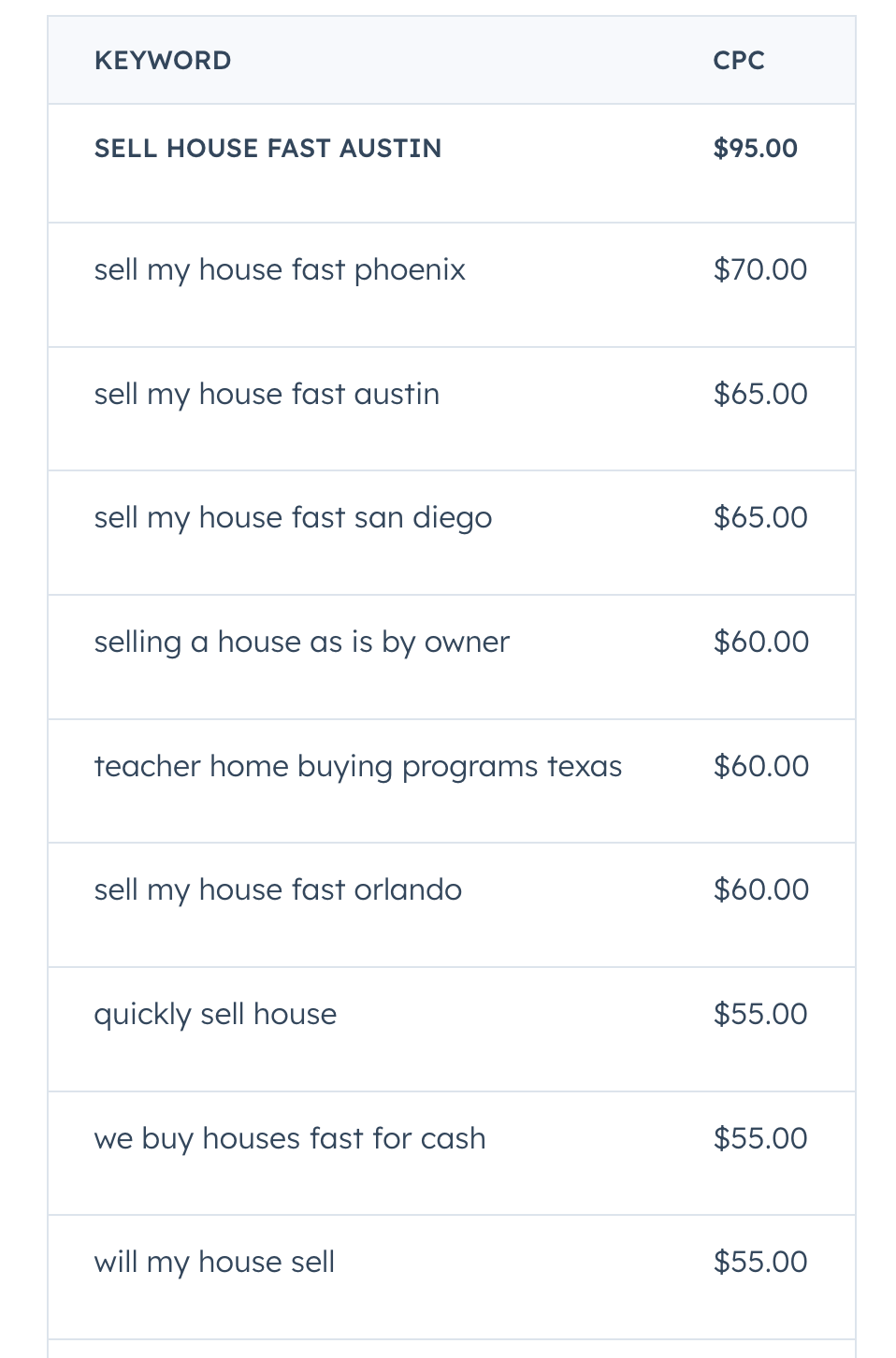
https://blog.hubspot.com/marketing/most-expensive-keywords-google
Have you seen how much it costs per click for real estate PPC campaigns?! YIKES!
The competition is even more complicated online, where the first page of search results determines who gets the clicks and leads. In this digital age, businesses need to have an online presence to stay relevant, and realtors are no exception. Realtors who want to acquire leads and grow their business need to invest in SEO services. SEO is essential for real estate businesses to get their websites ranking high on search engines like Google. In this blog post, we will discuss the importance of SEO services for realtors.
1. Boost website traffic and generate more leads
SEO services optimize your website to rank higher in search engines, increasing traffic to your website. SEO services help you generate relevant leads that are interested in your properties, making it less time-consuming and more cost-effective to acquire new leads.
2. Stay Ahead of the Competition
Real estate businesses have many competitors, and SEO services can help your business stand out. SEO experts can help you target specific keywords that are relevant to your business, making it easier for potential clients to find your website. When your website is optimized correctly, and you have a higher search engine ranking, you will be more visible to potential customers. This visibility is essential for your business’s continued success.
3. Cost-Effective Marketing
One of the most significant advantages of SEO is that it is cost-effective than traditional marketing. SEO services are an investment that can provide a positive return on investment. SEO services can keep your website optimised for long periods, making it more sustainable and cost-effective in the long run.
4. Better User Experience
SEO is focused on improving user experience on your website. SEO services optimize your website’s functionality, make it easier for users to navigate, and make relevant information about your properties easier to find. This improved user experience can lead to increased engagement, better customer retention, and, ultimately, better conversion rates.
5. Increased Credibility
Having a website that ranks high in search engines can boost your business’s credibility. Clients trust businesses that have a visible online presence and rank higher on search engines. Investing in SEO services can help increase your online visibility and brand credibility.
In conclusion, SEO services are essential for realtors who want to continue growing their business and stay relevant in this digital age. The benefits of SEO services for real estate businesses are vast, from increased traffic to higher credibility, SEO services are an investment that can provide long-term benefits for your business. So if you’re looking to stay ahead of the competition, generate more leads, and increase your online credibility, then consider investing in SEO services today!
Tired of seeing your business go unnoticed on the web?
This San Diego SEO firm can help you turn that around. We have the knowledge and expertise to make sure that your website is seen by more people, leading to a greater return on investment for you! Start generating leads with my San Diego SEO company today.
Imagine having more customers and reaching new heights as an online business – let us be a part of that journey by helping discoverability, increase traffic and ultimately grow your bottom line.
Take this exciting opportunity now – call (619) 719-1315 or visit our website for consultation about how we can get started! Don’t miss out – start growing your business with Jen Ruhman SEO today!
FAQ Section
Q: Why should I do SEO when I can just use Zillow or Redfin? A: Zillow is a “walled garden.” You are competing with every other agent on that platform for the same lead. SEO builds your brand. When a lead finds your site directly, you own that relationship 100%, and you aren’t paying a “referral fee” for your own hard work.
Q: What is “Lifestyle Search” and why does it matter? A: In 2026, people don’t just search for “3-bedroom houses.” They search for lifestyles. Optimizing for terms like “San Diego homes with EV charging” or “pet-friendly condos near Balboa Park” captures high-intent buyers that the big portals often miss.
Q: Can SEO help me get more listings (Sellers)? A: Absolutely. Seller leads are the most expensive in Google Ads (often $100+ per click). By creating “Market Report” content and “Home Valuation” guides for specific San Diego zip codes, you can capture sellers organically for a fraction of the cost.