
By Jen Ruhman, SEO Expert in San Diego
Most Business Owners Think SEO Is One Big Thing
One of the biggest misconceptions I hear from business owners is that successful SEO comes from finding one secret strategy.
Maybe it’s the perfect keyword.
Maybe it’s publishing one amazing blog post.
Maybe it’s getting a few backlinks.
Or maybe it’s surviving the next Google algorithm update.
After more than 20 years working in SEO, I can confidently tell you that’s almost never how it works.
The websites that consistently rank well don’t usually succeed because they discovered one magic trick.
They succeed because they make hundreds of smart decisions over time.
Every page becomes a little more helpful.
Every internal link strengthens another page.
Every piece of content has a purpose.
Every technical improvement makes the website a little easier for Google to understand.
Those improvements compound.
That’s what creates long-term organic growth.
One campaign that reinforced this philosophy for me was a fertility clinic I worked with throughout 2025. Our goal wasn’t to chase shortcuts or temporary ranking spikes. Instead, we focused on building a stronger website month after month.
Rather than asking, “What’s the fastest way to rank?”
We asked,
“What’s the next best improvement we can make?”
That simple shift in thinking changed everything.
If you’ve read my article about why publishing more blogs doesn’t always improve SEO, you’ll know I believe content is only one piece of a much larger strategy.
Likewise, building topical authority isn’t about writing hundreds of random articles. It’s about helping Google clearly understand what your website is an expert in.
Those ideas guided almost every decision I made during this campaign.
Small Improvements Add Up
One of my favorite things about SEO is that success usually isn’t dramatic.
It’s gradual.
Most people imagine rankings looking like this:
⬆️
Instead, they usually look more like a staircase.
One improvement creates a small gain.
That gain creates another opportunity.
Then another.
Eventually you look back six months later and realize how much progress has been made.
That’s exactly what happened here.
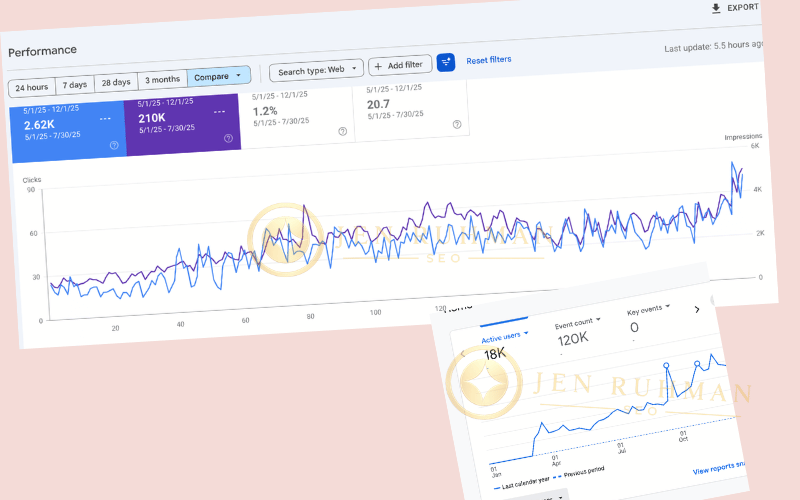
As we continued improving the website throughout the year, Google Search Console began showing something I always like seeing:
Steady increases in impressions.
Steady increases in clicks.
Not random spikes.
Not temporary success.
Consistent growth.
One thing I appreciate about this graph is that it reflects trust.
Google doesn’t suddenly decide your website is amazing overnight.
Trust is earned.
The more consistently you improve a website, the easier it becomes for Google to recommend it.
That’s why I rarely obsess over rankings from one month to the next.
I’m looking for momentum.
And that’s exactly what we started seeing.
I Didn’t Start by Writing More Blog Posts
This surprises people.
Whenever a business contacts me, they often assume the first thing I’m going to recommend is writing more blog articles.
Sometimes that’s true.
But many times it isn’t.
Before I recommend creating anything new, I want to understand whether the existing website is already providing the best possible experience.
Can visitors quickly find what they’re need?
Are important pages easy to navigate?
Are service pages answering the questions customers actually have?
Is Google able to understand how the website is organized?
Only after answering those questions do I decide where new content fits into the strategy.
I’ve worked on websites with hundreds of blog posts that generated very little business.
I’ve also worked on websites with fewer than fifty carefully planned pages that consistently outperformed much larger competitors.
The difference wasn’t how much content existed.
It was the strategy behind it.
That’s why I always tell clients:
Publishing content is important.
Building an SEO strategy is even more important.
I Focused on Improving Existing Pages First
One of the biggest opportunities on almost every website is the content that’s already there.
It’s easy to become excited about creating something new.
It’s much less exciting to improve an article that was written two years ago.
But that’s often where some of the biggest gains happen.
Throughout this campaign, I reviewed existing pages with fresh eyes.
Instead of asking,
“How can we make this page longer?”
I asked questions like:
- Is this answering the visitor’s question?
- Is anything repetitive?
- Are we making the page harder to understand?
- Does every section deserve to stay?
- Could this information be organized better?
Sometimes the answer was adding content.
Other times it was removing it.
Google isn’t awarding points for word count.
Google wants to recommend pages that genuinely help people.
That’s a very different mindset.
I often tell clients that every sentence should earn its place.
If it doesn’t make the page more useful, I question whether it belongs there at all.
One of the reasons this approach works so well is because it improves both SEO and user experience at the same time.
Visitors don’t have to dig through unnecessary information.
Google doesn’t have to guess what the page is about.
Everyone wins.
I Reorganized Headings Around Real Patient Questions
One thing I’ve noticed over the years is that many websites are written for search engines instead of people.
You’ll see headings that sound robotic because someone thought repeating the same keyword over and over would help rankings.
Fortunately, Google has become much better at understanding natural language.
People don’t search the way they did ten years ago.
Instead of typing a few disconnected keywords into Google, they’re asking complete questions.
They’re looking for answers.
That means the structure of a page matters just as much as the content itself.
Throughout this campaign, I spent time reorganizing headings so they reflected the questions prospective patients were actually asking.
Instead of thinking,
“How do I fit this keyword into a heading?”
I asked,
“If I were visiting this page, what question would I want answered next?”
That small change completely shifts how you write.
Clear headings make pages easier to scan.
They improve the user experience.
They also help Google understand the hierarchy of information on a page.
I often remind clients that people don’t read websites from top to bottom.
They skim first.
Good headings allow visitors to quickly decide whether a page contains the information they’re looking for.
If they stay longer because they immediately find relevant information, that’s a better experience for everyone.
Internal Linking Became One of the Most Important Parts of the Strategy
If I had to pick one SEO task that’s consistently overlooked, it would probably be internal linking.
It’s not glamorous.
Nobody talks about it on social media.
But it makes an enormous difference.
Most businesses publish a blog post, click Publish, and never think about it again.
I take a completely different approach.
Every new page becomes another opportunity to strengthen the rest of the website.
As the fertility clinic continued publishing educational content, I looked for opportunities to connect related topics together.
A page discussing fertility testing could naturally link to another page explaining treatment options.
An article answering a common patient question could support an important service page.
Those connections help visitors continue learning without having to search for the next piece of information themselves.
At the same time, they help Google understand how your website is organized and which pages are most important.
I often compare internal linking to a city’s road system.
Imagine if every building existed without roads connecting them.
You’d eventually find your destination, but it would be frustrating.
Websites work the same way.
Internal links create pathways.
They guide visitors naturally through your content while reinforcing relationships between pages.
If you’re interested in learning more about why this matters, I wrote another article explaining how internal linking improves SEO and why it’s one of the first things I evaluate during a website audit.
One of the biggest mistakes I see is businesses creating dozens of articles that never support each other.
That’s a missed opportunity.
Every page should help strengthen another page.
We Built Topic Clusters Instead of Publishing Random Content
This was probably the biggest shift throughout the campaign.
I wasn’t interested in creating content simply because we needed another blog post that month.
Every article had a job.
Every page needed a reason to exist.
Rather than covering unrelated subjects, we focused on answering the questions prospective fertility patients naturally ask throughout their journey.
One article led to another.
One question created the opportunity to answer the next question.
Over time, those individual pages became something much more valuable.
They became a complete resource.
This is what people are referring to when they talk about topical authority.
It’s one of my favorite concepts in modern SEO because it mirrors how people naturally learn.
When you’re researching an important decision, you rarely read one article and stop.
You continue exploring.
You ask another question.
Then another.
Google wants to recommend websites that can continue helping people throughout that process.
That’s why I spend far more time planning content than simply writing it.
Every page should strengthen another page.
Every topic should reinforce the overall expertise of the website.
If you’re curious about how this works, I recently published a guide explaining what topical authority is and why it’s becoming increasingly important for businesses that want to compete in Google and AI search.
One thing I tell clients all the time is this:
Publishing more content isn’t the goal.
Publishing content that supports a larger strategy is.
FAQ Sections Weren’t Added for Google—They Were Added for Patients
There’s a common misconception that FAQ sections exist purely for SEO.
That’s never been my philosophy.
I add FAQs because real people have real questions.
Throughout the campaign, I noticed patterns.
Patients were asking many of the same things before scheduling appointments.
Instead of burying those answers in long paragraphs, I created dedicated FAQ sections where they made sense.
The result was a better experience for visitors because they could quickly find the information they were looking for.
Whenever appropriate, I also implemented FAQ structured data to give search engines additional context about the content.
Notice I said additional context.
Not better rankings.
Structured data isn’t a magic ranking factor.
Think of it like labeling the chapters in a book.
The story hasn’t changed.
It’s simply easier to understand.
The same principle applies to schema markup.
It helps organize information.
That’s why I often recommend combining schema with helpful, well-structured content instead of treating it like an SEO shortcut.
In fact, if you’d like to learn more about structured data, I have another article that explains schema markup strategies for SEO in much more detail.
One Improvement Rarely Changes Everything
This campaign reminded me of something I’ve believed for years.
People love looking for the one thing that changed everything.
The reality is usually much less exciting.
There wasn’t one magical update.
There wasn’t one keyword that suddenly transformed the website.
There wasn’t one blog post that doubled the traffic overnight.
Instead, there were dozens of thoughtful improvements.
Each one made the website a little stronger.
Each one supported the others.
Those improvements compounded over time.
That’s why I always encourage business owners to think about SEO as an investment rather than a project.
You’re building an asset.
Every improvement makes the next improvement more valuable.
Eventually, those small gains become difficult for competitors to catch.
The Results
By the end of our work together, the website wasn’t just ranking for more keywords.
It was attracting more people.
More importantly, it was attracting the right people.
Throughout the campaign, we saw steady improvements in both Google Search Console and Google Analytics.
Organic impressions continued increasing.
Organic clicks followed.
Website traffic grew consistently over time.
One thing I always tell clients is that I’m much more interested in seeing consistent upward trends than sudden spikes.
A viral article might create one great month.
A strong SEO strategy creates years of growth.
That’s exactly what I strive for.
One of the reasons I love SEO is because it’s cumulative.
Every improvement makes the next improvement a little more effective.
Every helpful page supports another.
Every internal link strengthens the website.
Every technical enhancement makes Google’s job a little easier.
Eventually those improvements compound into measurable growth.
That’s much more rewarding than chasing temporary wins.
What I Would Do Differently Today
One of the things I enjoy most about working in SEO is that I’m constantly learning.
Google changes.
Search behavior changes.
AI is changing the way people discover information.
Because of that, my process continues to evolve.
If I were starting this same campaign today, there are a few things I’d do even earlier.
I’d use AI as a research assistant to help organize information and identify content opportunities faster.
I would spend even more time building topical clusters from the very beginning instead of expanding them gradually.
I’d monitor visibility across AI search experiences—not just traditional Google rankings.
And I’d place an even stronger emphasis on entity relationships and structured content to help search engines and AI platforms better understand the website’s expertise.
One thing that wouldn’t change?
My philosophy.
I still believe the best SEO comes from helping real people.
Algorithms evolve.
Helpful websites continue winning.
The Biggest Lesson I Learned
If someone asked me what made the biggest difference during this campaign, my answer probably wouldn’t be what they’re expecting.
It wasn’t one keyword.
It wasn’t one backlink.
It wasn’t one blog post.
It wasn’t one technical fix.
It was the strategy.
Every decision supported another.
Content supported service pages.
Internal links supported topical authority.
Technical SEO supported user experience.
Structured data supported Google’s understanding of the website.
Nothing existed in isolation.
That’s how I approach every SEO campaign.
Because SEO isn’t really about rankings.
Rankings are simply the result of building a website that deserves to be found.
That’s the difference between chasing Google…
…and earning Google’s trust.
Frequently Asked Questions
How long does SEO take before you see results?
SEO is a long-term marketing strategy.
While some improvements can have an impact relatively quickly, the strongest results usually come from making consistent improvements over several months. Every website is different, which is why I focus on building sustainable growth rather than promising unrealistic timelines.
Can removing content actually improve SEO?
Absolutely.
One of the biggest misconceptions in SEO is that longer always means better.
If content is repetitive, confusing, or doesn’t answer the visitor’s question, simplifying the page often creates a much better user experience.
Quality almost always wins over quantity.
Is publishing more blog posts enough to improve rankings?
Publishing helpful content is an important part of SEO, but it’s only one piece of the puzzle.
Without a clear strategy, internal linking, technical optimization, and topical authority, even great articles can struggle to perform.
If you’d like to learn more about that philosophy, I recently wrote about why publishing more blogs doesn’t always improve SEO.
Why is internal linking so important?
Internal links help both visitors and search engines understand how your website is organized.
They’re one of the simplest ways to strengthen important pages while creating a better browsing experience.
I discuss this in more detail in my guide to internal linking for SEO.
Does AI replace SEO?
No.
AI has become an incredible tool for research, brainstorming, and improving efficiency.
I use it in my own workflow every day.
But AI doesn’t understand your business goals.
It doesn’t prioritize opportunities.
It doesn’t decide which pages deserve attention first.
Strategy still requires experience and human judgment.
That’s why I believe AI makes SEO professionals more effective—not obsolete.
You may also enjoy my article about why AI can’t replace SEO strategy.
Final Thoughts
One of the reasons I wanted to share this campaign wasn’t to highlight impressive graphs.
It was to show how real SEO actually works.
Most successful websites don’t grow because of one extraordinary decision.
They grow because someone consistently makes good decisions over time.
That’s what I enjoy most about my work.
Looking beyond today’s rankings.
Finding opportunities competitors overlook.
Building websites that become stronger every single month.
After more than 20 years working in SEO, that’s still what excites me.
Helping businesses build something that lasts.
About This Case Study
This article is based on SEO work I performed for Aphrodite Fertility throughout 2025. We are no longer working together, but the campaign provides a great example of how consistent, strategic SEO improvements can compound over time.
Curious What I’d Recommend for Your Website?
Every website has opportunities for improvement.
Sometimes they’re technical.
Sometimes they’re content-related.
Sometimes they’re as simple as reorganizing existing pages or strengthening internal links.
The challenge isn’t finding something to improve.
It’s knowing what to prioritize first.
That’s where experience makes a difference.
If you’re wondering why your website isn’t attracting more qualified leads—or you’d simply like a second opinion on your current SEO strategy—I’d be happy to review it.
Whether you’re a local business in San Diego or serve customers nationwide, my goal is always the same: build an SEO strategy that’s designed for long-term growth, not short-term tricks.
If that sounds like the kind of approach you’re looking for, I’d love to learn more about your business.
Schedule Your Free SEO Consultation
Related Articles
If you found this case study helpful, here are a few other articles you might enjoy:
What Is Topical Authority? A Simple Guide for Business Owners
Why Publishing More Blogs Doesn’t Always Improve SEO
Why Some Websites Rank for Hundreds of Keywords (And Others Don’t)