
Sep 11, 2023 | SEO Tips
SEO Strategies for Therapists to Grow Website Traffic
As a therapist, it is important that you make sure your website can be found by potential clients. A good SEO strategy will help you reach more people and grow traffic to your website. There are several elements to creating an effective SEO strategy for therapists, including keyword research and content creation. Let’s take a look at what makes up a good SEO strategy for therapists.
Keyword Research
The first step of any effective SEO strategy is keyword research. Keywords are words or phrases that potential clients may use when searching for a therapist online. For example, someone searching for a “therapist near me” is likely looking for a therapist in their local area. Knowing the keywords that potential clients may use when looking for a therapist is key to making sure your website gets found in search engine results.
Content Creation
Once you have identified keywords related to the services you provide as a therapist, the next step is creating content that incorporates those keywords into your website and blog posts. This content should be informative and relevant to potential clients so that they can find the information they need quickly and easily. Additionally, using keywords in your content helps search engines understand what your website is about and rank it higher in search results pages (SERPs).
Prioritizing Specialized Therapies and Developing Targeted Landing Pages
For practitioners looking to enhance their online presence, a successful model can be seen with a client of ours who operates a practice in San Diego. They recognized the importance of more than just listing the range of conditions they treat on their website.
Instead, the emphasis should be on creating specialized landing pages that align with specific search terms, such as “teenage psychiatric care“. These pages should provide comprehensive information about the respective treatment, demonstrate their expertise, address commonly asked questions, and showcase their approach to treating teens with mental health challenges.
The objective of these tailored landing pages is twofold: to achieve higher rankings on search engines like Google and to offer valuable insights to potential clients, ultimately driving conversions and establishing a trustworthy digital presence.
Optimizing Your Website
Your website should also be optimized correctly so that it can be crawled by search engine bots easily and accurately. This includes making sure all images are properly labeled with alt-text, titles, descriptions, etc., as well as making sure all page headings are formatted correctly using HTML tags such as H1s or H2s. All of these elements contribute to helping search engines understand what your website is about and how it should rank in SERPs for certain searches related to therapy services.
Following an effective SEO strategy can drastically improve how well-known your therapy services become online by increasing visibility on SERPs and improving the overall user experience on your website or blog. Optimizing your webpages with keyword-rich content will ensure that potential clients find the information they need quickly while optimizing other elements like images will help search engine bots crawl and index your site accurately so it shows up higher on SERPs when people are searching for therapy services near them. By taking these steps toward an effective SEO strategy, you can gain more website traffic than ever before!
Are you looking for monthly SEO services to improve your therapy website’s ranking?
Jen Ruhman SEO is an SEO company in San Diego – the perfect choice for you! We have over 20 years of experience in the industry and can help your website rank higher in search engines like Google, Yahoo, and Bing.
Higher website rankings mean more potential patients for you! Let us help you get there with our monthly SEO services.
Sign up today for a free consultation with one of our experts!

Sep 8, 2023 | SEO Tips
How to Find Long-Tail Keyword Ideas
You don’t need to guess which long-tail keywords people might use. There are several places I look for real search language and topic ideas.
Google Autocomplete
Start typing your main service or topic into Google and pay attention to the suggestions that appear. These can reveal more specific ways people search around the broader topic.
People Also Ask and Related Searches
Google’s search results can reveal related questions and searches that help you understand what people want to know before, during, and after searching for your primary topic.
Google Search Console
For an established website, this is one of my favorite sources because you’re looking at queries for which Google is already showing your pages. You can often discover valuable long-tail variations that traditional keyword research didn’t uncover.
Customer Questions
Pay attention to the language potential customers use in emails, phone calls, consultations, reviews, and contact forms.
If several customers keep asking the same specific question, there’s a good chance other people are searching for it too.
Competitor Research
Review the topics and searches your competitors appear for, but don’t simply copy their content strategy. Look for questions they haven’t answered well or areas where you can provide more useful information based on your own experience.
Reddit, Forums, and Online Discussions
Online discussions can be useful for discovering how real people describe their problems in their own words. I use these sources for topic research and customer-language insights rather than simply copying phrases into an article as keywords.
Keyword Research Tools
Tools such as Semrush, Ahrefs, and Google Keyword Planner can help expand a seed keyword into related searches and provide additional data about demand and competition.
However, I don’t let a keyword tool make the final content decision for me.
The keyword still needs to have the right search intent and fit logically somewhere within the website’s existing keyword map.

Sep 5, 2023 | SEO Tips
Not every keyword is equally valuable.
Some keywords can bring thousands of visitors to your website and generate almost no business.
Other keywords may have far less search volume but attract people who are actively looking for exactly what you sell.
Those are what I think of as money keywords.
I’ve worked in SEO for more than 20 years, and one of the biggest mistakes I see businesses make is focusing too heavily on search volume.
A keyword with 10,000 searches per month might look impressive in a report.
But if the people searching it aren’t potential customers, that traffic may have very little value.
I would rather rank a business for a smaller group of highly relevant searches with strong buying intent than attract thousands of visitors who will never convert.
In this guide, I’ll explain how I identify money keywords, how they differ from informational searches, and how I decide which keywords deserve the most attention in an SEO strategy.
Table of Contents
Quick Answer: What Are Money Keywords?
Money keywords are search terms that are closely connected to a potential sale, lead, consultation, booking, or other valuable business action.
They usually indicate that the searcher is further along in the buying process.
Examples might include:
- SEO company San Diego
- Personal injury lawyer San Diego
- Financial advisor near me
- Spray tan Encinitas
- Hair transplant Los Angeles
- Best local SEO company
- Book a personal trainer near me
Compare those with informational searches such as:
- What is SEO?
- How does a hair transplant work?
- What is retirement planning?
- What is a spray tan?
Those informational keywords can still be valuable.
But they usually represent an earlier stage of the customer journey.
Money keywords are generally much closer to revenue.
Why Money Keywords Matter
SEO isn’t just about getting more traffic.
It’s about attracting the right traffic.
This is an important distinction.
You could rank #1 for a keyword that brings 5,000 visitors per month and still generate very little revenue.
Meanwhile, another page might attract only 100 visitors but generate several qualified leads.
Which one is more valuable?
From a business perspective, the answer is usually obvious.
This is why I don’t judge an SEO campaign by traffic alone.
I want to understand:
- Which searches bring potential customers
- Which pages attract buying intent
- Which keywords lead to calls or form submissions
- Which services generate the most revenue
- Which searches are worth competing for
A successful SEO strategy connects rankings to business goals.
Start With Search Intent
The first thing I look at when evaluating a keyword is search intent.
Search intent is the reason behind the search.
What is the person actually trying to accomplish?
For example:
“What is SEO?”
This person is likely looking for information.
Now compare that with:
“SEO company San Diego”
This searcher may be actively comparing companies or preparing to hire someone.
Those two keywords should not be treated the same.
The second keyword has much stronger commercial intent.
This is why I think search intent is often more important than raw search volume.
I explain this concept in more detail in my guide to what search intent means for SEO.
Look for Commercial and Transactional Keywords
Money keywords usually fall into commercial or transactional search intent.
Commercial searches often indicate that someone is comparing options.
Examples include:
- Best SEO company San Diego
- Top financial advisor San Diego
- Best personal trainer near me
- SEO company reviews
- Local SEO pricing
- Best hair transplant clinic Los Angeles
Transactional searches usually indicate that someone is even closer to taking action.
Examples include:
- Hire SEO company San Diego
- Book spray tan Encinitas
- Schedule financial consultation
- Personal injury lawyer consultation
- Hair transplant financing Los Angeles
These searches can be extremely valuable because the person isn’t merely learning about the topic.
They’re considering taking action.
Identify Your Core Service Keywords
One of the first things I do when planning SEO for a business is identify the primary services that actually generate revenue.
Then I look for the searches customers use to find those services.
For example, an SEO company might target:
- SEO company San Diego
- Local SEO San Diego
- SEO consultant San Diego
- SEO services San Diego
- AI SEO San Diego
A law firm might focus on:
- Car accident lawyer San Diego
- Personal injury attorney San Diego
- Motorcycle accident lawyer San Diego
- Wrongful death attorney San Diego
A med spa might target:
- RF skin tightening San Diego
- Botox San Diego
- Microneedling San Diego
- Skin tightening near me
These are much more valuable than broad keywords such as “marketing,” “law,” or “skincare.”
The keyword should reflect the actual service someone is trying to buy.
Find Local Money Keywords
For local businesses, geographic keywords can be especially valuable.
Someone searching:
“personal trainer”
could be anywhere.
Someone searching:
“personal trainer San Diego”
has given us much more useful information.
They’ve told Google both what they want and where they want it.
Local money keywords may include:
- Service + city
- Service + neighborhood
- Service + near me
- Best service + city
- Company type + city
For example:
- SEO company San Diego
- Spray tan La Jolla
- Personal trainer Hillcrest
- Financial advisor San Diego
- Plumber near me
If local customers are important to your business, these keywords can become some of your most valuable targets.
You can learn more about how I approach this in my Local SEO guide for San Diego businesses.
Don’t Ignore Long-Tail Money Keywords
Long-tail keywords are longer, more specific search phrases.
They often have lower search volume.
That’s not necessarily a bad thing.
A highly specific search can reveal extremely strong intent.
Compare:
“SEO”
with:
“SEO company for small business in San Diego”
The second search has far more context.
The person has told us:
- They need SEO
- They’re looking for a company
- They run a small business
- They care about San Diego
That’s potentially a much more qualified visitor.
This is why I don’t dismiss a keyword simply because a keyword tool reports low search volume.
Sometimes the lower-volume keyword is much closer to a sale.
Use Google Search Console to Find Money Keywords You’re Already Ranking For
Keyword research tools are useful, but one of my favorite sources of keyword information is Google Search Console.
Why?
Because Search Console shows what Google is already connecting to your website.
I can look for queries that:
- Already generate impressions
- Already generate clicks
- Are associated with important service pages
- Have strong commercial intent
- Are beginning to rank but haven’t reached page 1
This data can uncover opportunities that keyword tools don’t always make obvious.
For example, I might find a service page receiving impressions for several variations of a keyword that weren’t originally part of the SEO plan.
That tells me Google already sees relevance.
Instead of creating another page, I may strengthen the page that’s already gaining visibility.
Look for Striking-Distance Keywords
Some of my favorite SEO opportunities are keywords already sitting close to page 1.
These are often called striking-distance keywords.
For example, if an important money keyword is ranking:
- Position 8
- Position 11
- Position 14
- Position 18
I want to investigate that before automatically creating something new.
Google already understands that the page is relevant.
Now the question becomes:
What is preventing it from moving higher?
The answer might involve:
- Search intent
- Content depth
- Internal linking
- Backlinks
- Topical authority
- Technical issues
- Competitor strength
I wrote a separate guide explaining why websites get stuck on page 2 of Google because these near-page-one keywords can be some of the best SEO opportunities available.
Analyze Competitor Keywords Carefully
Competitor research can be useful.
Tools such as Semrush and Ahrefs can show which keywords appear to drive traffic to competing websites.
But I don’t blindly copy a competitor’s keyword list.
Your competitor may rank for thousands of keywords that have nothing to do with your actual business goals.
I want to know:
- Which service keywords they’re ranking for
- Which pages bring commercial traffic
- Which local searches they dominate
- Which content supports their service pages
- Where their website has stronger topical authority
- Where they have gaps we can exploit
The goal isn’t to imitate everything a competitor does.
The goal is to understand the search landscape.
Map Each Money Keyword to the Right Page
This is where many SEO strategies fall apart.
Finding the right keyword isn’t enough.
You also need the right page targeting it.
I call this keyword mapping.
For example, if a company provides:
- Local SEO
- National SEO
- AI SEO
- Google Business Profile optimization
I wouldn’t necessarily try to make one page rank equally well for all four services.
Different search intents may deserve different pages.
At the same time, I don’t want five nearly identical pages competing for the same keyword.
Ideally, each important search intent has a clear primary page.
Supporting articles can then link into that page and strengthen the topic.
This structure helps avoid keyword cannibalization and makes it easier for Google to understand which URL should rank for which search.
Don’t Confuse Traffic Keywords With Revenue Keywords
This is one of the biggest lessons I want business owners to understand.
Traffic is not the same thing as revenue.
An informational blog post may generate thousands of visits.
That’s great if those visitors eventually discover your services.
But it doesn’t automatically make that keyword more valuable than a commercial keyword with 100 searches per month.
Suppose:
- Keyword A gets 5,000 searches per month and generates no leads
- Keyword B gets 150 searches per month and generates five new customers
Which keyword would you rather rank for?
This is why I care about qualified traffic.
SEO reports can look impressive when traffic increases dramatically.
But I want to know whether that visibility is connected to actual business opportunities.
Do Money Keywords Still Matter in AI Search?
Yes.
Search behavior is evolving, but customer intent hasn’t disappeared.
People still have problems they need solved.
They still compare businesses.
They still look for providers.
They still ask questions before making purchases.
What’s changing is where those searches happen.
People may now discover businesses through:
- Traditional Google results
- Google Maps
- AI Overviews
- ChatGPT
- Gemini
- YouTube
- Reddit
- Other discovery platforms
This is why I think modern keyword research needs to look beyond exact-match phrases.
I also want to understand the broader concepts and questions surrounding a service.
But the underlying goal remains the same:
Connect your business with people who have a need you can solve.
Money keywords still help us identify where that intent is strongest.
Common Money Keyword Mistakes
Choosing Keywords Only Because They Have High Search Volume
Search volume can be useful, but it shouldn’t make the decision for you.
A smaller commercial keyword can be worth far more than a massive informational keyword.
Ignoring Search Intent
A keyword might sound relevant while attracting the wrong type of visitor.
Always examine what Google currently ranks for the search.
That often reveals what type of content the search engine believes users want.
Trying to Rank One Page for Every Service
If your business provides multiple distinct services, forcing every keyword onto one page can weaken relevance.
Important services often need their own dedicated pages.
Creating Too Many Similar Pages
The opposite mistake is creating a separate page for every tiny keyword variation.
That can create thin pages and keyword cannibalization.
Ignoring Existing Rankings
Before creating a new page, check whether an existing page already ranks for the keyword.
Improving the existing URL may be far more effective.
Ignoring Conversion Value
A keyword isn’t valuable simply because you rank for it.
The ultimate question is whether it helps attract potential customers.
How I Prioritize Money Keywords
When I’m deciding which keywords deserve the most SEO attention, I consider several things together.
- Business value: Does this search relate to a profitable service?
- Search intent: Is the person likely researching, comparing, or ready to buy?
- Relevance: Does the business genuinely provide what the person wants?
- Current rankings: Are we already close to page 1?
- Competition: What will it realistically take to compete?
- Location: Is geographic intent important?
- Conversion potential: Could this search realistically become a lead or customer?
I don’t believe one keyword metric can answer all of those questions.
That’s why keyword research is part data and part strategy.
Want to Find the Keywords That Can Actually Grow Your Business?
If you’re ranking for keywords but those rankings aren’t generating meaningful business—or you’re not sure which keywords you should be targeting—I can help.
I’ve worked in SEO for more than 20 years and help businesses identify the searches that matter most, map those searches to the right pages, improve existing rankings, and build stronger organic visibility over time.
As a San Diego SEO expert, I focus on attracting qualified search traffic rather than chasing vanity metrics.
Learn more about my San Diego SEO services and request a consultation.
Frequently Asked Questions About Money Keywords
What is a money keyword in SEO?
A money keyword is a search term closely connected to a potential purchase, lead, consultation, booking, or other valuable business action. These keywords often have commercial or transactional intent and can be more valuable than informational keywords with higher search volume.
How do I find money keywords for my business?
Start by identifying your most valuable products or services and the searches customers would use when actively looking for them. Review commercial intent, local modifiers, Google Search Console queries, competitor rankings, long-tail searches, and keywords already ranking close to page 1.
Are high-volume keywords always the best keywords?
No. High search volume does not automatically mean high business value. A lower-volume keyword with strong purchase intent can generate more revenue than a high-volume informational keyword that attracts visitors who are not potential customers.
What is the difference between a money keyword and an informational keyword?
A money keyword usually indicates stronger buying or commercial intent, while an informational keyword is primarily used by someone trying to learn about a subject. Both can be valuable, but money keywords are generally closer to a business conversion.
Are local keywords considered money keywords?
They often can be. Searches that combine a service with a city, neighborhood, or “near me” modifier frequently indicate that someone is actively looking for a local provider, which can make those searches highly valuable for local businesses.
Should I target long-tail money keywords?
Yes. Long-tail keywords often have lower search volume but can reveal stronger intent because the searcher is being more specific about what they want. These searches can attract highly qualified visitors.
Can Google Search Console help find money keywords?
Yes. Google Search Console shows the queries your website is already receiving impressions and clicks for. Reviewing commercially relevant queries and keywords ranking near page 1 can uncover valuable SEO opportunities.
Should every money keyword have its own page?
No. Each distinct search intent should generally have a clear primary page, but closely related keyword variations can often be targeted together. Creating too many nearly identical pages can lead to thin content and keyword cannibalization.
Do money keywords still matter with AI search?
Yes. AI search changes how people discover information and businesses, but commercial intent still exists. People continue to search for products, services, providers, comparisons, and solutions, so identifying valuable customer intent remains an important part of SEO strategy.
Aug 31, 2023 | Case Study, SEO Tips
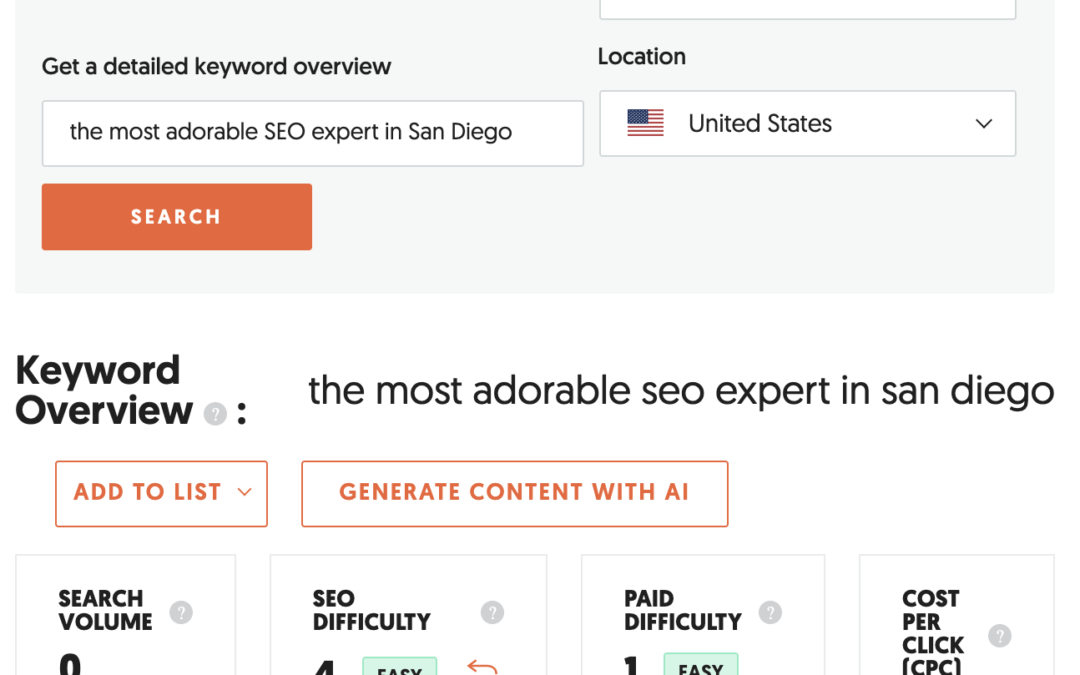
In the bustling world of SEO, there’s a hidden secret that many aren’t aware of. Somewhere in the heart of San Diego, there’s an SEO expert who’s not just skilled, but also the most adorable one you’ll ever meet. But wait, before you rush to Google to find this expert, let me tell you a secret: “the most adorable SEO expert in San Diego” is a keyword that has a monthly search volume of… wait for it… zero.
Don’t let SEO companies promise to rank you for keywords that don’t get any searches!
And whatever you do, don’t let them boast about it like they’re doing you a huge favor. They’re not rockstars.
Do you know how many consultations I have with potential clients that say they’re ranking for crappy keywords? Too many.
They mentioned they’re not happy with the current SEO agency they’re working with.
I hear mostly:
we’ve been working with a popular SEO company and we’re not seeing any improvements at 6 months into it the process no keywords have moved except this one ….. (and it’s always the one with zero search volume.)
That’s right, not a single person is searching for this term: screenshot
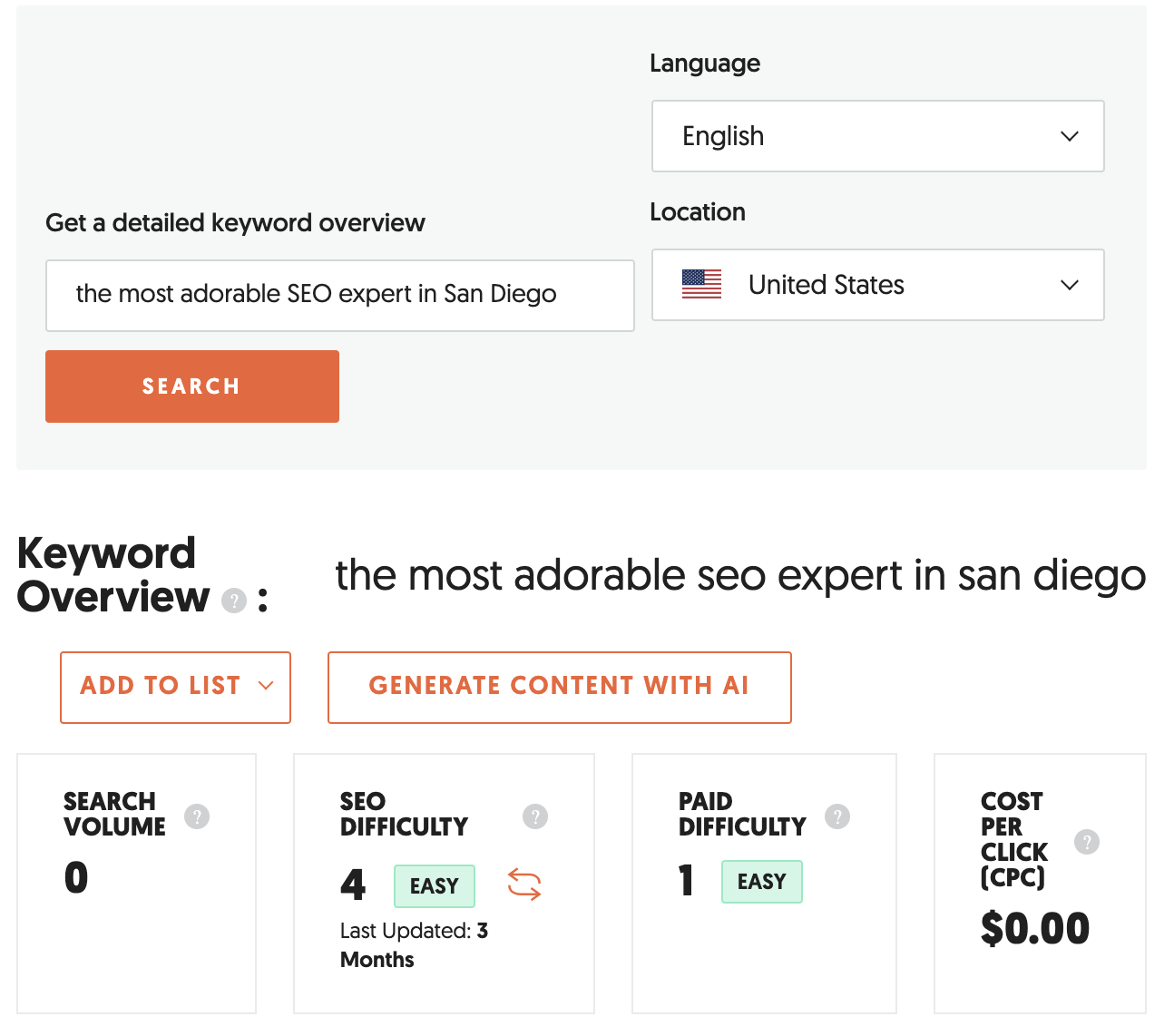
Now, you might be wondering, why are we even talking about a keyword that no one is searching for? The answer lies in a common tactic some SEO companies use to keep their clients hooked.
The Zero-Search Volume Keywords Trap
In the vast ocean of keywords, there are those high-volume ones that everyone wants to rank for. Think “best smartphones 2023” or “top holiday destinations.” These are the keywords that can drive massive traffic to your website. But then, there are the “most adorable SEO expert in San Diego” type of keywords. These are terms that, quite frankly, no one is searching for. Their monthly search volume is a big, round zero.
Some SEO companies, in an attempt to show quick wins and keep clients on a monthly retainer, will boast about how they can rank your website for such keywords. “Look,” they’ll say, “we got you to the number one spot for ‘the most adorable SEO expert in San Diego’!” While it might sound impressive at first, when you dig a little deeper, you’ll realize the hollow victory. After all, what’s the point of ranking first for a term that no one is searching for?
Why Checking Keyword Volume is Crucial
Your SEO strategy should always be rooted in data. One of the most critical data points? Search volume. Before you invest time and resources into ranking for a keyword, you need to know how many people are actually searching for it.
If you’re targeting keywords with zero search volume, you’re essentially trying to sell ice to Eskimos. It’s a futile effort that won’t drive any meaningful traffic or conversions.
In Conclusion
While the idea of being the top result for “the most adorable SEO expert in San Diego” might sound cute, it’s essential to see through the smoke and mirrors of SEO promises. Always base your strategy on data, and be wary of anyone who boasts about rankings without showing the search volume to back it up.
Remember, in the world of SEO, it’s not just about ranking; it’s about ranking for the right terms. So, the next time someone promises you the moon with keywords that sound too good (or too quirky) to be true, take a moment to check their search volume. Your SEO strategy will thank you.
Was this a fun blog post or what? Now I get to casually say to potential clients….I rank for the most adorable SEO expert in San Diego. And who wouldn’t want to rank for that? Nobody! LOL.
Tired of Watching Your Website Languish in Search Results?
Discover the magic touch of Jen Ruhman SEO! As San Diego’s premier SEO specialists, we don’t just promise results – we deliver them. With our deep-rooted expertise, we’re committed to catapulting your business to the digital limelight.
Transparent Progress Reports: Every month, receive a detailed breakdown of our strategic moves and their impact on your rankings. Witness the tangible growth and track every penny of your investment.
Stay Ahead, Stay Informed: We believe in a partnership where you’re not just a client but an integral part of the journey. As your business scales new heights, we ensure you’re always in the driver’s seat, fully informed.
Let’s Ignite Your Growth: Ready to transform your digital presence? Reach out for a no-obligation consultation. We’re eager to chart out your success story.
Dial or Text: (619) 719-1315. Talk to Jen directly.
For a brighter digital tomorrow, choose Jen Ruhman SEO.

Aug 28, 2023 | SEO, SEO Tips
Publishing more content doesn’t automatically improve SEO.
I’ve worked on SEO for more than 20 years, and one of the biggest mistakes I see businesses make is assuming that every new blog post gives Google another reason to rank their website.
That’s not necessarily how it works.
A website can have hundreds of blog posts and still struggle with organic traffic if those articles target the wrong keywords, overlap with existing pages, don’t satisfy search intent, or aren’t connected to the site’s broader SEO strategy.
In fact, sometimes the best SEO decision isn’t publishing another article at all. It’s improving a page you already have.
Here’s how I approach SEO content today.
Quick Answer: SEO content should answer a specific search intent, target a clearly defined topic, provide genuinely useful information, demonstrate experience or expertise, and fit logically within the rest of your website. Strong internal linking and regular content updates can make that content even more valuable.
Table of Contents
What Is SEO Content?
SEO content is content created to help people while also making it easier for search engines to understand what a page is about and when it should appear in search results.
That could include:
- Service pages
- Blog posts
- Location pages
- Guides
- FAQs
- Case studies
- Comparison pages
- Industry-specific resources
The important distinction is that SEO content shouldn’t exist simply because someone told you that you need to publish a certain number of blog posts every month.
Every page should have a reason to exist.
1. Start With Search Intent, Not Just a Keyword
Before I create a new page, I want to understand why someone is searching for that topic.
This is called search intent.
Someone searching for:
“what is local SEO”
is probably looking for information.
Someone searching for:
“local SEO company San Diego”
is much more likely to be evaluating companies that provide the service.
Those searches shouldn’t necessarily lead to the same type of page.
The first might be best served by an educational guide. The second is better suited to a commercial service page.
This is why I don’t start an SEO content strategy by simply collecting hundreds of keywords from a keyword research tool.
I first determine what the searcher wants and what type of page should satisfy that search.
2. Give Every Important Page a Purpose
Before creating a lot of content, I recommend building a keyword map.
A keyword map assigns important topics and search intents to specific pages on your website.
For example, an SEO company’s website might have separate pages targeting:
- SEO services
- Local SEO
- AI SEO
- SEO pricing
- Specific locations
- Specific industries
Supporting blog posts can then answer narrower questions related to those core topics.
This creates a much more organized website than publishing dozens of disconnected articles and hoping Google figures out which page should rank.
3. Create Something Genuinely Useful
Before publishing an article, ask yourself a simple question:
Would I be satisfied with this page if I were the person searching for this information?
If the answer is no, the page probably isn’t finished.
Useful SEO content might include:
- A direct answer near the beginning
- Clear explanations
- Step-by-step instructions
- Real examples
- Original observations
- Common mistakes
- Comparisons
- Photos or screenshots when useful
- Frequently asked questions
- Links to relevant supporting resources
Don’t add sections just to make an article longer.
I’d rather publish 1,000 words that completely answer the question than 3,000 words padded with repetitive information.
4. Add Firsthand Experience Whenever You Can
This has become increasingly important in the type of SEO content I create.
There is an enormous amount of generic information online. AI tools have made it even easier to produce articles that sound polished but don’t contain anything particularly original.
Your actual experience is something competitors can’t duplicate as easily.
If you’ve worked with customers, solved the problem you’re discussing, tested a strategy, or learned something from experience, include that perspective.
For example, instead of simply writing:
“Internal linking is important for SEO.”
I can explain how I use older blog posts to strengthen important service and location pages, or how I’ve consolidated overlapping articles when I believe two URLs are competing for essentially the same search intent.
That’s much more useful than repeating a definition found on hundreds of other websites.
5. Use Keywords Naturally
Keywords still matter because they help clarify the subject of a page.
But that doesn’t mean repeating the same phrase twenty times.
I generally want the primary topic to be clear in important places such as:
- The page title
- The H1
- The introduction
- Relevant headings
- The body content
- Internal anchor text where appropriate
- The meta title and description
From there, I write naturally and use related terminology when it helps explain the topic.
If you’re trying to determine which searches have the greatest business value, my guide to finding your money keywords explains how I think about keyword value and conversion intent.
6. Cover the Topic Thoroughly Without Adding Fluff
SEO content should usually answer the natural follow-up questions someone might have about the topic.
For example, an article about Local SEO might naturally discuss:
- Google Business Profiles
- Google Maps
- Reviews
- Local keywords
- Location pages
- Local citations
- On-page optimization
That doesn’t mean every Local SEO article needs to explain every one of those subjects in depth.
The goal is to cover enough of the topic to satisfy the page’s particular search intent and then link readers to deeper resources where appropriate.
7. Use Internal Links Strategically
Internal linking is one of the most underused SEO opportunities I see on established websites.
When I publish a new article, I don’t only think about links going from the new article.
I also look for older pages that could logically link to it.
This helps create relationships between related content.
More importantly, supporting informational articles can point toward the commercial pages that matter most to the business.
For example, articles about Google Maps, Google Business Profiles, reviews and local keyword research can naturally support a site’s main Local SEO services page.
Internal links should make sense to the reader. I don’t recommend forcing an exact-match keyword into every link just because you’re trying to rank a page.
8. Don’t Create Multiple Pages for the Same Search Intent
This is particularly important for websites that have been publishing content for years.
You may eventually discover that you’ve written several articles answering almost the same question.
Instead of automatically refreshing all of them, determine whether they actually deserve separate URLs.
Sometimes the better SEO strategy is to:
- Choose the strongest page
- Move useful information from the weaker article into it
- Improve the stronger article
- 301 redirect the redundant URL
This can create one comprehensive resource rather than maintaining several weak or overlapping pages.
That’s also why I recommend understanding the difference between short-tail and long-tail keywords. Different keyword variations don’t always require separate pages.
9. Update Existing Content Instead of Only Publishing New Posts
One of the first things I look at on an established website is what it already has.
There may be years of content sitting in the blog archive.
Some pages may need updated information. Others may have weak titles, poor internal links, outdated screenshots, thin content or sections that no longer reflect how search works.
Some may already be appearing on page two of Google and need improvement rather than replacement.
Before creating another 50 blog posts, look at your existing content inventory.
You might already own many of the URLs you need.
10. Use Content to Strengthen Local SEO
For local businesses, content can help demonstrate geographic relevance in addition to topical expertise.
That doesn’t mean inserting your city into every paragraph.
Instead, create content that genuinely reflects the market you serve.
A San Diego business, for example, might publish resources about:
- Questions frequently asked by San Diego customers
- Local regulations or considerations
- Neighborhoods or service areas
- Local case studies
- Regional trends
- Events or issues affecting local customers
I’ve spent years working on SEO for San Diego businesses, and I’ve found that the strongest local content usually feels genuinely connected to the location rather than simply having the city name inserted into generic copy.
11. Create Content That Can Also Be Understood by AI Search
Search is no longer limited to the traditional list of ten blue links.
People now discover businesses and information through Google AI experiences, ChatGPT and other AI-powered tools.
I don’t believe this means businesses need to abandon traditional SEO.
Many of the same fundamentals still matter:
- Clear page structure
- Accurate information
- Strong topical relevance
- Firsthand expertise
- Original examples
- Consistent business and author information
- Useful answers to specific questions
- Authoritative mentions and links
I think of AI SEO as an evolution of search optimization rather than a replacement for everything we’ve been doing.
12. Measure What Your Content Actually Does
Don’t judge a piece of content only by whether it ranks #1 for one keyword.
I also look at:
- Organic impressions
- Clicks
- Search queries
- Average ranking positions
- Conversions
- Leads
- Internal traffic to important service pages
- Backlinks
Google Search Console is particularly useful because it can show you which queries Google already associates with a page.
Sometimes a page starts appearing for searches you didn’t originally anticipate. Those queries can reveal opportunities to expand the page or create a closely related supporting resource.
What I Would Prioritize If You’re Starting Today
If you’re building an SEO content strategy from scratch, don’t begin with a goal like:
“We need four blog posts every month.”
Start with:
- What services or products make the business money?
- What searches indicate someone needs those services?
- Which core pages should target those searches?
- What questions do potential customers ask before making a decision?
- What supporting content would genuinely help them?
- How should those pages link together?
That’s a content strategy.
Publishing for the sake of maintaining a content calendar isn’t.
Frequently Asked Questions About SEO Content
Does publishing more content improve SEO?
Not automatically. Publishing useful content can increase the number of relevant searches your website can appear for, but low-quality, redundant or poorly targeted content may provide little SEO value. I recommend focusing on the purpose and quality of each page rather than simply increasing publishing frequency.
How often should I publish SEO content?
There isn’t one publishing schedule that works for every website. A smaller business may benefit more from publishing one excellent article and improving several existing pages than publishing multiple weak posts every week. Your schedule should depend on your goals, competition, resources and existing content library.
How long should an SEO article be?
There is no ideal word count for SEO. The article should be long enough to satisfy the search intent and answer the important questions surrounding the topic. Avoid adding unnecessary sections simply to reach a particular word count.
Should every blog post target a keyword?
If organic search is one of the reasons you’re publishing the article, I generally recommend understanding the primary topic or search intent you’re targeting. However, not every piece of content needs to exist specifically for keyword rankings. Case studies, company news, research and thought leadership can provide other forms of value.
Can AI-generated content rank on Google?
The more important question is whether the content is accurate, useful, original enough to provide value, and appropriate for the audience. Using AI doesn’t eliminate the need for human expertise, fact checking, editing, examples and a clear content strategy.
Should I update old blog posts?
Yes, when an older article still targets a useful topic but contains outdated or incomplete information. Updating strong existing URLs can sometimes be more valuable than creating another article on essentially the same subject.
What is keyword cannibalization?
Keyword cannibalization generally refers to situations where multiple pages on a website compete for very similar keywords or search intent. When pages substantially overlap, consolidating them into one stronger resource may make the site’s structure clearer.
How do internal links help SEO content?
Internal links help users discover related information and help search engines understand relationships between pages. They can also help supporting articles reinforce important service, product, category and location pages.
Need Help Building an SEO Content Strategy?
I’m Jen Ruhman, a San Diego SEO professional with more than 20 years of experience working with websites and search optimization.
I help businesses build SEO strategies around the pages and searches that can actually contribute to growth—not simply publishing content because someone said you need another blog post this week.
My SEO work can include keyword research, keyword mapping, on-page optimization, Local SEO, technical improvements, content strategy, internal linking and optimization for today’s evolving search landscape.
If you’d like to find out where your website has opportunities to improve, contact me for a consultation.
Call or text: (619) 719-1315

Aug 21, 2023 | SEO Tips
Not all keywords are equally useful.
Some keywords are broad and attract a large number of searches. Others are longer, more specific, and may attract fewer people—but those searchers can be much closer to taking action.
Those two categories are commonly called short-tail keywords and long-tail keywords.
I’ve worked in SEO for more than 20 years, and one of the biggest mistakes I see is assuming the keyword with the highest search volume is automatically the best keyword to target.
It isn’t.
The better question is:
What is the person searching for, and how closely does that search connect to the page, service, or business goal we’re trying to support?
Quick Answer:
Short-tail keywords are broad search terms, often one or two words, while long-tail keywords are more specific phrases that express a narrower intent. Short-tail keywords usually have broader reach and more competition. Long-tail keywords often have lower search volume but can attract more qualified visitors because the searcher’s intent is clearer.
Table of Contents
What Are Keywords?
Keywords are the words and phrases people use when searching for information, products, services, or businesses.
For example:
- SEO
- SEO company
- SEO company San Diego
- SEO company for small businesses in San Diego
All four are keywords.
But they represent very different levels of specificity and intent.
That difference matters because SEO isn’t simply about ranking for the largest number of keywords possible.
It’s about ranking for searches that connect the right people with the right page.
What Are Short-Tail Keywords?
Short-tail keywords, sometimes called head terms, are broad search phrases that usually contain one or two words.
Examples include:
- SEO
- lawyer
- dentist
- shoes
- financial advisor
These searches are broad.
Someone searching “SEO” could be looking for:
- A definition of SEO
- An SEO job
- SEO software
- SEO training
- An SEO company
- SEO news
That ambiguity is one of the biggest challenges with short-tail keywords.
Pros and Cons of Short-Tail Keywords
Advantages of Short-Tail Keywords
- Broader reach: More people may search for the general topic.
- Strong topical relevance: Ranking for broad terms can demonstrate substantial authority.
- Useful for research: Broad terms can help you discover related services, questions, and subtopics.
Disadvantages of Short-Tail Keywords
- High competition: Broad phrases often have many established websites competing for them.
- Unclear intent: It may be difficult to know what the searcher actually wants.
- Lower qualification: A broad visitor may not be anywhere near becoming a customer.
This is why I rarely choose a keyword just because it has a large reported search volume.
What Are Long-Tail Keywords?
Long-tail keywords are more specific search phrases that usually contain additional detail about what the searcher wants.
Examples include:
- SEO company for small businesses in San Diego
- financial advisor for retirement planning San Diego
- personal trainer for women over 40 near me
- car accident lawyer free consultation San Diego
- best running shoes for flat feet
The key isn’t simply the number of words.
The important difference is specificity.
A long-tail search often gives us much more information about the person’s needs.
Pros and Cons of Long-Tail Keywords
Advantages of Long-Tail Keywords
- Clearer search intent: You usually know more about what the person wants.
- More qualified traffic: The searcher may be closer to making a decision.
- Often less competitive: More specific searches may have fewer strong competitors.
- Excellent content opportunities: Long-tail searches reveal real questions and customer needs.
- Strong Local SEO potential: Service + location combinations can have strong commercial intent.
Disadvantages of Long-Tail Keywords
- Lower individual search volume: Each phrase may attract fewer searches.
- Easy to over-fragment: Creating a separate page for every small variation can create thin or overlapping content.
- Keyword tools may underreport demand: Highly specific searches can be difficult to estimate accurately.
Short-Tail vs. Long-Tail Keywords
| Factor | Short-Tail Keywords | Long-Tail Keywords |
|---|
| Specificity | Broad | Specific |
| Search Volume | Often higher | Often lower |
| Competition | Often higher | Often lower |
| Search Intent | Often less clear | Usually clearer |
| Conversion Potential | Varies widely | Can be stronger when intent is commercial |
Neither category is automatically better.
The right keyword depends on what you’re trying to accomplish.
Search Intent Matters More Than Keyword Length
This is the most important point in the entire article.
A long keyword isn’t automatically valuable just because it’s long.
And a short keyword isn’t automatically bad because it’s broad.
You have to understand the intent.
Compare:
“SEO”
with:
“what does SEO stand for and how does it work?”
The second phrase is much longer, but it’s still primarily informational.
Now compare that with:
“SEO company San Diego”
That’s actually shorter, but the commercial intent may be much stronger.
This is why I focus on search intent rather than using keyword length as the main decision-making factor.
Which Keywords Are More Likely to Convert?
Long-tail keywords often convert well because the searcher is more specific.
But the real factor is how closely the keyword connects to a purchase, booking, consultation, or other business action.
For example:
“financial advisor”
is broad.
“financial advisor for retirement planning San Diego”
reveals far more about the person’s needs.
They’ve told us:
- They want a financial advisor
- They need retirement planning
- They care about San Diego
That’s a highly qualified search.
I think of keywords like these as money keywords because they are more closely connected to real business opportunities.
How Long-Tail Keywords Help Local SEO
Long-tail searches can be especially useful for local businesses.
Local customers often search using combinations of:
- Service
- Location
- Specific need
- Customer type
- Problem
Examples might include:
- SEO company for small businesses San Diego
- personal trainer for beginners Hillcrest
- financial advisor for retirement San Diego
- spray tan before wedding La Jolla
These can have much stronger local intent than broad terms.
But I still don’t create a separate page for every phrase.
Instead, I group related searches by intent.
If you’re researching local keyword opportunities, see my guide to local keyword research.
How to Use Short-Tail and Long-Tail Keywords Together
A strong SEO strategy can use both.
Broad keywords help define major topics.
Long-tail keywords help uncover specific questions, needs, and search intents within those topics.
For example, imagine a website about Local SEO.
A broad topic might be:
Local SEO
Supporting long-tail searches could include:
- How to rank higher in Google Maps
- How to do local keyword research
- How proximity affects Local SEO
- How to optimize a website for a local audience
Those supporting pages can then connect back to the main Local SEO service or authority page.
That’s how short-tail and long-tail concepts can work together within a topical cluster.
Map Keywords to the Right Pages
One of the biggest keyword strategy mistakes is finding a new variation and immediately creating another URL.
Before you do that, ask:
Do I already have a page that should rank for this search?
For example, these phrases:
- SEO company San Diego
- San Diego SEO company
- SEO services San Diego
- SEO agency San Diego
may belong to the same commercial page rather than four separate URLs.
This is why I use keyword mapping.
The goal is not:
One keyword = one page.
The better approach is:
One primary search intent = one primary page.
Use Google Search Console to Find Long-Tail Opportunities
One of the best places to find long-tail keyword opportunities is Google Search Console.
Why?
Because it shows the searches Google already associates with your website.
You may find that an existing page is already receiving impressions for dozens or hundreds of variations you never specifically targeted.
Look for:
- Long-tail queries generating impressions
- Commercial variations
- Local variations
- Questions
- Keywords ranking on page 2
- Searches receiving impressions but very few clicks
Those can reveal opportunities to improve an existing page instead of creating something from scratch.
Do Long-Tail Keywords Still Matter With AI Search?
Yes—but the way people express long-tail intent is changing.
People may now ask AI systems full conversational questions rather than typing traditional keyword phrases.
For example, instead of:
“SEO company San Diego”
someone might ask:
“Who is a good SEO expert for a small business in San Diego?”
That’s essentially long-tail intent expressed conversationally.
This is one reason I don’t think keyword research is becoming obsolete.
I think it’s becoming more focused on:
- Intent
- Topics
- Questions
- Entities
- Services
- Locations
- Natural language
The exact phrase may change.
The customer need behind it does not.
Common Short-Tail and Long-Tail Keyword Mistakes
Choosing a Keyword Only Because It Has High Search Volume
High search volume doesn’t automatically mean high business value.
Assuming Every Long-Tail Keyword Converts
A long-tail keyword can still be purely informational.
Intent matters.
Creating a New Page for Every Keyword Variation
This can produce thin content and keyword cannibalization.
Ignoring Existing Rankings
Check Google Search Console before creating something new.
Stuffing Exact Keywords Into Content
You don’t need to repeat an exact phrase unnaturally throughout a page.
Write clearly around the topic and intent.
Ignoring Related Phrases
A good page can rank for many semantically related searches.
Thinking Keyword Length Is the Strategy
The number of words isn’t what makes a keyword valuable.
The searcher’s intent does.
Which Should You Target: Short-Tail or Long-Tail Keywords?
Usually, both.
But they serve different purposes.
Use broad terms to understand and establish the main topics your business wants to be known for.
Use long-tail searches to understand the specific questions, problems, services, locations, and customer needs within those topics.
Then organize them strategically.
I don’t recommend chasing every keyword individually.
I recommend building strong pages around clear search intents and supporting those pages with useful related content.
That creates a much stronger SEO foundation than collecting hundreds of disconnected keywords in a spreadsheet.
Need Help Choosing the Right SEO Keywords?
If you’re not sure which keywords your business should target—or you’re getting traffic but not enough qualified leads—I can help.
I’ve worked in SEO for more than 20 years and help businesses identify valuable search intent, map keywords to the right pages, strengthen existing rankings, and build content strategies designed to attract potential customers.
As a San Diego SEO expert, I focus on qualified search visibility rather than chasing vanity traffic.
Learn more about my San Diego SEO services and request a consultation.
Frequently Asked Questions About Short-Tail and Long-Tail Keywords
What is the difference between short-tail and long-tail keywords?
Short-tail keywords are broad search terms with less specificity, while long-tail keywords contain more detail and usually express a narrower search intent. Long-tail keywords often attract fewer searches individually but can bring more qualified traffic.
Are long-tail keywords better for SEO?
Not automatically. Long-tail keywords can be valuable because their intent is often clearer, but the best keyword depends on the page, audience, competition, and business goal. A strong SEO strategy usually includes both broad topics and more specific searches.
Do long-tail keywords have less competition?
They often do because more specific searches may have fewer websites targeting them directly. However, some commercially valuable long-tail keywords can still be highly competitive.
Do long-tail keywords convert better?
They can when the increased specificity reveals stronger commercial or transactional intent. However, some long-tail searches are still purely informational, so keyword length alone does not guarantee higher conversions.
How many words make a long-tail keyword?
There is no strict word count that determines whether a keyword is long-tail. Long-tail keywords are better understood as specific, lower-frequency search queries rather than simply phrases containing three or more words.
Should I target short-tail keywords?
Yes, when they are relevant to your broader topic or service strategy. Short-tail keywords can help define major topics, but highly competitive broad terms may require substantial authority to rank well.
Should every long-tail keyword have its own page?
No. Closely related long-tail searches often share the same intent and can be addressed by one strong page. Creating a separate URL for every variation can lead to thin content and keyword cannibalization.
Are long-tail keywords good for Local SEO?
Yes. Local long-tail searches often combine a service, location, customer need, or other specific intent. These can attract highly relevant visitors looking for a nearby provider.
How can I find long-tail keywords?
You can find long-tail opportunities using Google Search Console, autocomplete suggestions, related searches, customer questions, competitor research, keyword tools, and by reviewing the specific needs people express when contacting your business.
Do long-tail keywords still matter with AI search?
Yes. AI search encourages more conversational queries, which often express highly specific long-tail intent. Modern keyword strategy should focus on the user’s underlying need, topic, service, and intent rather than exact-match wording alone.