
May 15, 2026 | AI
AI-powered search is changing how people discover businesses, research services, and compare their options.
Traditional Google rankings still matter. But visibility is expanding into experiences such as AI Overviews, AI Mode, ChatGPT, Gemini, Perplexity, and other AI-powered search tools.
That creates an important question for business owners:
What makes a website trustworthy enough to appear, be cited, or be recommended in AI-powered search?
Quick Answer: What Makes a Website Trustworthy to AI Search?
A website is easier for AI-powered search systems to understand and potentially reference when its information is clear, well-structured, consistent, useful, and supported by credible signals across the web.
In practice, that means having:
- clear services and areas of expertise
- logical website architecture
- strong internal linking
- useful, original content
- identifiable authors and business information
- relevant structured data
- consistent information across trusted sources
- reviews, citations, mentions, and other reputation signals
AI visibility isn’t created by one special “AI SEO” tactic.
Many of the same fundamentals that help Google and potential customers understand and trust a business also make its information easier for AI systems to interpret.
As a San Diego SEO consultant working with businesses across traditional and AI-powered search, I’m paying particularly close attention to one question:
Can a search system clearly understand who you are, what you do, where you operate, and why your information should be trusted?
If those answers are unclear, earning visibility becomes much harder.
AI Search Works Differently Than Traditional Search
Traditional search typically gives users a list of webpages to choose from.
AI-powered search can go further by:
- interpreting information
- summarizing multiple sources
- comparing businesses or products
- answering detailed questions
- citing sources
- and sometimes recommending options
That changes the way we need to think about visibility.
A traditional SEO question might be:
“Can this page rank for my target keyword?”
An additional question now is:
“Can an AI system clearly understand this page and determine whether its information is useful and credible?”
Those goals aren’t completely separate.
A technically sound, authoritative, well-organized website can benefit traditional SEO while also creating a stronger foundation for AI-powered discovery.
What AI Search Systems Need to Understand About Your Website
There isn’t one universal list of “AI ranking factors.”
Different AI platforms use different models, retrieval systems, search indexes, crawling policies, data sources, and methods for generating answers.
That’s why I don’t recommend chasing supposed AI ranking hacks.
Instead, focus on reducing ambiguity.
Your website should make it easy to determine:
- Who owns or operates this website?
- What does this business actually do?
- Who does it serve?
- Where does it operate?
- What services does it provide?
- Who created the content?
- Why should that person or business be considered knowledgeable?
- How do the pages relate to one another?
- Is the information consistent with credible information elsewhere online?
The clearer those answers are, the easier your website is for machines and people to understand.
What AI Crawlers Look for on Websites
AI crawlers and other automated systems may need to access and interpret website information before that information can become useful within certain AI-powered search experiences.
While different platforms use different systems and policies, making a website technically accessible and easy to understand is a strong foundation.
Important elements include:
- crawlable pages
- descriptive headings
- clear navigation
- logical website architecture
- internal links between related pages
- structured data where appropriate
- clear service information
- clear location information
- identifiable business and author information
- consistent terminology across related pages
Internal linking is particularly useful because it establishes relationships between your content.
For example, a primary service page connected to supporting guides, relevant location information, case studies, FAQs, and related resources provides considerably more context than an isolated webpage.
Not All AI Crawlers Are the Same
It’s also important to understand that “AI crawler” is a broad term.
Different companies may operate different crawlers for different purposes.
Crawling associated with search or AI-powered search experiences is not necessarily identical to crawling used for other AI purposes, such as model development.
Website owners should understand which crawlers they allow or block and evaluate those decisions based on their own visibility and content-use goals.
The goal isn’t to “optimize for a bot.”
The goal is to remove unnecessary ambiguity so search engines, AI systems, and potential customers can interpret your website accurately.
Clear Website Structure Builds Trust
One of the easiest things a business can control is website structure.
A well-organized website makes relationships between information clearer.
That includes:
- heading hierarchy
- page organization
- internal linking
- navigation
- service-page structure
- topical organization
- appropriate schema markup
Imagine a local business with one homepage that vaguely mentions 15 different services.
Now compare that with a website containing:
- a clear homepage
- dedicated service pages
- useful supporting resources
- appropriate location information
- case studies
- an About page
- author information
- and logical internal links connecting everything
The second website gives search systems considerably more context.
Clarity reduces ambiguity.
And that’s valuable whether we’re talking about Google, AI search, or a potential customer visiting your website.
Schema Markup Can Help Machines Understand Your Content
Schema markup provides structured, machine-readable information about content and entities on a website.
Depending on the page and what is actually present, structured data may help identify things such as:
- an organization
- a person
- an article
- a local business
- a product
- an event
- breadcrumbs
- and other supported information
Schema can help clarify what information represents.
However, I would not treat schema as an AI visibility hack.
Adding schema does not automatically make a website trustworthy, authoritative, or likely to appear in an AI answer.
Think of structured data as another way to make accurate information easier for machines to interpret.
The underlying website still needs to be useful and credible.
Topical Authority Comes From Depth, Not Content Volume
Publishing hundreds of articles does not automatically make a website authoritative.
I’ve seen the opposite happen.
A website can accumulate so many similar articles that multiple pages begin competing for essentially the same searches.
That’s one reason I regularly consolidate content during SEO campaigns.
I’d rather have one excellent resource that completely addresses a subject than four weak articles repeating 70% of the same information.
A strong topical structure usually involves:
- clearly defined primary topics
- useful supporting resources
- logical internal links
- minimal unnecessary duplication
- distinct search intent for important pages
- and content based on genuine expertise
The goal isn’t:
“How many articles can we publish?”
The better question is:
“Does every important page have a clear reason to exist?”
That’s an important distinction for traditional SEO and AI visibility.
Real Experience Makes Content More Valuable
AI tools have made producing generic content extremely easy.
Anyone can generate a basic article about almost any topic in seconds.
That means simply publishing information that already exists on hundreds of other websites provides less differentiation.
Businesses have something AI-generated content often doesn’t:
actual experience.
That can include:
- original case studies
- firsthand observations
- proprietary data
- client examples
- original photographs
- demonstrations
- professional opinions
- lessons learned from real projects
- industry-specific expertise
For example, I can write about keyword cannibalization from the perspective of someone who has actually opened a client’s website and discovered dozens of pages competing for overlapping searches.
That firsthand context is more useful than simply defining keyword cannibalization.
Your website should demonstrate what you actually know—not just repeat what already exists online.
Make It Clear Who Created the Content
Trust also involves accountability.
When appropriate, visitors and search systems should be able to understand who created the information they’re reading.
Consider providing:
- author names
- author biographies
- relevant credentials
- professional experience
- About pages
- company information
- editorial information where appropriate
- links to legitimate professional profiles
This is especially important for topics where expertise can materially affect a reader’s decision.
An anonymous article on an unclear website provides less context than an article connected to a real professional with relevant experience and an established business.
Reviews and Reputation Help Establish Credibility
Your website doesn’t exist in isolation.
Potential customers often research a business across multiple sources before making a decision.
They may look at:
- Google reviews
- testimonials
- professional profiles
- industry directories
- local publications
- social profiles
- third-party articles
- Reddit discussions
- news coverage
- and other mentions across the web
These external sources can provide additional context about a business’s reputation and legitimacy.
For local businesses, reviews are particularly valuable because they can demonstrate that real customers have actually interacted with the company.
That matters to humans first.
It also creates a broader digital footprint that can help corroborate information about the business online.
Can AI Systems Verify Your Business Across the Web?
One of the concepts I think businesses should pay more attention to is corroboration.
If your website makes a claim about your business, is there legitimate information elsewhere online that supports the broader picture?
For example, suppose your website says you’re a San Diego company specializing in a particular service.
Ideally, other credible sources may reinforce things such as:
- your business name
- your location
- your services
- your areas of expertise
- your reputation
- and the people associated with the company
That might include information appearing on:
- your Google Business Profile
- professional profiles
- reputable directories
- industry organizations
- review platforms
- local publications
- podcasts
- interviews
- contributed articles
- or other relevant third-party sources
This does not mean creating hundreds of low-quality profiles simply to manufacture mentions.
The goal is genuine corroboration.
A business that exists clearly and consistently across the web is easier to understand than one whose only evidence of expertise comes from its own website.
That’s one reason I believe brand building and SEO are becoming increasingly connected.
Local SEO Still Matters in AI Search
AI search isn’t making local SEO obsolete.
People still search for businesses based on location, service area, reputation, proximity, and availability.
Local businesses should continue strengthening fundamentals such as:
- Google Business Profile
- accurate business information
- appropriate business categories
- service information
- reviews
- local relevance
- location and service-area information
- reputable citations
- local backlinks and mentions
- and strong locally relevant website content
Your website and Google Business Profile should support one another rather than operating as two unrelated marketing assets.
If you’re a local business, make it easy to understand both what you do and where you do it.
Semantic Consistency Matters
Businesses sometimes describe themselves differently everywhere online.
Their homepage says one thing.
Their Google Business Profile says something else.
Their LinkedIn page uses an outdated description.
Old directories list services the company no longer provides.
Location information varies from platform to platform.
That creates ambiguity.
You don’t need to use identical wording everywhere.
But the core facts about your business should be consistent:
- brand name
- services
- locations
- expertise
- people associated with the company
- contact information
- and overall positioning
Consistency makes your business easier for both customers and machines to understand.
Internal Linking Helps Explain Relationships
Internal linking isn’t just about moving SEO authority around a website.
Links also provide context.
They help establish relationships between:
- services
- topics
- supporting articles
- location information
- case studies
- and important conversion pages
For example, if I publish an article about AI search visibility, it makes sense for that article to connect naturally to my AI SEO service page and other relevant resources.
That relationship provides context.
Good internal linking should feel useful to a reader.
If a person would reasonably want the additional information, that’s usually a good indication that the link belongs there.
Why Generic AI Content Can Become a Liability
AI-generated content itself isn’t automatically bad.
The problem is low-value content.
If a business publishes hundreds of articles that:
- repeat existing information
- target nearly identical keywords
- contain no firsthand expertise
- answer the same questions repeatedly
- exist primarily to manipulate rankings
…the website can become bloated and confusing.
More content can actually make SEO harder when pages begin competing with one another.
That’s why content strategy increasingly requires both creation and subtraction.
Sometimes the best SEO decision isn’t publishing another article.
It’s improving, consolidating, or removing content that’s no longer earning its place.
Traditional SEO and AI Search Should Work Together
I don’t recommend treating traditional SEO and AI search as completely separate strategies.
The fundamentals overlap too much.
A business that improves:
- technical accessibility
- website architecture
- service-page quality
- original content
- internal linking
- local SEO
- brand authority
- reviews
- reputation
- structured information
- and entity clarity
is building a stronger digital presence overall.
That can support visibility across traditional search while also making the business easier for emerging AI systems to understand.
I would be cautious of anyone promising a secret trick that will make a business “rank #1 in ChatGPT.”
AI visibility can vary by platform, query, context, personalization, source availability, and other factors.
The goal should be to build a business that is easy to find, easy to understand, and well-supported by credible information.
AI Search Trust Checklist for Business Websites
If you’re wondering what to improve first, start here.
Website Clarity
- Is it immediately obvious what your business does?
- Are your primary services clearly explained?
- Is your location or service area clear?
- Can visitors easily identify who operates the business?
Website Structure
- Does every important service have an appropriate page?
- Is navigation logical?
- Are headings descriptive?
- Are related pages internally linked?
- Are important pages easy to reach?
Content Quality
- Does your content provide something genuinely useful?
- Does it demonstrate firsthand expertise?
- Are multiple pages competing for the same topic?
- Are outdated or low-value pages still indexed?
Trust
- Are authors identifiable where appropriate?
- Does your business have an informative About page?
- Are claims supported by real experience?
- Do you have genuine reviews and testimonials?
Entity and Brand Consistency
- Is your business information accurate across major platforms?
- Are your services described consistently?
- Are professional profiles current?
- Can third-party sources corroborate important information about the business?
Technical Foundation
- Can search engines crawl important pages?
- Are accidental indexing blocks present?
- Is structured data accurate and appropriate?
- Are redirects and canonical signals configured correctly?
- Is important content available in a machine-readable format?
You don’t need perfection in every category.
But improving these fundamentals creates a much stronger foundation for both traditional SEO and AI-powered discovery.
Final Thoughts: Build a Business AI Systems Can Understand
AI search is changing how information is discovered, summarized, and presented.
But I don’t believe businesses need to abandon everything they know about SEO and start over.
Quite the opposite.
The strongest strategy is increasingly about making your business:
- easier to find
- easier to understand
- easier to verify
- and easier to trust
That means building a clear website, demonstrating real expertise, strengthening your reputation, organizing content strategically, maintaining accurate business information, and creating legitimate authority across the web.
Those aren’t tricks.
They’re good marketing and good SEO.
And they’re increasingly important as customers move between Google Search, Google Maps, AI-powered search, social platforms, reviews, and other sources while deciding which businesses they trust.
I’m Jen Ruhman, a San Diego SEO consultant and founder of Jen Ruhman SEO. I help businesses improve visibility across Google, local search, and emerging AI-powered search experiences through strategic SEO rather than shortcuts.
If your website has accumulated years of content and you’re unsure what’s helping, what’s competing, or what’s making your business difficult for search systems to understand, that’s exactly the type of problem I look for during an SEO analysis.
Want to improve how your business appears across Google and emerging AI search experiences?
Learn more about my AI SEO services in San Diego.
Learn how to choose an SEO company in San Diego:
https://jenruhman.com/compare-seo-companies-san-diego/
Request a free website analysis:
https://jenruhman.com/free-website-analysis/
Frequently Asked Questions
What makes a website trustworthy to AI search?
A trustworthy website clearly identifies the business or people behind its content, provides useful and accurate information, demonstrates relevant expertise, uses a logical website structure, and is supported by credible reputation and authority signals across the web.
What do AI crawlers look for on websites?
Different AI crawlers have different purposes and policies. In general, clear machine-readable content, logical website architecture, descriptive headings, internal linking, accessible pages, consistent business information, and appropriate structured data can make website information easier for automated systems to interpret.
Does schema markup help with AI search?
Schema markup can provide structured information that helps machines understand certain types of content and entities. However, schema isn’t a guarantee of AI visibility and should accurately represent information already present on the website.
Does AI search use the same ranking factors as Google?
There isn’t one universal set of AI search ranking factors. Different platforms use different models, indexes, retrieval systems, data sources, and methods for generating answers. Many traditional SEO fundamentals—such as accessibility, relevance, authority, clarity, and useful content—remain valuable.
Are reviews important for AI visibility?
Reviews are valuable reputation signals for customers and can help establish a broader, credible digital footprint for a business. For local businesses especially, reviews can reinforce information about services, customer experiences, reputation, and location.
Does internal linking help AI understand a website?
Internal links help establish relationships between pages and topics. A logical internal-linking structure can make it easier for search engines, automated systems, and users to understand which pages are important and how different subjects relate.
Can AI-generated content hurt SEO?
AI-generated content isn’t inherently harmful. Problems arise when businesses publish large amounts of repetitive, inaccurate, unoriginal, or low-value content. Content should have a clear purpose and provide genuine value regardless of how it was produced.
How can a local business improve its visibility in AI search?
Start with the fundamentals: clearly explain your services and locations, maintain an accurate Google Business Profile, earn genuine reviews, create useful original content, strengthen your website structure and internal links, build legitimate authority and mentions, and keep your business information consistent across credible sources.
May 15, 2026 | AI
SEO isn’t only about choosing keywords and earning backlinks.
The way information is organized across a website matters too.
When I audit a website, I look at questions such as:
Can visitors quickly understand what this business does?
Does each important service have a clear place on the website?
Are related pages connected logically?
Do headings make the content easy to follow?
Are multiple pages competing to answer the same question?
Can search engines crawl and discover the site’s important content?
This is what I mean when I talk about structured content.
It’s not a special AI SEO trick.
It’s simply the practice of organizing information so that people and search systems can more easily understand how the pieces of a website fit together.
And as websites accumulate more service pages, location pages, articles, case studies and AI-generated content, good structure becomes even more important.
What Is Structured Content in SEO?
Structured content is information organized according to a clear and consistent hierarchy.
On a website, that can include:
- logical page architecture
- descriptive headings and subheadings
- clearly defined service pages
- useful internal links
- distinct search intent for individual URLs
- consistent terminology
- scannable sections
- appropriate structured data
- clear relationships between related subjects
The objective isn’t to make a website look more technical.
The objective is to make the information easier to navigate, understand and maintain.
Structured Content and Structured Data Are Not the Same Thing
These two terms are easy to confuse.
Structured content refers to how the information itself is organized.
Structured data is machine-readable markup—such as Schema.org vocabulary—that can explicitly describe certain information on a webpage.
For example, an article can be well structured because it has a descriptive title, logical H2s, useful sections and appropriate internal links.
Structured data could separately identify information about the article, author or organization in a standardized format.
I use both when appropriate, but adding schema doesn’t fix poorly organized content.
Good website structure comes first.
Why Website Structure Matters for SEO
Search engines need to discover pages, process their content and understand relationships across a website.
Website structure can help with that.
Imagine a local company that provides five major services.
Instead of burying every service inside one enormous page, the website might have a primary services section with individual pages for services that warrant their own detailed explanation.
Relevant articles can then support those pages.
Case studies can demonstrate actual work.
The About page can establish who is behind the company.
Internal links connect those resources where they’re useful.
That creates a logical website rather than a collection of disconnected URLs.
Every Page Should Have a Clear Job
This is one of the biggest lessons I’ve learned from working on SEO websites.
Before creating a page, I want to know:
What is this page supposed to accomplish?
Maybe it’s a service page intended for someone considering hiring the company.
Maybe it’s an educational article answering a specific question.
Maybe it’s a case study showing how a problem was solved.
Maybe it’s a location page containing genuinely useful information for customers in that area.
Problems arise when several URLs all try to perform essentially the same job.
That’s when you can end up with overlapping content and unclear page targeting.
More pages don’t automatically create more SEO opportunities.
Sometimes fewer, stronger pages create a much cleaner website.
I’ve applied this to my own site by consolidating older articles when I realized several of them were covering substantially the same search intent.
Internal Linking Is Part of Content Structure
Internal links connect information across your website.
They help visitors move naturally from one useful resource to another, and they help search engines discover pages and understand aspects of site structure.
For example, an educational article about AI-powered search might naturally connect readers with my AI SEO services in San Diego when professional help becomes relevant.
An article about meaning, concepts and relationships can connect to my guide to semantic entities in SEO.
And content discussing how artificial intelligence is affecting local discovery can connect readers with my guide to how AI search is changing local SEO.
The goal isn’t to cram exact-match anchors into every article.
The link should make sense for the reader and help them continue exploring the subject.
Heading Structure Helps Organize Information
Headings aren’t merely places to put keywords.
They organize a page into understandable sections.
A good H1 establishes the primary subject.
H2s divide that subject into major sections.
H3s can organize subsections when necessary.
This makes longer content easier for people to scan and creates a more coherent document structure.
I don’t create headings simply because an SEO tool tells me I need another keyword variation.
I use them to organize the information.
Content Structure Starts at the Site Level
Structured content isn’t only about formatting individual articles.
I also look at the architecture of the entire website.
For a service business, that might look something like:
Homepage
→ Primary services
→ Individual service pages
→ Supporting educational content
→ Relevant case studies
The exact architecture will vary by business.
The important thing is that the hierarchy reflects the actual company rather than a giant list of keywords someone wants to rank for.
Avoid Creating a Page for Every Keyword Variation
This is especially important today because creating content has become incredibly easy.
A keyword tool might give you:
SEO company San Diego
San Diego SEO company
SEO companies San Diego
best SEO company San Diego
SEO services San Diego
That does not mean you need five pages.
If those searches represent substantially the same intent, one strong page may be the better solution.
Creating a separate page for every variation can produce unnecessary duplication and make the site’s architecture harder to manage.
I prefer to organize websites around real services, meaningful search intent and genuinely useful subjects.
Structured Content Can Reduce Cannibalization
This is one reason I’ve been consolidating content on my own website.
Over time, it’s easy for a site with a large publishing history to accumulate multiple articles addressing nearly identical questions.
Instead of continuing to add more, I periodically evaluate whether each URL still deserves to exist.
Sometimes I:
keep it
rewrite it
or
merge it into a stronger page and redirect the old URL.
The goal is to give important subjects a clear home.
That makes the content library easier for me to manage and easier for visitors to navigate.
It’s also why I don’t believe publishing more content automatically improves SEO. I’ve written more about this in Why Publishing More Blogs Doesn’t Improve SEO.
Where Semantic SEO Fits
Website structure and semantic SEO overlap, but they aren’t exactly the same subject.
Semantic SEO considers meaning, concepts, entities and relationships—not merely exact keyword matching.
Structured content provides an organized framework in which those relationships can be communicated.
For example:
A business has services.
Services relate to customer problems.
Some services relate to specific locations.
Articles can explain concepts associated with those services.
Case studies can demonstrate actual experience.
People can be associated with the business through their roles and expertise.
I explain that side of the subject more deeply in my guide to semantic entities in SEO.
What About AI Search?
AI-powered search adds another reason to care about clear information, but I wouldn’t rebuild a website around guesses about what an AI system supposedly “likes.”
Different search and AI systems work differently.
There isn’t a universal content structure that guarantees inclusion in ChatGPT answers or Google AI Overviews.
Instead, I focus on fundamentals that are useful regardless of which interface delivers the answer:
clear information
logical organization
accurate business details
useful original content
crawlable pages
descriptive internal links
credible supporting evidence
and a website that makes sense as a whole
If AI visibility is part of your strategy, I explain the broader approach in How to Get Your Business Recommended by ChatGPT and AI Search.
And if you’re specifically interested in Google’s AI-generated search experience, see How Google AI Overviews Are Changing Local SEO for San Diego Businesses.
Where Does Schema Markup Fit?
Schema markup can complement good content structure by explicitly describing certain information in a standardized format.
Depending on the page and the structured data types supported by search engines, appropriate markup might describe an organization, person, article, product, event or other information.
But I don’t add schema simply because I want an AI system to cite a page.
And I don’t assume more schema is better.
Structured data should accurately represent information that actually exists on the page.
It is a supporting layer, not a substitute for useful content or logical architecture.
Structured Content for Local Businesses
The same principles apply to local SEO.
A local business website should make basic information easy to understand:
What does the company do?
Where does it operate?
What services does it actually provide?
Who is behind the business?
How can someone contact it?
Location information should be included where it’s genuinely useful.
That doesn’t mean adding San Diego neighborhood names or landmarks to unrelated articles simply to create geographic relevance.
If I mention La Jolla, Santee, Hillcrest or another part of San Diego, I want there to be a legitimate reason for it.
That’s also why local SEO and AI search shouldn’t be treated as completely separate strategies. I discuss that relationship further in How AI Search Is Changing Local SEO.
Structure Before Volume
One of the biggest changes I’ve made in my own approach to content is placing more value on content architecture than publishing volume.
Publishing another article isn’t automatically progress.
Before I create something new, I want to know:
Do I already have a page answering this?
Could an existing page be improved instead?
Will this page support an important service or topic?
Does it have a distinct purpose?
Where will it fit within the rest of the site?
If I can’t answer those questions, I probably don’t need another URL.
That’s a much stronger long-term strategy than publishing simply to hit a weekly content quota.
A Simple Structured Content Checklist
When reviewing a website, I look for:
Clear hierarchy: Can someone understand the major sections of the site?
Distinct page intent: Does every important URL have a reason to exist?
Useful headings: Do H1s, H2s and H3s organize information logically?
Strong service architecture: Are important services clearly represented?
Internal relationships: Do related pages connect naturally?
Minimal duplication: Are multiple URLs unnecessarily covering the same subject?
Consistent terminology: Are important services and business information described clearly?
Appropriate structured data: Does schema accurately reflect visible information?
Crawlability: Can search engines reach the pages you actually want discovered?
Useful content: Does the information genuinely help the intended visitor?
You don’t need a complicated system.
You need a website where every important page has a purpose and a logical place to live.
Final Thoughts
Structured content isn’t about formatting a website for robots.
It’s about organizing information well.
When pages have clear purposes, related information is connected logically, important services are easy to find and overlapping content is consolidated, the entire website becomes easier to use and maintain.
That’s good for visitors.
It’s good for SEO.
And it creates a stronger foundation as search continues evolving.
If your website has accumulated years of pages and you’re no longer sure what should stay, what should be rewritten or what should be consolidated, that’s exactly the type of SEO work I do.
Learn more about my AI SEO services in San Diego, or call/text me at (619) 719-1315.
Get found. Get trusted. Get chosen.
— Jen Ruhman
San Diego SEO Expert
FAQs
What is structured content in SEO?
Structured content is website information organized in a clear and logical way through page hierarchy, headings, internal links, distinct page intent and consistent terminology. The goal is to make information easier for visitors and search systems to navigate and understand.
Is structured content the same as structured data?
No. Structured content describes how information itself is organized. Structured data is standardized machine-readable markup that can explicitly describe certain information on a webpage.
Does internal linking help website structure?
Yes. Useful internal links connect related pages, help visitors navigate the website and help search engines discover pages and understand aspects of the site’s organization.
Does every keyword need its own page?
No. Different keyword variations can represent the same underlying search intent. When they do, one strong page may be more useful than creating several substantially overlapping pages.
Does schema markup improve SEO?
Schema markup can help search engines understand certain information and can make pages eligible for supported search features when requirements are met. It doesn’t automatically improve rankings, establish authority or guarantee AI-search visibility.
Does structured content help with AI search?
Clear, logically organized content can make information easier to process and understand, but there is no universal content structure that guarantees inclusion in an AI-generated answer. I recommend focusing on clear information, useful content, crawlability, evidence and logical site architecture rather than trying to reverse-engineer an AI system.

May 14, 2026 | AI
SEO is changing faster right now than it has in years.
One of the biggest shifts is the expansion of Google AI Overviews.
If you’ve searched on Google recently, you’ve probably noticed AI-generated summaries appearing above traditional search results for more and more searches.
That changes how visibility works online.
As an SEO company in San Diego focused on AI search visibility and local SEO, I believe many businesses still underestimate how significant this shift actually is.
Because Google AI Overviews are not simply a new “feature.”
They represent a change in how information is interpreted, summarized, and surfaced to users.
What Are Google AI Overviews?
Google AI Overviews are AI-generated summaries that appear directly inside search results.
Instead of simply showing a list of blue links, Google increasingly attempts to:
- summarize answers
- explain topics
- recommend sources
- and provide quick information directly within the search experience
These summaries are powered by Google’s AI systems and semantic understanding models.
In many searches, users may get part of their answer before ever clicking a website.
That changes SEO significantly.
SEO Is Becoming More About Visibility
For years, SEO was heavily focused on:
- rankings
- traffic
- and clicks
Those things still matter.
But AI Overviews are pushing SEO toward something bigger:
- visibility
- authority
- trust
- and semantic relevance
Businesses are no longer competing only for rankings.
They are increasingly competing to become:
- trusted sources
- referenced entities
- and semantically understood authorities
This is a major shift.
AI Overviews Change User Behavior
AI summaries naturally reduce some clicks for informational searches.
Users can now:
- get summaries quickly
- compare information faster
- and make decisions without visiting as many websites
This means businesses relying heavily on broad informational traffic may notice changes over time.
However, it also creates opportunities.
Businesses with stronger:
- authority
- structure
- and trust signals
…may become more likely to be referenced and surfaced across AI-driven search experiences.
Google Is Prioritizing Trust More Aggressively
One thing I’ve noticed is that Google AI Overviews appear heavily influenced by:
- authority
- expertise
- consistency
- and semantic trust
This aligns closely with Google’s long-term focus on E-E-A-T:
- Experience
- Expertise
- Authoritativeness
- Trustworthiness
Generic content is becoming much less effective.
AI systems increasingly try to determine:
- who appears credible
- which websites demonstrate expertise
- and which businesses seem genuinely useful
That means trust matters more than ever.
Structure Is Becoming Extremely Important
AI systems rely heavily on structure.
That includes:
- heading hierarchy
- internal linking
- schema markup
- semantic organization
- topical consistency
- and clear website architecture
AI Overviews need to quickly interpret:
- what your page is about
- how topics connect
- and whether your website appears authoritative
This is one reason structured websites may gain a major advantage moving forward.
Generic SEO Strategies Are Becoming Less Effective
Many businesses still approach SEO with outdated thinking.
They:
- mass-produce generic blogs
- chase keyword volume
- or publish repetitive content
But AI systems are increasingly able to recognize:
- originality
- usefulness
- expertise
- and depth
That means websites relying heavily on low-value content may struggle more over time.
The businesses likely to perform best are the ones building:
- strong topical authority
- semantic clarity
- trust signals
- and useful content ecosystems
Internal Linking Matters More Than Ever
Internal linking has always been important for SEO.
But I believe it is becoming even more valuable in AI-driven search.
Strong internal linking helps AI systems understand:
- topic relationships
- page importance
- authority flow
- and semantic relevance
For example, if multiple pages consistently connect topics like:
- AI SEO
- local SEO
- search visibility
- authority
- and website structure
…Google begins understanding your website more deeply around those subjects.
This helps strengthen topical authority over time.
Local SEO Still Matters in AI Search
AI Overviews are not replacing local SEO.
If anything, local SEO may become even more important.
Google still relies heavily on:
- local trust signals
- reviews
- Google Business Profiles
- citations
- and geographic relevance
Businesses with strong local SEO foundations may have a major advantage as AI search continues evolving.
As an SEO company in San Diego, I’ve seen businesses improve visibility significantly simply by:
- improving clarity
- strengthening local authority
- and building stronger semantic consistency online
Businesses Need More Than Rankings Now
One of the biggest mindset shifts happening right now is this:
SEO is becoming less about:
“Can I rank?”
…and more about:
“Can Google and AI systems clearly understand and trust this business?”
That includes:
- website structure
- reviews
- authority
- brand consistency
- content quality
- and visibility across the web
Businesses focusing only on rankings may struggle to adapt to this shift.
What Businesses Should Focus on Now
Businesses should focus less on:
- publishing endless generic content
- vanity traffic
- and short-term SEO tricks
…and more on:
- authority
- trust
- visibility
- semantic structure
- topical consistency
- and user clarity
Some of the best things businesses can improve right now include:
- service page quality
- internal linking
- schema markup
- local SEO
- brand consistency
- and useful content aligned with real user intent
These things help both:
- traditional search visibility
- and AI-driven visibility.
Final Thoughts
Google AI Overviews are changing SEO in important ways.
Businesses that continue relying on outdated SEO strategies may struggle as AI search evolves.
The businesses most likely to succeed are the ones becoming:
- easier to understand
- easier to trust
- and easier for AI systems to interpret clearly
As an SEO company in San Diego focused on AI visibility and local search strategy, I believe businesses that adapt early to these changes may gain a major long-term advantage over competitors still focused only on rankings.
About the Author
Jen Ruhman is an SEO consultant and SEO company in San Diego specializing in:
- local SEO
- AI-focused SEO
- search visibility
- and content strategy
She helps businesses improve online visibility through SEO strategies designed for both traditional search engines and emerging AI-powered search systems.
👉 Learn more here:
https://jenruhman.com/
👉 AI SEO services:
https://jenruhman.com/services/ai-seo-san-diego/
👉 Related guide:
https://jenruhman.com/how-to-choose-seo-company-san-diego/
FAQs
What are Google AI Overviews?
Google AI Overviews are AI-generated summaries that appear directly within search results to answer questions and summarize topics.
How are AI Overviews changing SEO?
AI Overviews are shifting SEO toward visibility, trust, authority, semantic relevance, and structured content rather than rankings alone.
Do AI Overviews reduce website traffic?
AI Overviews may reduce some informational clicks, but they also increase the importance of becoming a trusted referenced source online.
Does local SEO still matter with AI search?
Yes. Local SEO remains extremely important because Google still relies heavily on reviews, local relevance, citations, and trust signals.
What should businesses focus on for AI SEO?
Businesses should focus on:
- structured content
- authority
- semantic clarity
- internal linking
- local SEO
- and trust signals
May 11, 2026 | AI
AI-powered search has created a whole new collection of SEO terms, tools and proposed standards.
One of them is llms.txt.
I recently enabled the llms.txt feature through Yoast SEO on my own WordPress website, and it’s surprisingly simple to set up.
But there’s an important distinction I want to make before showing you how:
Enabling llms.txt is not a proven way to rank in ChatGPT, Google AI Overviews or other AI search experiences.
I wouldn’t sell it that way.
Instead, I view llms.txt as an emerging method of providing AI systems and agents with a cleaner guide to important information on a website.
Here’s what it is, what Yoast actually does and how I set it up.
What Is llms.txt?
llms.txt is a proposed standard for publishing an LLM-friendly file on a website.
The concept was introduced as a way to provide language models and AI agents with concise information about a site and links to useful resources.
It’s typically placed at:
yourwebsite.com/llms.txt
The file uses Markdown, which provides a relatively clean, text-based format.
I wouldn’t describe llms.txt as an AI sitemap, because that can imply it has the same established role that XML sitemaps have with search engines.
It doesn’t.
A better way to think about it is as a suggested guide to useful website content for systems that choose to use it.
The llms.txt proposal itself describes the file as a way to provide LLM-friendly information and links to more detailed resources. llms-txt
Is llms.txt an Official AI Search Standard?
Not in the same sense that robots.txt or XML sitemaps are established web standards used by major search engines.
That’s an important limitation.
The llms.txt format has gained adoption, and the proposal was updated in 2026 as more websites and tools began using it. llms-txt
However, Yoast has also noted that major LLM providers have not officially adopted llms.txt as a standard part of their crawler behavior. Yoast
So when a client asks me:
“Will llms.txt make ChatGPT recommend my business?”
My answer is:
No one should promise you that.
That’s not what this file does.
Why Did I Enable llms.txt Anyway?
Because it’s easy to implement through Yoast, it doesn’t require me to restructure my website, and I can review what the file contains.
I see it as an experimental and low-effort addition, not a major SEO strategy.
That’s a very different mindset from:
“Turn this on and your AI rankings will improve.”
I don’t have evidence to make that claim.
My core SEO work still goes into things such as:
quality content
clear services
technical SEO
internal linking
site architecture
original experience
local SEO
brand authority
and making the business easy to understand across the web.
Those are far more important to me than whether a site has an llms.txt file.
How to Enable llms.txt in Yoast SEO
This is the part that’s genuinely easy.
I enabled the feature directly inside WordPress using Yoast SEO.
Step 1: Open Yoast SEO
Log into your WordPress dashboard.
Go to:
Yoast SEO → Settings
Step 2: Go to Site Features
Inside Yoast SEO Settings, open Site Features.
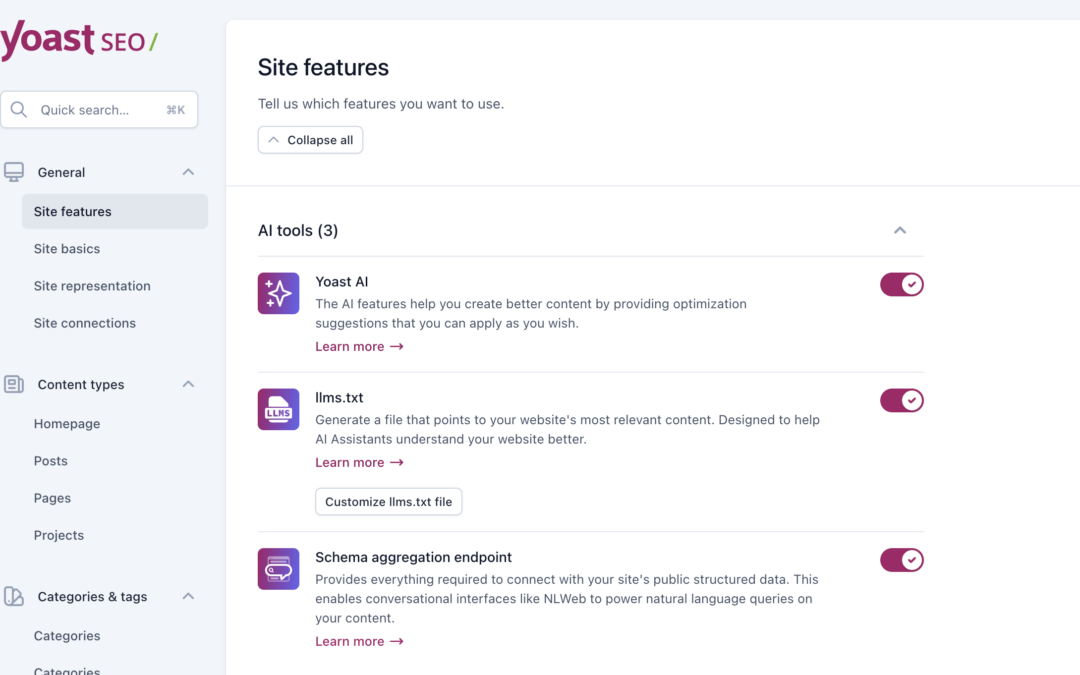
Yoast currently places its llms.txt option within the AI tools section. Yoast
Step 3: Find llms.txt
Scroll to the AI tools area until you see the llms.txt setting.
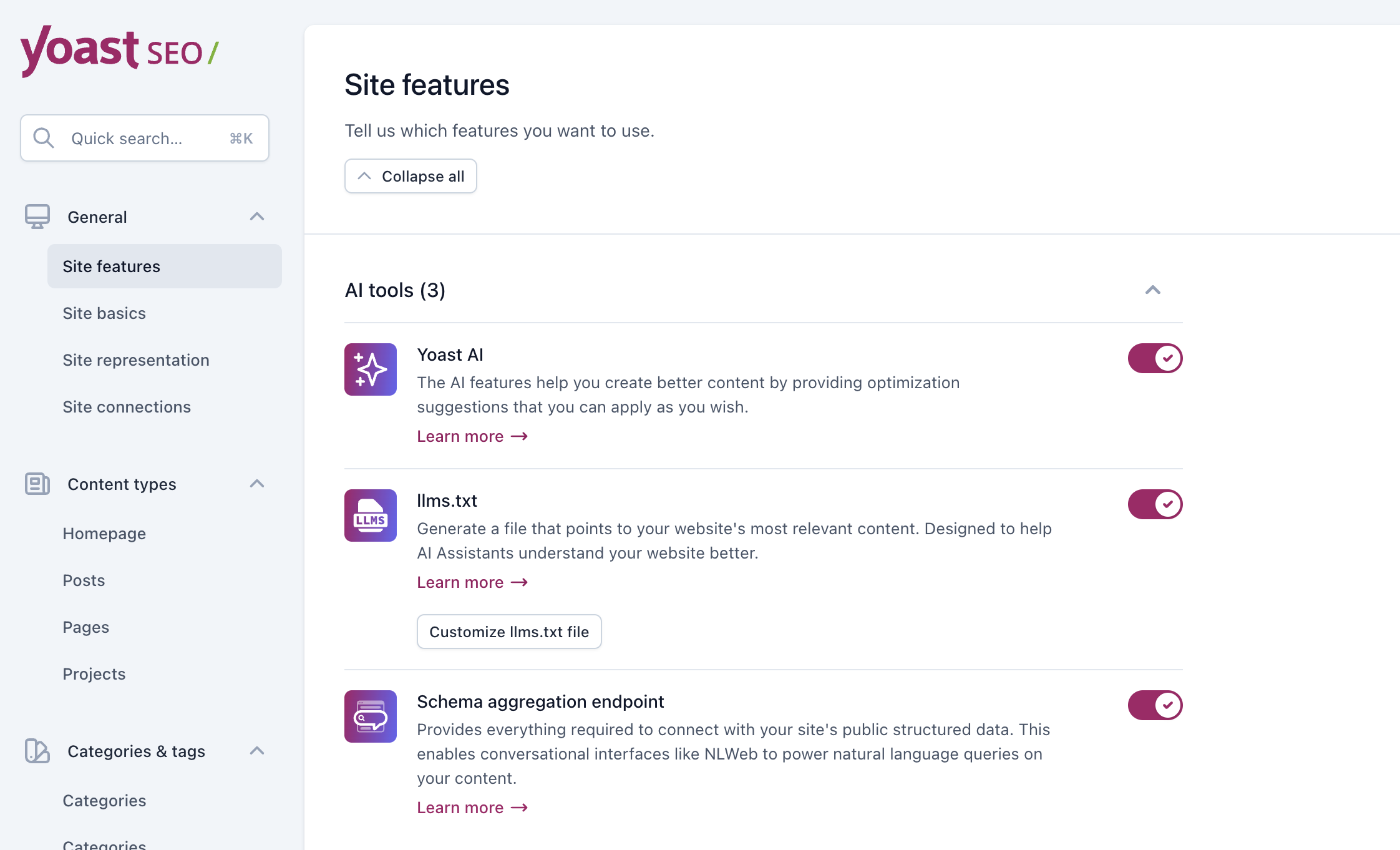
This is what the llms.txt setting looks like inside my own Yoast SEO dashboard.
That screenshot is useful because readers can see exactly what they’re looking for.
Step 4: Enable llms.txt
Toggle the llms.txt option on.
Then click:
Save changes
Yoast will generate the llms.txt file for the website. Yoast
Step 5: Review Your llms.txt File
I wouldn’t simply turn it on and forget about it.
Look at the generated file.
Ask:
Does this accurately represent my website?
Are the pages useful?
Are important pages missing?
Is outdated or low-value content being highlighted?
Yoast’s current implementation can automatically select content, and it also offers manual page selection for more control. Yoast
That’s particularly useful on a large site.
How Does Yoast Choose Pages for llms.txt?
This is one of the most useful details to understand.
According to Yoast’s current technical documentation, its automatic system considers recently updated content and gives priority to cornerstone content. Yoast also allows manual page selection. Yoast developer portal
The generated file is updated weekly. Yoast developer portal
For a website with hundreds of URLs, I would definitely inspect what Yoast selected rather than assuming automatic selection perfectly represents the business.
That’s especially relevant to my own site because I’ve spent a lot of time consolidating older SEO articles and giving important topics clearer homes.
I don’t want an experimental AI-discovery file emphasizing pages I no longer consider important.
Automatic vs. Manual Selection
Yoast now gives website owners more control over the pages included in llms.txt.
You can allow Yoast to select content automatically or choose pages manually. Yoast
For a small website with a very clean structure, automatic selection may be perfectly reasonable.
For a larger website, I’d at least review the manual option.
If I were choosing pages myself, I’d prioritize resources that accurately explain:
who the business is
what it provides
important services
important expertise
and genuinely useful cornerstone information.
I wouldn’t fill the file with every article I’ve ever published.
llms.txt vs. robots.txt
These files have very different purposes.
robots.txt provides crawler directives about access to parts of a website.
llms.txt is intended to provide useful information and references to systems that choose to consume it.
So I would not think of llms.txt as a replacement for robots.txt.
It isn’t.
And turning on llms.txt doesn’t mean you’ve granted or blocked AI crawlers from accessing your website.
Those are separate issues.
llms.txt vs. XML Sitemaps
They’re also not the same thing.
An XML sitemap is an established search-engine discovery mechanism that provides information about URLs on a website.
llms.txt is an emerging proposal intended to provide a more curated, LLM-friendly representation of important content.
That’s why I avoid calling llms.txt an “AI sitemap.”
The analogy is convenient, but technically it gives the file more authority than it currently has.
Does llms.txt Improve Google Rankings?
There is no evidence I would rely on to claim that enabling llms.txt improves traditional Google rankings.
I wouldn’t expect a business to jump from position #8 to position #2 because someone flipped this Yoast toggle.
That’s not how I approach SEO.
Does llms.txt Improve AI Visibility?
This is more complicated.
The purpose of llms.txt is to make useful website information easier for compatible systems to find and consume.
But that doesn’t mean enabling the file guarantees that ChatGPT, Gemini, Claude, Perplexity or Google will use it when answering a particular query.
And it certainly doesn’t guarantee that those systems will recommend your business.
That’s why I consider llms.txt an experimental supporting feature, not an AI SEO strategy by itself.
If you’re interested in the much bigger picture, read my guide on how to get your business recommended by ChatGPT and AI search.
llms.txt Doesn’t Replace Good Website Structure
This is especially important.
You can’t take a confusing website with thin content, overlapping pages and unclear services, enable llms.txt and suddenly make everything understandable.
The underlying website still matters.
I would first focus on:
clear page intent
logical architecture
strong service pages
useful content
internal linking
technical accessibility
and removing unnecessary duplication.
I explain this approach in more detail in Why Structured Content Matters for SEO.
llms.txt should sit on top of a well-organized website, not compensate for a poorly organized one.
What About Entities and Semantic SEO?
The same principle applies to entities.
A business should clearly communicate:
who it is
what it does
who is associated with it
where it operates
what services it provides
and how those concepts relate.
That’s a broader semantic SEO issue—not something llms.txt magically creates.
I explain that distinction in my guide to semantic entities in SEO.
Should You Enable llms.txt in Yoast?
For most WordPress websites already using Yoast SEO, I think it’s reasonable to enable it as long as you understand what it is and what it isn’t.
The feature is easy to implement.
You can review the output.
You can turn it off.
And Yoast now provides more control over which pages are included.
But I wouldn’t spend hours obsessing over it.
And I definitely wouldn’t prioritize llms.txt over fixing important SEO problems on the actual website.
If I had to choose between:
fixing weak service pages
or
perfecting an llms.txt file
I’m fixing the service pages.
If I had to choose between:
cleaning up hundreds of overlapping URLs
or
adding llms.txt
I’m cleaning up the URLs.
That’s where the larger SEO opportunity usually is.
What I Recommend After Enabling It
Once you’ve turned it on:
Check the file.
Make sure it exists and loads properly.
Review the selected pages.
Make sure they represent content you actually want emphasized.
Consider manual selection.
Especially if you have a large or older website.
Keep your website itself organized.
Don’t expect llms.txt to solve content architecture problems.
Continue normal SEO.
Don’t abandon traditional search optimization because a new AI-related feature appeared.
Watch how the standard develops.
The technology and adoption around AI discovery are still evolving.
That’s exactly why I think it’s worth understanding—but not overhyping.
AI Search Requires More Than a Text File
AI search visibility is much bigger than llms.txt.
If I want a business to become easier to find, understand and potentially reference across AI-powered search experiences, I’m looking at the entire digital presence.
That includes:
website content
technical SEO
brand information
entities
third-party mentions
local search presence
original expertise
content structure
and traditional search visibility.
That’s why I treat llms.txt as one tiny technical component rather than the strategy itself.
If you’re working on the broader picture, learn more about my AI SEO services in San Diego.
And if you’re looking for a San Diego SEO company to review both your traditional and AI search visibility, that’s exactly the kind of work I do.
Final Thoughts
I enabled llms.txt on my own website because I want to understand emerging search technology by actually using it—not just writing about it.
But experimentation and evidence are two different things.
Right now, I see llms.txt as an interesting emerging standard and an easy feature for Yoast users to test.
I don’t see it as a ranking factor.
I don’t see it as a shortcut to ChatGPT recommendations.
And I wouldn’t build an AI SEO strategy around it.
Enable it if it makes sense for your site.
Review what it contains.
Then get back to the SEO work that matters most.
Get found. Get trusted. Get chosen.
— Jen Ruhman
San Diego SEO Expert
Frequently Asked Questions
What is llms.txt?
llms.txt is a proposed Markdown-based format designed to provide language models and AI agents with concise information about a website and links to useful resources.
Is llms.txt the same as robots.txt?
No. robots.txt provides crawler-access directives. llms.txt is intended to provide useful information and content references for compatible AI systems. It doesn’t replace robots.txt.
Is llms.txt an AI sitemap?
I wouldn’t technically call it an AI sitemap. XML sitemaps are established discovery mechanisms for search engines. llms.txt is an emerging proposal for providing AI-friendly information and curated content references.
Does llms.txt improve Google rankings?
There is no evidence that enabling llms.txt directly improves traditional Google rankings.
Will llms.txt make ChatGPT recommend my business?
There is no guarantee that ChatGPT or another AI system will use your llms.txt file or recommend your business because you have one.
How do I enable llms.txt in Yoast SEO?
In WordPress, go to Yoast SEO → Settings → Site Features → AI tools → llms.txt, enable the feature and save your changes. Yoast will generate the file automatically. Yoast
Can I choose which pages Yoast includes?
Yes. Yoast currently offers automatic selection as well as manual page selection so you can have more control over which pages appear in the file. Yoast
Should I enable llms.txt?
If you’re already using Yoast SEO, I think it’s a reasonable low-effort experiment. Just don’t treat it as a replacement for good content, technical SEO, internal linking, site architecture or traditional search optimization.
Jan 25, 2026 | AI
Google AI Overviews have created another place where businesses and websites can potentially earn visibility in Google Search.
But there isn’t a special trick, schema type, FAQ formula, or guaranteed optimization method that gets a business featured.
That’s important.
As a San Diego SEO expert, I’m approaching AI Overviews the same way I approach other major changes in search: understand what has changed, keep the fundamentals that still matter, and improve the website so its information is as clear, useful, accessible, and credible as possible.
This checklist covers the areas I would review first for a San Diego business that wants to strengthen its visibility across traditional Google Search and newer AI-powered search experiences.
Quick Checklist: Optimizing for Google AI Overviews
Start here:
- Give every important page a clear primary purpose
- Answer important questions directly
- Strengthen your core service pages
- Make your San Diego or service-area relevance clear
- Demonstrate firsthand experience
- Improve internal linking
- Use descriptive headings
- Keep important business information consistent
- Add appropriate structured data where useful
- Earn genuine reviews and authoritative mentions
- Consolidate overlapping content
- Make important pages technically accessible to search engines
- Measure leads and qualified visibility, not just traffic
None of these individually guarantees inclusion in an AI Overview.
Together, however, they create a stronger search presence.
First: What Are Google AI Overviews?
Google AI Overviews are AI-generated responses that can appear within Google Search.
Instead of displaying only a traditional list of search results, Google can generate an answer or overview and provide links to supporting webpages.
That means a website may have opportunities to earn visibility in more than one place within the search experience.
Traditional organic rankings still matter.
Google Maps still matters.
Your Google Business Profile still matters.
And now AI-powered search experiences matter too.
I cover the bigger strategic implications in my guide to how Google AI Overviews are changing local SEO for San Diego businesses.
This article focuses on implementation.
Step 1: Give Every Important Page One Clear Job
One of the first things I look for when auditing a website is competing or overlapping content.
I’ve seen websites accumulate several articles that essentially answer the same question.
That can make the site harder to manage and can create unnecessary competition between URLs.
Instead, decide what each page is supposed to accomplish.
For example, a plumbing website might have separate pages for:
Emergency plumbing
Water heater repair
Drain cleaning
Sewer repair
Those services can be related without forcing every topic onto one giant page.
The same principle applies to informational content.
If you already have an excellent guide answering a question, improving that guide may be more useful than publishing another article targeting essentially the same intent.
I’ve been doing exactly this on my own website by consolidating overlapping SEO articles.
Checklist:
Does this page have a clear primary purpose?
Is another page targeting nearly the same search intent?
Would combining two similar pages create a stronger resource?
Does the page naturally support one of your primary services?
If you can’t explain why a page needs to exist, that’s worth investigating.
Step 2: Answer Important Questions Clearly
Don’t bury the answer underneath five paragraphs of introduction.
If someone asks:
Do you provide same-day plumbing service in Clairemont?
Answer the question.
If someone asks:
How long does this service usually take?
Give them a realistic answer when one is available.
If the answer depends on circumstances, explain those circumstances.
Clear answers help visitors quickly determine whether the page contains what they need.
They’re also easier for search systems to interpret than vague marketing language.
That doesn’t mean every answer has to be two sentences long.
Start clearly, then provide the depth necessary to explain the subject properly.
Step 3: Strengthen Your Core Service Pages
Before publishing another 20 AI-search articles, look at the pages that actually generate business.
Your primary service pages should clearly explain:
What you offer
Who the service is for
What problem it solves
Where it’s available
What customers should expect
Why someone should consider your company
What they should do next
Supporting articles should strengthen these pages—not replace them.
This is particularly important for local businesses.
A blog can bring someone to your website.
A strong service page helps turn that visitor into a potential customer.
Step 4: Make Your Local Relevance Clear
If you’re a San Diego business, don’t make Google or your visitors guess where you operate.
Clearly communicate legitimate location information.
Depending on the business, that might include:
- Your primary location
- Service areas
- Relevant San Diego communities
- Locations where specific services are available
- Local examples or projects
- Appropriate contact information
Don’t stuff a page with neighborhood names just to make it look local.
Local information should be useful and accurate.
For example, if you genuinely serve La Mesa, Santee, El Cajon and other parts of San Diego County, explaining your service area can help customers determine whether you’re a fit.
That’s much better than creating dozens of nearly identical city pages with the location name swapped out.
Step 5: Demonstrate Real Experience
AI has made generic content extremely easy to create.
Real experience is harder to replicate.
Whenever appropriate, strengthen your website with things that come from actually doing the work.
That can include:
Original case studies
Client examples
Firsthand observations
Original photographs
Professional experience
Before-and-after examples
Your own data
Lessons learned from real projects
Common questions actual customers ask
For my own SEO content, I can discuss things I’ve seen inside Google Search Console, Google Analytics, client websites and SEO campaigns.
That’s different from simply summarizing someone else’s article about SEO.
Look for opportunities to bring that same level of experience into your own content.
Step 6: Improve Your Internal Linking
Internal links help visitors and search engines understand how your pages relate to one another.
For example, you might have:
Service page
↓
Supporting guide
↓
Case study
↓
Related FAQ or resource
The links should make sense to someone actually reading the page.
Don’t force exact-match anchor text everywhere.
Don’t randomly link every page to every other page.
Build logical relationships.
This article, for example, discusses a specific component of AI search optimization. If you’re looking for help implementing a broader strategy, learn more about my AI SEO services in San Diego.
Step 7: Use FAQs When They Actually Help
FAQs can be useful.
But I would not say every page needs an FAQ section simply because AI search exists.
Use FAQs when there are genuine related questions that don’t fit naturally into the main body of the page.
Good questions might come from:
- Actual customer conversations
- Sales calls
- Search Console data
- Search behavior
- Customer emails
- Questions your team repeatedly answers
And don’t write an FAQ just to insert another keyword.
Write it because someone genuinely needs the answer.
Step 8: Use Structured Data Appropriately
Structured data can help search engines understand certain types of information on a webpage.
Depending on the page, appropriate schema might identify an organization, person, local business, article, product, event, breadcrumbs, or other supported information.
But schema is not a shortcut into AI Overviews.
Adding structured data doesn’t guarantee that Google will cite your page.
The markup should accurately represent information that is actually visible and relevant on the webpage.
Use schema for clarity—not because someone promised it would unlock AI visibility.
Step 9: Strengthen Your Business Beyond Your Website
Your website isn’t the only place where people encounter your business.
Depending on your industry, your broader digital footprint might include:
Google Business Profile
Customer reviews
Professional profiles
Industry organizations
Local publications
Business directories
Interviews
Podcasts
Social profiles
Relevant third-party articles
These sources can help establish a more complete picture of your business online.
For local companies, I particularly like legitimate San Diego mentions.
I’d rather earn one meaningful mention from a relevant local or industry source than create dozens of low-quality links simply to increase a backlink count.
Step 10: Keep Your Business Information Consistent
Consistency doesn’t mean repeating identical marketing copy everywhere.
It means the important facts agree.
Check things such as:
Business name
Location
Service area
Services
Contact information
People associated with the business
Professional expertise
If your website says one thing, your Google Business Profile says another, and an old professional profile says something completely different, you’re creating unnecessary ambiguity.
Keep important information current.
Step 11: Make Important Content Easy to Crawl
Great content doesn’t help much if search engines can’t properly access it.
Technical SEO still matters.
Check for issues involving:
robots directives
noindex tags
canonical URLs
redirects
broken internal links
site architecture
mobile usability
page performance
XML sitemaps
JavaScript rendering when relevant
AI search hasn’t eliminated technical SEO.
A strong technical foundation makes it easier for search engines to discover and process the pages you actually want visible.
Step 12: Stop Publishing Content Just to Publish
This is one of the biggest changes I’ve made in my own approach.
I don’t believe businesses need to constantly publish new articles simply to prove that their website is active.
Before creating something new, ask:
Does this topic already exist on my site?
Is there genuine search or customer demand for it?
Does it support an important service?
Do I have something useful or original to contribute?
Could improving an existing article accomplish the same thing?
Sometimes publishing is the right move.
Sometimes rewriting is better.
Sometimes merging two articles and redirecting one is the strongest SEO decision.
Content quality includes knowing when not to create another URL.
Step 13: Don’t Optimize Only for AI Overviews
This may be the most important item on the checklist.
Your customers don’t live inside one Google feature.
They may discover you through:
Google Search.
Google Maps.
Your Google Business Profile.
An AI Overview.
ChatGPT.
Perplexity.
A review.
A local publication.
A social platform.
A referral.
A branded search.
That’s why I don’t recommend building an entire strategy around trying to manipulate one AI feature.
Build a strong search presence.
Make your business easy to find.
Make your expertise clear.
Make your website easy to understand.
Build a reputation people can verify.
Then adapt as the search interfaces continue to change.
What I Would Prioritize First
If I were reviewing a San Diego business website today, my order would generally be:
First: Fix the core service pages.
Second: Fix technical/indexing problems.
Third: Strengthen Google Business Profile and local information.
Fourth: Improve internal linking and website structure.
Fifth: Consolidate competing or low-value content.
Sixth: Strengthen experience, authority and reputation signals.
Seventh: Create new supporting content only where there’s a legitimate gap.
That’s much closer to how I actually approach SEO than simply telling a business to publish more FAQs or add more schema.
Can You Guarantee a Business Will Appear in Google AI Overviews?
No.
There is no legitimate way to guarantee that Google will feature a particular business or webpage in an AI Overview.
Google controls what appears in its search results, and AI-generated experiences can change based on the query and other factors.
SEO can improve the conditions that help a website become discoverable, understandable and competitive.
It cannot guarantee placement.
That’s an important distinction.
How Long Does AI Overview Optimization Take?
There isn’t a universal 60-day or 90-day timeline.
The outcome depends on factors such as:
Your existing website
Competition
Technical condition
Content quality
Authority
Query
Industry
Existing visibility
Google’s own search features
Some changes may be discovered relatively quickly.
Other improvements may take considerably longer to produce measurable results.
That’s why I recommend tracking visibility over time rather than promising a fixed timeline.
Frequently Asked Questions
What is a Google AI Overview?
A Google AI Overview is an AI-generated response that can appear within Google Search. It may summarize information and include links to webpages where users can learn more.
Can a small San Diego business appear in Google AI Overviews?
A small business can potentially earn visibility within AI-powered Google search experiences when its content is relevant and useful for a particular query. Business size alone does not guarantee or prevent inclusion.
Do I need FAQs to appear in Google AI Overviews?
No. FAQs can be useful when they answer genuine customer questions, but having an FAQ section does not guarantee AI Overview visibility.
Does schema guarantee inclusion in Google AI Overviews?
No. Structured data can help search engines understand certain information, but it does not guarantee inclusion in an AI Overview.
Should I create separate pages for every San Diego neighborhood?
Usually not. Create location pages when they serve a genuine user and business purpose. Avoid producing near-duplicate pages that simply swap one city or neighborhood name for another.
How long does it take to see results from AI search optimization?
There is no universal timeline. Results depend on the website, query, competition, existing authority, technical condition and the search platform itself.
Is AI SEO different from traditional SEO?
There are additional considerations around AI-powered discovery, but many fundamentals overlap with traditional SEO: crawlability, useful content, clear site architecture, internal linking, authority, reputation, local relevance and technical accessibility.
Final Checklist
Before you worry about whether Google will feature your business in an AI Overview, make sure you can answer yes to most of these:
- Does every important page have a clear purpose?
- Are your core service pages strong?
- Do you answer important questions clearly?
- Is your local relevance accurate and obvious?
- Does your content demonstrate real experience?
- Are related pages internally linked?
- Is your structured data accurate?
- Is your business information consistent?
- Does your business have genuine reviews and third-party authority?
- Can Google crawl and index your important pages?
- Have you consolidated unnecessary overlapping content?
- Are you measuring leads and meaningful visibility rather than vanity metrics?
If those fundamentals are strong, you’re building a much better foundation for both traditional search and AI-powered discovery.
Want Help Preparing Your Business for AI Search?
I help San Diego businesses improve visibility across Google Search, local search, and emerging AI-powered search experiences.
My approach combines traditional SEO fundamentals with the newer considerations created by AI-powered discovery—without chasing shortcuts or promising guaranteed AI placements.
Learn more about my AI SEO services in San Diego.
Or call/text me directly at (619) 719-1315.
Get found. Get trusted. Get chosen.
— Jen Ruhman
San Diego SEO Expert
Dec 6, 2025 | AI, SEO Tips
If you’re a local business in San Diego, your Google Business Profile can be one of the most important parts of your local search presence.
It’s often what potential customers see when they search for your business, look for services nearby, compare local companies or find you through Google Maps.
But Google Business Profile optimization isn’t about stuffing keywords into every available field or posting every day because you think Google wants “freshness.”
It’s about giving potential customers—and Google—accurate, useful information about your business.
I’m Jen Ruhman, a San Diego SEO expert, and Google Business Profile optimization is a regular part of the local SEO work I do for clients.
Here’s how I approach it in 2026.
Quick Answer: How Do You Optimize a Google Business Profile?
Start with the fundamentals:
Choose the most accurate business categories.
Complete the important business information.
Add the services you actually provide.
Keep your hours and contact information accurate.
Use real, useful photos.
Earn legitimate customer reviews.
Respond professionally to reviews.
Keep your website and Google Business Profile consistent.
Use posts when you have something useful to communicate.
Track performance rather than making changes based on assumptions.
The goal is simple:
Make it easy for someone who discovers your business on Google to understand what you do, where you operate and whether you’re the right business for them.
Why Google Business Profile Matters for Local SEO
Google Business Profile is closely connected with how businesses appear across Google Search and Google Maps.
For a local business, the profile can display information such as:
business name
category
address or service area
phone number
website
hours
services
photos
reviews
and other business details.
That makes your profile much more than a basic directory listing.
It’s part of the customer’s search experience.
Someone may interact with your business through Google before ever visiting your website.
That’s why I treat the website and Google Business Profile as two parts of the same local search strategy, not completely separate marketing channels.
I explain that relationship more broadly in my guide to how AI search is changing local SEO.
Start With the Correct Primary Category
One of the first things I check during a Google Business Profile audit is the primary category.
Your primary category should accurately describe the core business.
Additional categories can be useful when they accurately represent other parts of the business, but I don’t add categories simply because I want to appear for more searches.
Accuracy comes first.
For example, a business shouldn’t choose an unrelated category just because that category appears to have attractive keywords associated with it.
I want Google’s information about the business to reflect the business that actually exists.
Review Your Business Information
Next, I review the basic information on the profile.
That includes things such as:
Business name
Use the real-world business name rather than adding extra keywords solely for SEO.
Address
If customers visit the business at a qualifying location, make sure the address is accurate.
Service area
For eligible service-area businesses, use service areas that reflect where the business actually operates.
Phone number
Make sure customers can reach the business.
Website
Send visitors to the most appropriate website destination.
Hours
Keep regular and special hours current.
These details sound basic, but they’re important because they’re information customers rely on.
Add the Services You Actually Offer
If your Google Business Profile category supports services, review them carefully.
I want the services listed on GBP to reflect what the company genuinely provides.
I also compare them with the website.
For example, if a business promotes a major service prominently on its website but that service is missing from the Google Business Profile, that’s something I would investigate.
Likewise, I don’t want the profile advertising a service the company no longer provides.
This is where GBP and website alignment becomes important.
A customer should receive a consistent understanding of the company whether they find it through the website, Google Search or Google Maps.
Don’t Stuff Your Business Profile With Keywords
Google Business Profile optimization is not an excuse to stuff keywords into every field.
I don’t recommend turning a business name into something like:
“Company Name | Best Plumber San Diego Emergency Plumbing Water Heater Repair”
if that isn’t the company’s actual real-world name.
The same principle applies elsewhere.
Use natural language.
Describe the business accurately.
Include relevant service and location information where appropriate.
But don’t make every sentence sound like it was written for an SEO tool.
Good local SEO should still read like normal communication.
Service Areas: Be Accurate, Not Ambitious
San Diego County is large, and many businesses serve multiple communities.
Depending on the business, that could include areas such as:
La Mesa
Santee
Chula Vista
La Jolla
Encinitas
El Cajon
Poway
or other communities.
But I wouldn’t add locations simply because I want to rank there.
The service area should represent where the company genuinely does business.
And adding a location to a Google Business Profile doesn’t automatically mean the business will rank prominently there.
Local visibility involves more than filling out a service-area field.
Your Website and GBP Should Tell the Same Story
This is one of the most important things I look for.
Suppose your Google Business Profile says you provide five primary services.
But your website barely mentions three of them.
Or your website uses one business name while your GBP uses another.
Or the phone number is outdated.
Or the website says you’re open Saturday while your GBP says you’re closed.
That’s confusing for customers.
I want the important facts about the business to be accurate and reasonably consistent.
This connects closely with the concept of semantic entities in SEO: clearly communicating who the business is, what it does and how important information relates.
Use Real Photos That Help Customers
Photos can make a Google Business Profile substantially more useful.
Depending on the business, useful photos might include:
the exterior
the interior
employees
completed projects
products
equipment
treatment rooms
before-and-after examples when appropriate
or the actual team doing the work.
I prefer authentic photos over a profile consisting primarily of logos and generic stock photography.
The goal isn’t to upload photos because of a supposed secret ranking benefit.
The goal is to help potential customers understand the business they’re considering.
For some companies, that can be especially important.
A customer choosing a salon, med spa, restaurant, contractor or fitness facility may want to see the actual environment or work before making contact.
What About Geotagging GBP Photos?
I wouldn’t make EXIF data or geotagging a major part of a local SEO strategy.
I’d spend that time getting better real photographs.
Make the image useful.
Use an appropriate filename and alt text when the image is placed on your own website.
But don’t assume adding GPS metadata to an image is going to unlock Google Maps rankings.
I prefer strategies that improve the actual quality and usefulness of the business’s online presence.
Reviews Matter—But Don’t Script Them for SEO
Reviews are important for local businesses.
They help prospective customers evaluate a company, and review information is visible throughout Google’s local search experience.
But I would not tell customers which keywords they need to put into a review.
Ask for an honest review.
Let the customer describe the experience in their own words.
A genuine review might naturally mention the service, employee, result or location because that’s what the customer experienced.
That’s very different from saying:
“Please mention ‘Botox San Diego’ in your review.”
I don’t recommend that.
Authenticity is more valuable.
Respond to Reviews Like a Business Owner, Not an SEO Tool
I recommend responding to reviews when it makes sense.
But again, don’t turn the response into keyword stuffing.
If someone says:
“Jen helped us reorganize our website and improve our local SEO.”
I don’t need to respond:
“Thank you for choosing the best San Diego SEO company for San Diego SEO services and local SEO San Diego!”
That looks ridiculous.
A normal response is better:
“Thank you! I really enjoyed working with your team and I’m glad the changes are helping.”
Review responses are communication with real customers.
Treat them that way.
Should You Use Google Business Profile Posts?
Yes, GBP posts can be useful.
But I don’t tell businesses they need to post constantly because posting itself guarantees higher rankings.
Instead, I use posts as another way to communicate timely or useful information.
Examples might include:
a new service
an upcoming event
a seasonal offer
a recent project
an important business update
a useful tip
or a relevant article from the website.
If I’ve just published an excellent resource, I may turn the central idea into a short GBP post and link interested visitors to the full article.
That’s useful content repurposing.
It doesn’t need to be framed as an AI hack.
How Often Should You Post on Google Business Profile?
There isn’t one magic posting frequency that works for every business.
I would rather publish something useful than create filler merely to satisfy a calendar.
Some businesses have enough activity to post regularly.
Others may have fewer meaningful updates.
If I’m managing a client’s GBP as part of a broader local SEO strategy, I may maintain a consistent posting schedule because it keeps the profile useful and gives us opportunities to highlight services, content, promotions or business developments.
But I wouldn’t promise a ranking increase simply because we moved from one post per month to two posts per week.
What About Google Business Profile Q&A?
Google has changed features within Business Profile over time, so I don’t build an entire SEO strategy around any single profile feature.
When question-and-answer functionality is available and relevant, accurate answers can obviously be useful to customers.
But your website should also answer the important questions prospective customers have.
That’s more durable.
If customers repeatedly ask the same question, that’s a clue.
Maybe the answer belongs:
on a service page
in an FAQ section
in appointment information
in your contact information
or somewhere else customers can easily find it.
Customer questions are excellent content research.
Build Strong Service Pages Behind Your GBP
Your Google Business Profile shouldn’t be expected to do all the work.
If someone discovers you through Google and clicks through to your website, the destination needs to continue the experience.
Important services should be explained clearly.
A good service page may answer:
What is the service?
Who is it for?
What problem does it address?
What does the process involve?
Where is it available?
Why should someone trust this business to provide it?
What should the customer do next?
That’s where GBP optimization and website SEO start working together.
Local Landing Pages Need a Real Purpose
The same rule applies to location pages.
Don’t create dozens of nearly identical pages where only the city name changes.
If you create a page for a particular location, ask whether you have something useful and legitimate to say about serving customers there.
I would rather have fewer strong pages than a giant collection of thin city pages.
This is part of the broader structured content approach I use for SEO.
Every important URL should have a reason to exist.
How Google Business Profile Fits Into AI Search
This is where I would be careful with the hype.
AI-powered search is changing how people discover businesses and information, but I don’t tell clients that filling out a GBP field will make ChatGPT recommend them or cause Google AI Overviews to cite them.
There isn’t a universal formula like that.
What I do believe is increasingly valuable is having a clear digital presence.
A business should be easy to identify.
Its services should be understandable.
Its location should be accurate.
Its website should provide useful information.
Its important third-party profiles should be current.
And information about the company shouldn’t unnecessarily contradict itself across the web.
Those are sensible practices whether a customer discovers you through Google Maps, traditional Google Search or an AI-powered search experience.
For the broader strategy, read How to Get Your Business Recommended by ChatGPT and AI Search.
GBP Optimization and AI SEO Are Not the Same Thing
I also wouldn’t turn Google Business Profile optimization into “AI SEO.”
GBP optimization is primarily part of local SEO.
AI SEO is broader.
It can involve how a business and its information are represented and discovered across AI-influenced search experiences, not merely what’s entered into a Google Business Profile.
There is overlap because search is becoming more interconnected.
But they’re not interchangeable.
If that’s the area you’re interested in, you can learn more about my AI SEO services in San Diego.
Common Google Business Profile Mistakes I See
Some of the most common problems I encounter are surprisingly basic.
Choosing inaccurate categories
Don’t select categories merely because you’d like to rank for searches associated with them.
Adding keywords to the business name
Use the actual business name and follow Google’s guidelines.
Forgetting to update hours
Incorrect hours frustrate customers.
Listing outdated services
Your profile should reflect what the business currently provides.
Using weak or generic photos
Show people the actual business when possible.
Ignoring reviews
Customer feedback deserves attention.
Treating GBP separately from the website
Your profile and website should support the same real-world business.
Creating fake local relevance
Don’t stuff descriptions, posts or pages with neighborhood names simply to appear more local.
Making changes without tracking results
If you’re doing SEO professionally, measure what happens.
How I Track Google Business Profile Performance
I don’t judge GBP success by whether we completed every available field.
I care about business outcomes.
Depending on the business and the available reporting, I may look at things such as:
search visibility
website visits
calls
direction requests
bookings
forms
qualified leads
and changes in the searches associated with the business.
I also compare GBP performance with website analytics and Search Console data when appropriate.
SEO decisions are much better when they’re based on evidence instead of assumptions.
My Google Business Profile Optimization Process
When I’m reviewing a San Diego business, my process generally starts with the fundamentals.
1. Verify the core business information
I check the business name, website, phone, hours, address or service area and other important details.
2. Review categories
I make sure the primary and additional categories accurately represent the business.
3. Review services
I compare GBP services with what the company actually offers and what the website communicates.
4. Review the website connection
I look at whether someone clicking from the profile reaches a useful website experience.
5. Review photos
I look for opportunities to show the actual business, work, team or environment.
6. Review customer feedback
I evaluate reviews and responses from the perspective of both reputation and customer experience.
7. Look for content opportunities
Repeated customer questions can reveal missing information on the website or profile.
8. Review local relevance
I make sure location information reflects where the business genuinely operates.
9. Check for inconsistencies
I look for conflicting business information that could confuse customers.
10. Measure what matters
I track visibility and conversions rather than treating profile completion as the end goal.
Google Business Profile Optimization Checklist
If you want to review your own profile today, start here:
Business name: Is it your actual business name?
Primary category: Does it accurately describe your main business?
Additional categories: Are they genuinely applicable?
Phone: Is it correct?
Website: Does it lead to the right page?
Hours: Are regular and special hours current?
Address/service area: Does it accurately represent the business?
Services: Are your important current services listed?
Photos: Do they show the real business?
Reviews: Are you consistently earning legitimate customer feedback?
Responses: Are you communicating professionally with reviewers?
Website alignment: Does your site reinforce the services and information customers see on GBP?
Tracking: Do you know whether your local visibility is generating calls, forms, bookings or other meaningful actions?
That’s a much better place to start than chasing a new “Google Maps hack” every month.
Final Thoughts
Google Business Profile optimization doesn’t need to be mysterious.
Start with accuracy.
Choose appropriate categories.
Clearly communicate your services.
Keep business information current.
Use authentic photos.
Earn legitimate reviews.
Build a strong website behind the profile.
And measure whether your local visibility is actually producing business.
AI is changing search, but that doesn’t mean local businesses need to abandon the fundamentals.
If anything, I think it makes clear, accurate and trustworthy business information even more valuable.
If you’d like me to review your Google Business Profile and website together, I provide local and AI SEO services in San Diego.
Call or text me at (619) 719-1315.
Get found. Get trusted. Get chosen.
— Jen Ruhman
San Diego SEO Expert
Frequently Asked Questions
How do I optimize my Google Business Profile?
Start by making sure your business name, category, contact information, hours, address or service area and services are accurate. Add useful photos, earn legitimate reviews, keep the profile current and make sure your website supports the same services and business information.
How often should I update my Google Business Profile?
Update the profile whenever important business information changes. Posts can also be used when you have useful updates, offers, events, services or content to share. There isn’t a universal posting frequency that guarantees better rankings.
Do Google Business Profile posts improve rankings?
I wouldn’t promise a local ranking improvement simply from publishing posts. Posts can make a profile more useful and give businesses another way to communicate timely information, services and offers to potential customers.
Do reviews help local SEO?
Reviews are an important part of Google’s local search ecosystem and can also influence whether prospective customers choose a business. Businesses should seek genuine reviews rather than scripting keywords or locations for customers to include.
Should I put keywords in my Google Business Profile name?
Only if they’re genuinely part of the business’s real-world name. Don’t add extra keywords solely to manipulate search visibility.
Can adding service areas make me rank in more cities?
Adding a service area does not guarantee rankings in that location. Use service areas to accurately represent where your business operates rather than as a way to manufacture local relevance.
Does Google Business Profile help with AI search?
A complete and accurate Google Business Profile contributes to a clear online representation of a local business within Google’s ecosystem. However, I wouldn’t claim that particular GBP optimizations guarantee inclusion or recommendations in AI-generated search results.
Is Google Business Profile optimization the same as AI SEO?
No. Google Business Profile optimization is primarily part of local SEO. AI SEO is broader and can involve how a business, its content and its expertise are discovered and represented across AI-influenced search experiences.