Jun 9, 2026 | AI
AI search has created a lot of new terminology.
Over the last couple of years, you’ve probably heard phrases like:
AI SEO. GEO. AEO. AI optimization. Generative search optimization.
And if you’re a small business owner, all of this can make it sound like the SEO work you’ve already done is suddenly obsolete.
It isn’t.
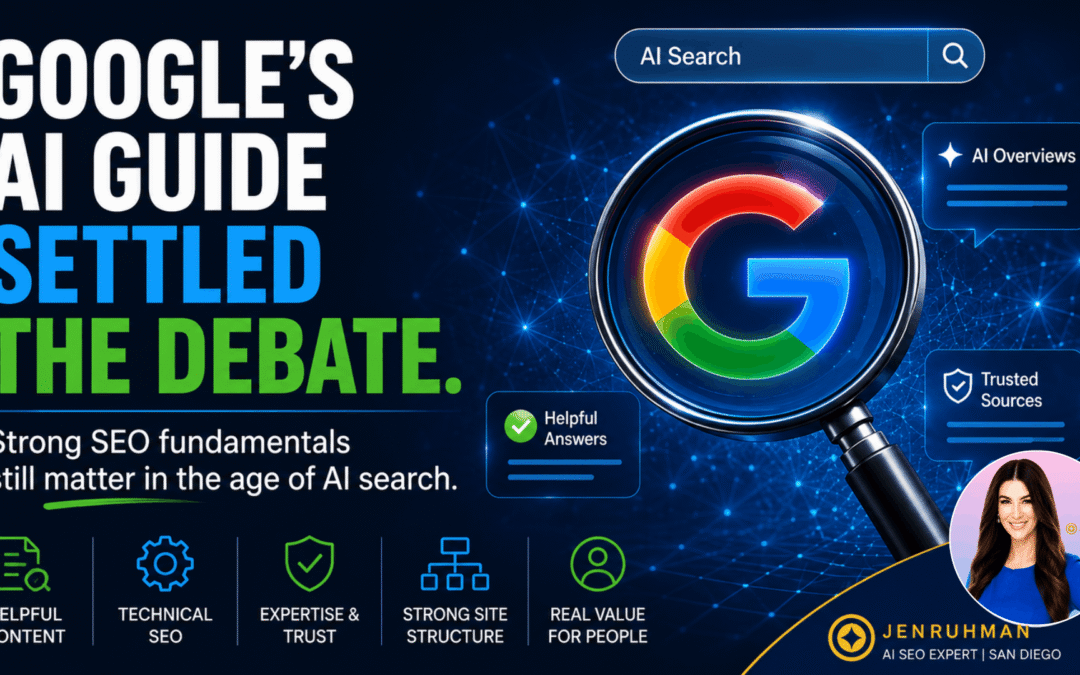
One of the biggest takeaways I see in Google’s guidance about AI-powered search is actually reassuring:
You don’t need to throw away good SEO and start over.
Google’s AI search experiences may change how information is displayed, but many of the fundamentals that help Google discover, understand and surface website content remain relevant.
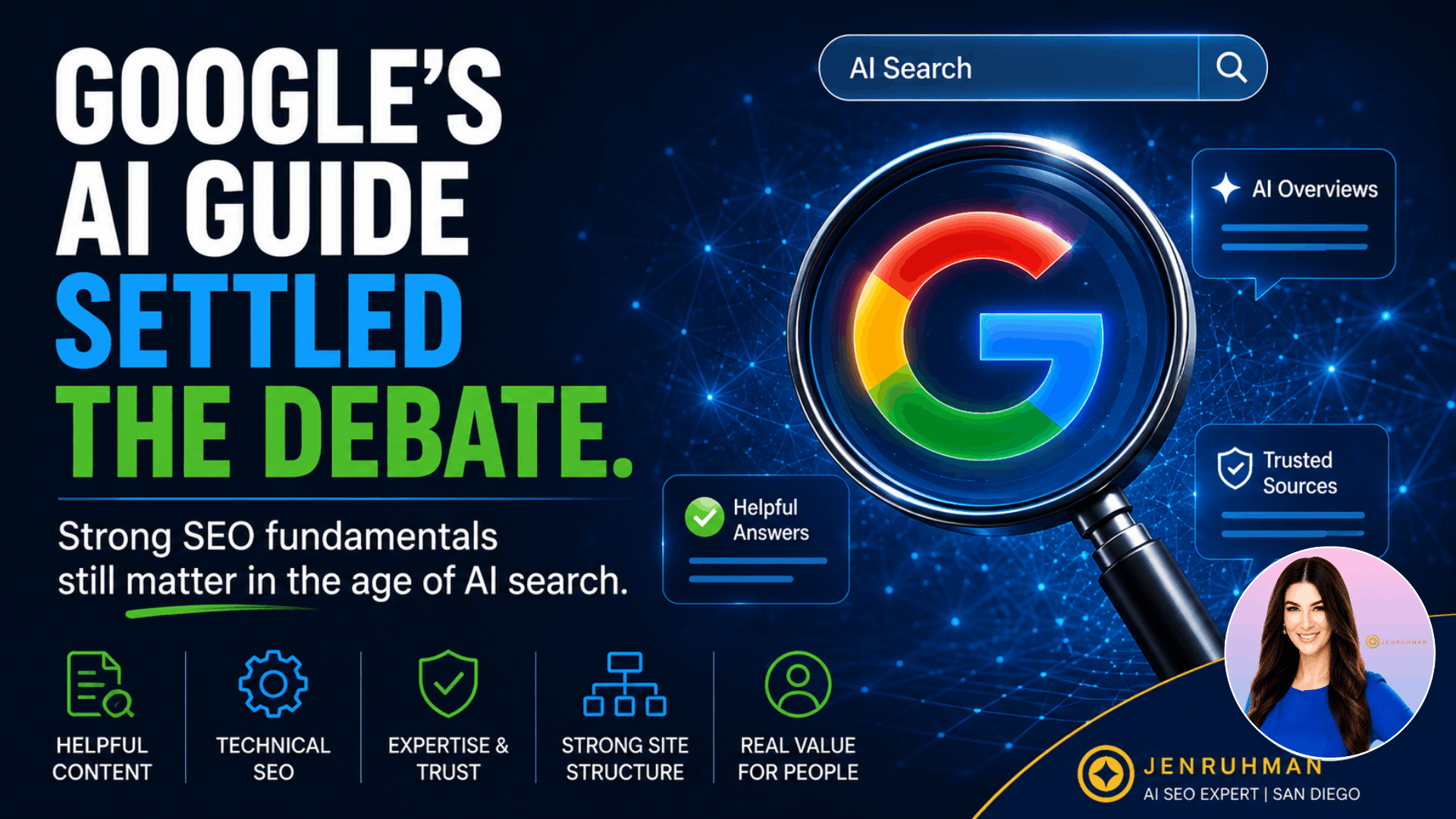
Google specifically says that the same SEO best practices used for traditional search remain relevant for its AI features, including AI Overviews and AI Mode. Google also says there are no additional technical requirements, special schema or AI-specific files required to appear in these features.
You can read Google’s guidance directly here:
Google: AI features and your website
For small businesses, that’s important.
You don’t need to chase every new AI acronym.
You need a website that’s technically accessible, genuinely useful, easy to understand and built around the things your business actually knows and does.
Quick Answer: Do You Need a Different SEO Strategy for AI Search?
Not an entirely different one.
Google’s guidance for appearing in its AI search experiences continues to emphasize many familiar SEO fundamentals.
That means businesses should still focus on things such as:
- creating useful content for people
- making important pages crawlable and indexable
- maintaining strong technical SEO
- using internal links effectively
- providing a good page experience
- supporting important content with useful images and video where appropriate
- keeping business and product information accurate
- measuring performance through the tools Google provides
The biggest takeaway I see is this:
AI search isn’t a reason to abandon SEO. It’s another reason to get SEO right.
Google Isn’t Asking Businesses to Create a Second Website for AI
This is where I think a lot of the AI SEO conversation has become unnecessarily complicated.
Business owners sometimes come to me thinking they now need one strategy for Google, another for AI Overviews, another for ChatGPT, another for Gemini and another for every new AI platform that appears.
I don’t recommend approaching it that way.
Your first priority should still be building the strongest possible source of information about your business: your own website.
Your website should clearly communicate:
Who are you?
What do you do?
Who do you serve?
Where do you operate?
What experience do you have?
Why should someone trust you?
How do your services solve a customer’s problem?
If those basics aren’t clear, adding an “AI optimization” tactic isn’t going to magically solve the underlying problem.
Helpful Content Still Matters
One of the strongest principles behind Google’s search guidance continues to be creating content for people rather than creating pages primarily to manipulate search rankings.
That’s even more important now.
AI has made it incredibly easy to produce enormous amounts of generic content.
Anyone can ask an AI tool:
“Write 1,500 words about local SEO.”
And within seconds, there’s another article on the internet saying essentially the same thing as hundreds of others.
So what can make content genuinely useful?
Experience.
This is something I increasingly think about when creating SEO content.
Instead of simply explaining a topic, I look for opportunities to include:
real things I’ve seen working with clients
common mistakes I encounter
actual examples
case studies
before-and-after results
screenshots
original observations
local knowledge
and opinions based on professional experience.
That’s information another website can’t necessarily reproduce simply by targeting the same keyword.
Don’t Create Separate “AI Content” Just Because AI Search Exists
I wouldn’t start publishing dozens of articles about AI just because AI search is growing.
That’s exactly the kind of content expansion I’ve been cleaning up on my own website.
More content isn’t automatically better.
Every page should have a purpose.
Before publishing something, I want to know:
What question does this page answer?
Does another page already answer it?
Does this support one of my services or areas of expertise?
Is there a legitimate reason this page should exist?
That’s a healthier strategy than creating five slightly different articles around the same idea.
Sometimes the best SEO decision isn’t publishing another page.
It’s improving, consolidating or removing what you already have.
Your Website Still Needs to Be Crawlable
AI doesn’t eliminate technical SEO.
Your website still needs to be accessible to search engines.
That means I continue to pay attention to fundamentals such as:
Indexability
Internal links
Canonical tags
Robots directives
XML sitemaps
Mobile usability
Page performance
Site architecture
Duplicate content
Structured data where appropriate
You can create excellent content, but if Google can’t properly access or index the page, you’ve created an unnecessary obstacle.
Technical SEO isn’t glamorous.
But it remains part of the foundation.
Internal Linking Still Matters
This is something I’m paying even more attention to as websites accumulate content.
A site can have hundreds of useful pages and still become confusing if they’re poorly organized.
Internal links help users navigate between relevant resources and help search engines discover pages and understand aspects of website structure.
For example, this article is informational.
If you’re a business owner who wants professional help adapting your search strategy, my AI SEO services in San Diego page has a completely different purpose.
One page explains the subject.
The other explains how I can help.
That’s an important distinction.
Good internal linking isn’t about stuffing keyword-rich links everywhere.
It’s about helping people and search engines navigate the relationships between useful pages.
Your Most Important Information Should Be Available in Text
One practical consideration I wouldn’t overlook is how your important information is presented.
If essential information about your business exists only inside:
an image
a video
an animation
or a complicated interactive element
you’re making that information harder to access than necessary.
Visual content can absolutely improve a page.
But important information should also be clearly communicated in text.
For a service business, that includes basics such as:
What service do you provide?
Where do you provide it?
Who is it for?
What does it involve?
How can someone contact you?
Don’t make Google—or your customers—guess.
Structured Data Can Help Describe Your Content
Structured data is another area I continue to use where it makes sense.
Schema markup can provide explicit machine-readable information about certain types of content and entities.
Depending on the website, that might include supported structured data for:
organizations
local businesses
products
articles
breadcrumbs
events
videos
and other eligible content types.
But there’s an important distinction:
Schema isn’t a magic AI-ranking button.
Adding structured data doesn’t automatically make a business appear in an AI Overview.
Google explicitly says that businesses don’t need to add special schema or new machine-readable files just to appear in its AI search features.
I use structured data because it can help Google understand eligible information and can make content eligible for supported search features—not because I expect it to override weak content or poor SEO.
AI Search Makes Business Clarity Worth Paying Attention To
This is one area where I think small businesses should pay particular attention.
Your business shouldn’t look like five different companies depending on where someone finds you.
Your website, Google Business Profile, social profiles, business listings, reviews and other online references should accurately represent the same real-world business.
For a local company, I want potential customers to be able to understand:
Who is this business?
Where does it operate?
What does it specialize in?
Who are the people behind it?
Does the information elsewhere online support what’s being claimed on the website?
This isn’t some secret AI SEO trick.
It’s good brand building and good SEO.
If you want to understand the search concepts behind that more deeply, I explain them in my guide to semantic entities in SEO.
Local Businesses Still Have an Important Advantage
AI can generate generic information incredibly well.
But your business has something generic content doesn’t:
your actual experience.
A San Diego business can demonstrate things such as:
local projects
local customers
local reviews
real employees
real photographs
local case studies
community involvement
and genuine knowledge of the market.
Those are real differentiators.
If I’m optimizing a local business, I don’t want its website to sound like a generic national article with “San Diego” inserted every few paragraphs.
I want the local experience to be obvious because it’s real.
That’s one reason local SEO continues to matter even as search interfaces change.
Don’t Optimize Only for AI Overviews
Another mistake would be building your entire strategy around getting mentioned in an AI-generated answer.
Search behavior is becoming more diverse.
A potential customer might discover a business through:
traditional Google results
Google Maps
an AI Overview
ChatGPT
Gemini
YouTube
social media
reviews
a referral
or a branded search.
Your strategy should make your business easier to discover and evaluate across that entire journey.
That’s why I still care about rankings, links, service pages, Google Business Profiles, reviews, content, technical SEO, brand mentions and conversion optimization.
AI search is part of the ecosystem.
It isn’t the entire ecosystem.
If you’re particularly interested in Google’s AI-generated results, I’ve also written about how Google AI Overviews are changing local SEO for San Diego businesses.
What I Would Prioritize as a Small Business Owner
If I were running a small business and wondering what to do because of AI search, I wouldn’t begin by buying some mysterious “GEO package.”
I’d start with the fundamentals.
I’d make sure my most important service pages are excellent.
I’d fix technical problems that prevent Google from crawling or indexing important content.
I’d strengthen internal linking.
I’d remove or consolidate weak and overlapping content.
I’d publish genuinely useful information based on real expertise.
I’d continue earning legitimate reviews.
I’d make my business identity extremely clear.
I’d build authority around the subjects directly connected to what the business actually sells.
And I’d make sure the website turns visibility into inquiries.
That’s not as exciting as claiming there’s a secret formula for AI search.
But it’s a much stronger long-term strategy.
SEO and AI Optimization Aren’t Opposites
This is probably my biggest takeaway.
I don’t think businesses should view this as:
SEO vs. AI SEO.
The better question is:
How do we build a business and website that search systems can understand and people genuinely want to choose?
Good SEO already works toward much of that goal.
AI search gives businesses another search environment to consider, while many of the underlying SEO fundamentals remain relevant.
That’s why my approach to AI SEO in San Diego starts with the foundation rather than chasing gimmicks.
As a San Diego SEO expert, that’s also how I approach traditional SEO: build the strongest foundation first, then adapt as search evolves.
What Has Actually Changed?
That doesn’t mean nothing has changed.
Search absolutely is changing.
Users can now receive answers without clicking through a traditional list of search results.
AI systems can synthesize information from multiple sources.
Visibility can happen outside the traditional #1–#10 ranking model.
A business may also be mentioned or cited without immediately receiving a website click.
That means businesses increasingly need to think more broadly about search visibility, not simply rankings.
But that doesn’t invalidate SEO.
It expands the environments in which businesses may be discovered.
What About ChatGPT?
Google’s guidance applies specifically to Google’s search ecosystem.
I wouldn’t automatically assume that every recommendation Google makes tells us how ChatGPT, Claude, Perplexity or another AI platform chooses and presents information.
Different systems work differently.
That’s an important distinction.
The broader principles of having useful, accessible, accurate information still make sense, but I don’t claim that following Google’s guidelines guarantees visibility in another company’s AI product.
If you’re specifically interested in ChatGPT, I explain that separately in How to Get Your Business Recommended by ChatGPT and AI Search.
And if you’re wondering whether those AI platforms can actually produce measurable website visits, read Can ChatGPT Send Traffic to Your Website?.
Don’t Chase Every New AI SEO Tactic
AI search is moving quickly.
There will continue to be:
new tools
new terminology
new proposed standards
new optimization tactics
and plenty of confident predictions.
Some of them may become important.
Some won’t.
That’s why I try to separate experimentation from established SEO practices.
I’ll test new technology.
I’ll pay attention to how search changes.
I’ll adapt when the evidence supports it.
But I’m not going to tell a client to rebuild their entire strategy every time a new AI SEO acronym becomes popular.
My Approach to AI Search
When I work on AI search visibility, I don’t begin by asking:
“How do we trick an AI system into recommending this company?”
I begin with much more useful questions.
Is the website technically sound?
Are the important services clearly explained?
Does the company demonstrate genuine expertise?
Is the business easy to identify?
Is there original information worth finding?
Are important pages connected logically?
Does the company have a credible presence beyond its own website?
Can a visitor easily take the next step?
Those questions improve the overall digital presence rather than optimizing for one temporary interface.
Final Thoughts
If all the discussion around AI SEO has made you feel like you need to rebuild your marketing strategy from scratch, you probably don’t.
Start by getting the fundamentals right.
Create content worth finding.
Make your expertise obvious.
Keep your website technically accessible.
Build logical relationships between your pages.
Strengthen your brand.
Earn real-world trust.
And make it extremely easy to understand what your business does.
Google’s search experience will continue changing.
So will ChatGPT, Gemini and whatever comes next.
Your goal shouldn’t be to chase every interface change.
Your goal should be to become a source—and a business—worth finding.
If you’d like help figuring out where your website stands, learn more about my AI SEO services in San Diego or work directly with a San Diego SEO expert.
Get found. Get trusted. Get chosen.
— Jen Ruhman
San Diego SEO Expert
Frequently Asked Questions
Does Google say businesses need special AI SEO?
Google’s guidance for its AI search experiences largely points businesses back to established SEO fundamentals rather than requiring a completely separate optimization system. Google says the same SEO best practices remain relevant for AI features such as AI Overviews and AI Mode.
Do I need to optimize separately for Google AI Overviews?
You don’t need a separate website or special AI-only content strategy just for AI Overviews. Google says pages need to be indexed and eligible to appear in Google Search, while established SEO best practices remain relevant.
Does technical SEO still matter for AI search?
Yes. For Google’s AI search features, Google continues to recommend technical fundamentals that allow it to crawl, index and understand important website content.
Does schema markup help with AI search?
Structured data can help Google understand eligible information and support certain search features, but Google says no special schema markup is required to appear in AI Overviews or AI Mode. Structured data should accurately represent the visible content on the page.
Should small businesses create more content for AI search?
Not automatically. More pages can create duplication and overlapping search intent. I recommend publishing content when it fills a genuine information gap, demonstrates useful expertise or supports an important part of the business.
Is local SEO still important with AI search?
Yes. Local businesses still need accurate business information, strong service pages, genuine local relevance, customer reviews, a useful Google Business Profile and a website that clearly explains what they do and where they operate.
Is AI SEO replacing traditional SEO?
I wouldn’t view AI SEO and traditional SEO as opposites. AI-powered search is changing how information can be discovered and presented, but many established SEO fundamentals remain relevant.

Jun 8, 2026 | AI
Many businesses are starting to notice something interesting happening online.
Some websites continue getting visibility in:
- Google AI Overviews
- ChatGPT results
- AI-generated summaries
- and conversational search tools
…while other websites barely appear at all.
That raises an important question:
Why are some websites becoming visible to AI search while others seem invisible?
As an SEO company in San Diego focused on AI search visibility, I believe the answer comes down to something much bigger than traditional rankings alone.
AI systems interpret websites very differently than humans do.
And many websites are simply not structured in a way AI systems can easily understand.
AI Systems Do Not Browse Websites Like Humans
Humans browse websites visually.
They:
- scroll
- skim
- click around
- interpret branding
- and make emotional decisions
AI systems work differently.
They rely heavily on:
- structure
- semantic relationships
- entity signals
- schema markup
- internal linking
- content clarity
- and authority
That means websites that appear “fine” to humans may still be difficult for AI systems to interpret properly.
Why Generic Content Often Struggles
One of the biggest issues I see is that many websites publish content that feels interchangeable.
The pages are:
- technically optimized
- keyword-focused
- grammatically correct
…but there is very little:
- originality
- expertise
- perspective
- structure
- or authority behind them
AI systems are increasingly trying to identify:
- trustworthy sources
- useful information
- and clear expertise
If a website looks similar to hundreds of other websites online, AI systems may have little reason to surface it prominently.
Structure Matters More Than Ever
One of the biggest shifts happening in SEO right now is the importance of structure.
That includes:
- heading organization
- internal linking
- schema markup
- page hierarchy
- semantic clarity
- and topical consistency
AI systems rely heavily on these signals to understand:
- what your business does
- which pages matter most
- and what topics your website is authoritative about
This is one reason many businesses are now paying closer attention to:
- structured content
- schema
- and AI-focused SEO strategies
Authority Signals Are Becoming Critical
AI search systems increasingly look for authority.
That can include:
- reviews
- backlinks
- mentions
- citations
- author expertise
- content depth
- and topical consistency
As an SEO company in San Diego, I’ve noticed that businesses with:
- stronger authority
- clearer positioning
- and more consistent online signals
…tend to perform better across both traditional search and AI-driven visibility.
This is especially important for local businesses competing in crowded markets.
Why Local SEO Still Matters
Some people assume AI search will replace local SEO.
I do not believe that is happening.
In fact, I think local SEO may become even more important.
AI systems still rely heavily on:
- local relevance
- business trust
- reviews
- Google Business Profiles
- local citations
- and geographic consistency
That means businesses with strong local SEO foundations are likely to have an advantage as AI search evolves.
The Problem With “SEO Content at Scale”
Many businesses started mass-producing AI-generated content over the past few years.
The result?
A huge amount of:
- repetitive articles
- generic information
- low-value pages
- and content created primarily for rankings
The problem is that AI systems are increasingly becoming better at identifying:
- originality
- expertise
- effort
- and usefulness
That means simply producing more content is no longer enough.
Content now needs:
- structure
- purpose
- authority
- and clear value
Visibility Is Becoming More Important Than Rankings
I think one of the biggest mindset shifts happening right now is this:
SEO is no longer just about rankings.
It is increasingly about:
- visibility
- discoverability
- authority
- trust
- and becoming the obvious source
That includes visibility across:
- Google
- Google Maps
- AI Overviews
- ChatGPT
- Gemini
- Perplexity
- and other AI-driven systems
Businesses that understand this shift early may gain a significant advantage over the next few years.
How Businesses Can Improve AI Search Visibility
Businesses do not need to panic.
But they should start adapting.
Some of the best things businesses can focus on right now include:
- improving website structure
- strengthening internal linking
- building authority
- clarifying services
- improving local SEO
- using schema markup
- creating useful content
- building trust signals
- improving topical consistency
These things help both:
- traditional SEO
- and AI-driven search visibility
Why Strategy Still Matters Most
One of the biggest mistakes businesses make is assuming AI tools will replace strategy.
I do not believe that is true.
AI can generate content quickly.
But strategy is what determines:
- what should be created
- how pages connect
- which topics matter
- and how visibility compounds over time
That is why I still believe most SEO problems are strategic — not technical.
Final Thoughts
AI search is changing how businesses get discovered online.
Some websites are becoming more visible.
Others are becoming increasingly invisible.
The difference often comes down to:
- structure
- authority
- clarity
- trust
- and overall visibility strategy
Businesses that adapt early may have a major advantage moving forward.
As AI search continues evolving, I believe the businesses that win will not necessarily be the ones publishing the most content…
but the ones that are easiest for both humans and AI systems to understand and trust.
About the Author
Jen Ruhman is an SEO company in San Diego specializing in:
- local SEO
- AI-focused SEO
- search visibility
- and content strategy
She helps businesses improve online visibility through SEO strategies designed for both traditional search engines and emerging AI-powered search systems.
👉 Learn more here:
https://jenruhman.com/
👉 Related AI SEO page:
https://jenruhman.com/services/ai-seo-san-diego/
👉 Related guide:
https://jenruhman.com/how-to-choose-seo-company-san-diego/
FAQs
Why are some websites invisible to AI search?
Some websites lack the structure, authority, clarity, and trust signals AI systems rely on to understand and surface content effectively.
Does AI search change SEO?
Yes. AI search is changing SEO by placing greater importance on authority, structured content, semantic clarity, and overall visibility.
What helps websites appear in AI search results?
Helpful factors may include:
- structured content
- schema markup
- authority signals
- strong internal linking
- topical relevance
- and clear website organization
Is local SEO still important with AI search?
Yes. AI systems still rely heavily on local relevance, reviews, citations, Google Business Profiles, and geographic trust signals.
Can AI-generated content hurt SEO?
Generic AI-generated content with little originality or authority may struggle to perform well as AI search systems continue evolving.
May 22, 2026 | AI
Search is evolving quickly.
Most businesses are familiar with traditional search engine crawlers like:
- Googlebot
- Bingbot
- and other indexing systems
But AI-powered search is introducing a new layer of crawling behavior online.
As an SEO company in San Diego focused on AI visibility and local SEO strategy, one of the biggest shifts I’m noticing right now is this:
Businesses increasingly need to understand how AI crawlers work.
Because AI systems are not simply ranking pages anymore.
They are increasingly:
- interpreting information
- summarizing content
- connecting entities
- and evaluating trust across the web
That changes how visibility works online.
What Are AI Crawlers?
AI crawlers are automated systems that scan websites to:
- collect information
- understand content
- build semantic relationships
- and support AI-powered search systems
Some AI crawlers are connected to:
- AI search engines
- language models
- answer engines
- and conversational AI systems
Their goal is not always the same as traditional search indexing.
Instead of simply ranking pages, AI systems increasingly attempt to:
- interpret businesses
- summarize information
- answer questions
- and recommend sources
This changes how websites are evaluated.
AI Crawlers Focus Heavily on Understanding
Traditional crawlers primarily focused on:
- indexing pages
- discovering links
- and ranking content
AI crawlers increasingly focus on:
- semantic meaning
- structure
- relationships between topics
- and trust signals
AI systems try to answer questions like:
- What does this business do?
- Is this business trustworthy?
- What topics is this website authoritative about?
- How does this content relate to other information online?
This is a major shift from older SEO models.
Structure Matters More Than Ever
One of the biggest things businesses should understand is this:
AI systems rely heavily on structure.
That includes:
- heading hierarchy
- schema markup
- internal linking
- semantic organization
- navigation clarity
- and content relationships
Well-structured websites are much easier for AI systems to interpret.
Confusing websites create uncertainty.
Clear structure helps AI systems confidently understand:
- services
- expertise
- locations
- and topical authority
AI Crawlers Need Clear Semantic Signals
AI systems increasingly evaluate semantic relationships rather than relying only on exact keywords.
This means AI crawlers look for:
- topic consistency
- expertise signals
- service clarity
- and relationships between pages
For example, if a website consistently discusses:
- AI SEO
- local SEO
- search visibility
- and structured content
…AI systems begin associating the business strongly with those topics.
Semantic clarity reinforces authority.
Internal Linking Helps AI Crawlers Understand Websites
Internal linking is becoming increasingly important because it helps AI crawlers understand:
- page importance
- topical relationships
- content hierarchy
- and semantic structure
For example, linking:
- service pages
- local SEO pages
- AI SEO pages
- and authority blogs together
…helps reinforce broader topical authority.
This creates stronger semantic understanding for AI systems.
AI Crawlers Evaluate Trust Signals
AI search systems increasingly evaluate trust.
That includes:
- reviews
- citations
- expertise
- consistency
- and broader online visibility
AI systems want to confidently determine:
- whether a business appears legitimate
- whether expertise is demonstrated
- and whether users are likely to trust the information
This is one reason broader visibility ecosystems matter more now.
AI Search Is Expanding Beyond Websites
One major shift businesses need to understand is this:
AI systems increasingly evaluate businesses across the broader web.
That may include:
- LinkedIn
- Reddit
- reviews
- local citations
- social profiles
- and brand mentions
This means businesses are no longer evaluated only by:
- website content
- and rankings alone
Visibility is becoming much more ecosystem-based.
Generic Content Is Becoming Less Effective
Many businesses still rely heavily on:
- mass-produced blogs
- generic AI content
- and repetitive SEO pages
But AI systems increasingly prioritize:
- expertise
- usefulness
- authority
- and originality
Generic content often lacks:
- specificity
- real insight
- and semantic depth
Businesses producing:
- clear
- useful
- expertise-driven content
…often become easier for AI systems to trust and interpret.
AI Crawlers Are Changing SEO
One of the biggest shifts happening right now is this:
SEO is becoming less about:
“Can this page rank?”
…and more about:
“Can AI systems confidently understand and trust this business?”
That includes:
- structure
- semantic consistency
- authority
- trust signals
- local SEO
- and broader online visibility
Businesses focused only on traditional SEO tactics may struggle as AI search continues evolving.
Local SEO Still Matters
AI search is not replacing local SEO.
Google still relies heavily on:
- Google Business Profiles
- reviews
- local relevance
- citations
- and geographic consistency
Businesses with stronger local authority often appear:
- more trustworthy
- more relevant
- and easier for AI systems to confidently recommend
As an SEO company in San Diego, I’ve seen businesses improve visibility significantly simply by improving:
- structure
- messaging
- local optimization
- and authority signals
What Businesses Should Focus on Now
Businesses should focus less on:
- outdated SEO tricks
- keyword stuffing
- and mass content production
…and more on:
- structure
- semantic clarity
- authority
- local SEO
- internal linking
- and trust signals
Some of the best improvements businesses can make right now include:
- improving website organization
- strengthening service pages
- adding schema markup
- improving internal linking
- building reviews
- and reinforcing expertise consistently
These things help improve:
- traditional SEO
- and AI-driven visibility.
Final Thoughts
AI crawlers are changing how businesses are interpreted online.
The businesses most likely to succeed moving forward are the ones becoming:
- easier to understand
- easier to trust
- and easier for AI systems to confidently categorize
As an SEO company in San Diego focused on AI visibility and local SEO strategy, I believe businesses investing in:
- structure
- authority
- semantic consistency
- and trust signals
…may gain major long-term visibility advantages as AI-powered search continues evolving.
About the Author
Jen Ruhman is an SEO consultant and SEO company in San Diego specializing in:
- local SEO
- AI-focused SEO
- search visibility
- and content strategy
She helps businesses improve online visibility through SEO strategies designed for both traditional search engines and emerging AI-powered search systems.
👉 Learn more here:
https://jenruhman.com/
👉 AI SEO services
👉 Related guide
FAQs
What are AI crawlers?
AI crawlers are automated systems that scan and interpret websites to support AI-powered search engines and answer systems.
How are AI crawlers different from traditional search crawlers?
AI crawlers focus more heavily on semantic understanding, trust signals, topic relationships, and contextual interpretation.
Does website structure matter for AI crawlers?
Yes. AI systems rely heavily on structure, schema markup, internal linking, and semantic organization to interpret websites.
Do AI crawlers use reviews and trust signals?
Yes. Reviews, citations, authority signals, and broader online visibility help AI systems evaluate trustworthiness.
What should businesses focus on for AI visibility?
Businesses should focus on:
- semantic clarity
- website structure
- authority
- internal linking
- local SEO
- and expertise-driven content.

May 19, 2026 | AI
For years, businesses judged SEO success primarily by one thing:
Rankings.
If a website ranked on page 1 of Google, the assumption was:
- traffic would come
- leads would follow
- and business growth would naturally happen
But search is changing quickly.
As an SEO company in San Diego focused on AI search visibility and local SEO strategy, I believe one of the biggest shifts happening right now is this:
Businesses need much more than rankings to succeed online in 2026.
Because visibility itself is evolving.
Rankings Still Matter — But They Are No Longer the Whole Picture
Traditional Google rankings still matter.
But they are now only one layer of online visibility.
Today, businesses are increasingly discovered through:
- Google Search
- Google Maps
- Google AI Overviews
- ChatGPT
- Gemini
- Perplexity
- Reddit
- LinkedIn
- YouTube
- and conversational AI systems
That changes how users discover businesses.
And it changes what search engines prioritize.
AI Search Is Changing Visibility
AI-powered search systems are fundamentally changing SEO.
Instead of simply ranking pages based on keywords, AI systems increasingly try to determine:
- which businesses appear trustworthy
- which content demonstrates expertise
- which sources are authoritative
- and which websites are easiest to understand
This means businesses are no longer competing only for rankings.
They are competing for:
- trust
- authority
- visibility
- and semantic relevance
That is a major shift.
Visibility Is Becoming More Ecosystem-Based
One thing I’ve noticed is that visibility is becoming much more ecosystem-driven.
In other words:
Google and AI systems increasingly evaluate businesses across multiple platforms and signals.
That may include:
- reviews
- local citations
- social signals
- Reddit discussions
- LinkedIn presence
- content authority
- website structure
- and broader online consistency
This is one reason businesses with strong overall visibility often perform better than businesses focusing only on rankings alone.
Traffic Alone Is No Longer Enough
Many businesses still focus heavily on:
- impressions
- rankings
- and traffic volume
But traffic alone does not necessarily grow a business.
I’ve seen websites:
- rank well
- receive traffic
- and publish large amounts of content
…while struggling to generate meaningful leads.
Why?
Because modern SEO increasingly depends on:
- trust
- intent alignment
- authority
- clarity
- and conversion-focused visibility
Businesses need qualified visibility — not just traffic.
Search Engines Are Prioritizing Trust More Aggressively
One of the biggest changes happening in SEO is the growing importance of trust.
AI systems increasingly evaluate:
- expertise
- consistency
- usefulness
- authority
- and semantic relationships
Generic content is becoming less effective.
AI-generated content without real insight, perspective, or expertise often struggles because search systems increasingly prioritize:
- real-world experience
- strong signals of credibility
- and useful structured information
This aligns closely with Google’s continued focus on E-E-A-T:
- Experience
- Expertise
- Authoritativeness
- Trustworthiness
Structure Matters More Than Ever
Another major shift is the growing importance of structure.
AI systems rely heavily on:
- internal linking
- semantic relationships
- schema markup
- heading hierarchy
- topical organization
- and website clarity
Businesses with poorly structured websites may become harder for AI systems to interpret properly.
Meanwhile, websites with:
- strong architecture
- clear organization
- and strong semantic consistency
…may gain a major advantage.
Local SEO Still Matters in 2026
Some businesses mistakenly believe AI search will replace local SEO.
I do not believe that is happening.
Google still relies heavily on:
- local relevance
- reviews
- Google Business Profiles
- citations
- and geographic trust signals
As an SEO company in San Diego, I’ve seen businesses improve visibility significantly simply by:
- strengthening local authority
- clarifying services
- improving structure
- and building trust signals consistently
Local SEO remains extremely important.
The Businesses That Win Will Be Easier to Trust
I believe one of the biggest opportunities moving forward is becoming easier to:
- understand
- trust
- and choose
Businesses that communicate clearly online tend to perform better because both:
…can quickly understand:
- what the business does
- who it helps
- and why it is credible
This includes:
- clear service pages
- strong messaging
- reviews
- case studies
- topical authority
- and semantic consistency
SEO Is Becoming More About Authority
SEO is increasingly becoming a visibility and authority game.
That includes:
- content quality
- author expertise
- website structure
- brand mentions
- online consistency
- and topical depth
Businesses relying heavily on outdated SEO tactics may struggle as search evolves.
Meanwhile, businesses building:
- authority
- trust
- semantic clarity
- and visibility ecosystems
…may gain major long-term advantages.
What Businesses Should Focus on in 2026
Businesses should focus less on:
- vanity rankings
- random traffic spikes
- and mass-producing generic content
…and more on:
- authority
- visibility
- trust
- local SEO
- semantic structure
- and useful content
Some of the best areas to improve include:
- internal linking
- service page quality
- schema markup
- review generation
- local optimization
- and clear website messaging
These things help businesses perform better in both:
- traditional search
- and AI-driven search systems.
Final Thoughts
Rankings still matter.
But they are no longer enough on their own.
SEO in 2026 increasingly depends on:
- trust
- visibility
- authority
- structure
- and semantic clarity
Businesses that adapt to this shift early may gain a significant advantage over competitors still focused only on rankings alone.
As an SEO company in San Diego focused on AI search visibility and local SEO strategy, I believe the businesses that succeed moving forward will be the ones building:
- trust
- consistency
- authority
- and long-term visibility ecosystems
Not just rankings.
About the Author
Jen Ruhman is an SEO consultant and SEO company in San Diego specializing in:
- local SEO
- AI-focused SEO
- search visibility
- and content strategy
She helps businesses improve online visibility through SEO strategies designed for both traditional search engines and emerging AI-powered search systems.
👉 Learn more here:
https://jenruhman.com/
👉 AI SEO services:
https://jenruhman.com/services/ai-seo-san-diego/
👉 Related guide:
https://jenruhman.com/how-to-choose-seo-company-san-diego/
FAQs
Are rankings still important for SEO?
Yes. Rankings still matter, but modern SEO also depends heavily on trust, authority, visibility, and semantic relevance.
Why is SEO changing in 2026?
AI-powered search systems are changing how businesses are discovered online by prioritizing authority, trust, structure, and semantic understanding.
What matters more than rankings now?
Businesses increasingly need:
- authority
- trust
- visibility
- local SEO
- semantic structure
- and useful content
—not just rankings alone.
Does local SEO still matter with AI search?
Yes. Local SEO remains extremely important because Google still relies heavily on reviews, citations, Google Business Profiles, and geographic relevance.
What should businesses focus on for SEO now?
Businesses should focus on:
- structured websites
- authority building
- internal linking
- trust signals
- local SEO
- and visibility across multiple platforms.

May 17, 2026 | AI
Local SEO is changing.
For years, local search optimization has focused heavily on Google Business Profiles, reviews, local relevance, website optimization, citations, links, and visibility in Google Maps and organic search.
Those fundamentals still matter.
But there’s now another layer to consider: AI-powered search.
Potential customers can use Google AI features, ChatGPT, Perplexity, and other AI-powered tools to research businesses, compare options, learn about services, and narrow down who they want to contact.
As a San Diego SEO expert, I don’t see this as the end of local SEO.
I see it as an expansion of it.
Local businesses still need to rank and be visible in traditional search, but they should also think about whether their business is easy to find, understand, verify, and trust across the broader web.
Here’s what that means for local SEO.
AI Search Changes How People Discover Local Businesses
Traditional local search often starts with a short query such as:
SEO company San Diego
med spa near me
San Diego financial advisor
hair transplant Los Angeles
AI-powered search allows people to ask much more detailed questions.
Someone could ask:
Who helps small businesses in San Diego with local SEO and AI search?
Or:
What should I look for when choosing a hair restoration doctor in Los Angeles?
Or:
What financial advisors in San Diego specialize in retirement planning?
These are still searches.
But they’re more conversational and often contain much more context about what the person actually wants.
That means businesses need to think beyond matching individual keywords.
Your entire online presence should make it clear what your business does, who you serve, where you operate, and what makes you relevant to a potential customer’s question.
Traditional Local SEO Still Matters
I don’t recommend abandoning traditional local SEO because AI search is growing.
A strong local SEO foundation is still important.
That includes:
- An accurate and complete Google Business Profile
- Clear service pages
- Accurate business information
- Local relevance
- Customer reviews
- Useful website content
- Internal linking
- Technical SEO
- Local and industry authority
- A strong user experience
AI search doesn’t make those fundamentals obsolete.
If anything, I think this shift makes it even more important for businesses to create a clear and consistent online presence.
Your Google Business Profile Still Matters
Google Business Profile remains an important part of local visibility on Google.
Your profile helps Google understand basic information about your business, including its category, location, services, hours, reviews, and other business details.
For local businesses, I would continue treating GBP optimization as a core part of local SEO.
That means keeping your information accurate, choosing appropriate categories, adding relevant services, earning legitimate customer reviews, publishing useful updates when appropriate, and making sure your website reinforces what your profile says.
I wouldn’t neglect your Google Business Profile because you’re worried about ChatGPT.
The better approach is to build a strong local presence and prepare for additional ways customers may discover you.
Reviews Still Matter
Reviews are already important to local businesses for a very human reason:
People read them.
A potential customer deciding between several businesses may use reviews to evaluate reputation, customer experiences, responsiveness, quality, and trust.
Reviews can also play a role in Google’s local search ecosystem.
When thinking about AI search, however, I would avoid reducing reviews to a simple formula such as:
More reviews = more AI recommendations.
We don’t have a universal rule like that.
Instead, I think businesses should view reviews as part of their larger public reputation.
A strong collection of genuine customer feedback gives prospective customers—and potentially systems interpreting information about your business—more context about your company.
That’s valuable regardless of how the search interface changes.
Website Clarity Is Becoming Even More Important
One of the biggest themes I keep returning to with AI search is clarity.
Your website should make it easy to determine:
What does this company do?
Where does it operate?
Who does it serve?
What services does it provide?
Who is behind the business?
Why should someone trust its information?
This is good SEO even without AI.
But as search becomes more conversational and information is increasingly interpreted and summarized by machines, I don’t want important information buried underneath vague marketing language.
Clear service pages matter.
Clear location information matters.
Logical navigation matters.
Useful internal links matter.
Descriptive headings matter.
Your website shouldn’t make humans or machines work unnecessarily hard to understand your business.
Local SEO Is About More Than Exact Keywords
Keywords still matter.
They tell us how people search and help us understand demand and intent.
But modern SEO isn’t about repeating an exact phrase a certain number of times.
Search engines have become much better at understanding relationships between words, concepts, entities, locations, and intent.
For example, my website discusses concepts such as:
SEO company
SEO consultant
local SEO
Google Business Profile optimization
AI SEO
search visibility
San Diego
These aren’t random phrases.
Together, they help explain what my business does and where my expertise lies.
For a local business, the goal should be to develop clear, useful information around the actual services, problems, locations, and expertise relevant to the company.
AI Search Makes Entity Clarity More Interesting
One concept I think local business owners should understand is the idea of an entity.
Your business isn’t simply a keyword.
It’s a real organization connected to people, services, locations, reviews, websites, profiles, mentions, and other information.
For my own business, for example, I want the web to consistently reinforce relationships such as:
Jen Ruhman → SEO → San Diego → Local SEO → Google Search → AI Search
I can reinforce those relationships through my website, Google Business Profile, About page, service pages, professional profiles, books, interviews, reviews, articles, and legitimate third-party mentions.
This isn’t about manipulating an AI system.
It’s about making the business easier to understand.
Your Website Isn’t the Only Source of Information About Your Business
This is where AI search makes local SEO particularly interesting.
A business can exist across many places online.
That might include:
- Its own website
- Google Business Profile
- Professional directories
- Industry websites
- Local publications
- Social profiles
- Reviews
- Interviews
- Podcasts
- Business associations
- News coverage
- Other third-party mentions
Not every AI system uses all of these sources, and different platforms may retrieve information differently.
But from a broader search strategy perspective, I don’t want a business to exist only on its own website.
A strong digital footprint gives customers more opportunities to encounter and verify the business.
That’s valuable for SEO, branding, reputation, and AI-era discovery.
Local Authority Is Bigger Than Citations
Traditional local SEO has long emphasized citations: references to a business’s name, address, phone number, and other information across directories.
Accurate citations can still be useful.
But I think local businesses should think more broadly about authority.
A San Diego business being mentioned by a legitimate San Diego publication, professional organization, industry website, local chamber, podcast, or community resource can provide context that another generic directory listing may not.
That’s why I’ve become increasingly interested in the intersection between SEO and digital PR.
Don’t build links merely to increase a backlink number.
Build a business that has legitimate reasons to be mentioned.
Internal Linking Still Has an Important Job
Internal links help users and search engines navigate your website and understand relationships among your pages.
For example, an article about AI search and local SEO can naturally connect someone to a deeper resource about AI search optimization.
If you’re a San Diego business trying to understand how this applies commercially, you can learn more about my AI SEO services in San Diego.
That’s a logical relationship.
This article explains how AI is changing local SEO.
My service page explains how I help businesses with AI SEO.
I want every important page on a website to have a clear job rather than creating multiple pages competing for the same search intent.
Structured Data Can Help Clarify Information
Structured data, commonly called schema markup, gives search engines machine-readable information about certain content and entities.
Depending on the page, appropriate structured data can identify things such as an organization, person, article, product, event, or local business.
I use schema where it makes sense.
But I don’t consider schema a magic AI-search tactic.
Adding schema doesn’t guarantee that an AI platform will mention your business.
It should accurately represent information that already exists on the page.
Think of schema as another tool for clarity—not a shortcut to AI visibility.
Generic Content Is Becoming Easier to Produce
AI has made publishing content incredibly easy.
That’s both useful and problematic.
A business can now generate 50 generic blog posts faster than ever.
But more content doesn’t automatically create more authority.
I’ve actually been doing the opposite on my own website: consolidating overlapping articles and making sure every important page has a distinct purpose.
I think businesses will increasingly benefit from publishing information that demonstrates something real.
That might include:
First-hand experience.
Original case studies.
Local expertise.
Customer questions.
Original photographs.
Unique processes.
Professional observations.
Actual data.
Useful explanations based on experience.
The easier generic information becomes to produce, the more valuable genuine expertise can become.
AI Search Doesn’t Mean Rankings No Longer Matter
I wouldn’t go as far as saying local SEO is becoming “less about rankings.”
Rankings still matter.
Google Maps visibility matters.
Organic positions matter.
Clicks matter.
Calls matter.
Leads matter.
What is changing is that rankings are no longer the only form of search visibility businesses may care about.
A potential customer might encounter your business through Google Maps.
Another might discover an article in organic search.
Another might see your company referenced in an AI-generated answer.
Another might find you through a local publication.
Another might search your brand after seeing you mentioned somewhere else.
I increasingly think about SEO as search visibility across an ecosystem, rather than obsessing over one ranking in isolation.
What Should Local Businesses Focus on Now?
I wouldn’t completely reinvent your marketing strategy because AI search exists.
Start with the fundamentals.
Make sure your business information is accurate.
Strengthen your Google Business Profile.
Build excellent service pages.
Earn genuine reviews.
Improve website clarity.
Fix technical problems.
Create useful content around real customer questions.
Strengthen internal linking.
Develop local authority.
Make your expertise visible.
Keep important information about your business consistent across the web.
Then start thinking about how your business is represented across newer AI-powered search experiences.
That’s a much stronger strategy than chasing an “AI SEO hack.”
Can ChatGPT Recommend a Local Business?
AI assistants can surface businesses and information about businesses in response to certain queries.
But there isn’t a guaranteed optimization method that makes ChatGPT recommend your company.
Different AI systems work differently, and their responses can change based on the query, available information, product features, and other factors.
That’s why I focus on improving the underlying digital presence rather than promising a specific AI recommendation.
I’ve written a separate guide explaining how to get your business recommended by ChatGPT and AI search if you want to explore that topic in more detail.
AI Search and Local SEO Are Becoming More Connected
I don’t think we’re heading toward a world where businesses choose between:
Local SEO
or
AI SEO.
The two increasingly overlap.
Local SEO helps establish what your business does, where it operates, how customers experience it, and why it’s relevant locally.
AI search introduces additional ways that information may be discovered and presented.
The goal isn’t to optimize for every new platform separately.
The goal is to build a strong digital presence that can adapt as search evolves.
Frequently Asked Questions About AI Search and Local SEO
How is AI search changing local SEO?
AI-powered search gives consumers additional ways to research and discover local businesses. This makes clear business information, strong service pages, local relevance, reputation, authority, and useful content increasingly important alongside traditional rankings.
Does Google Business Profile still matter?
Yes. Google Business Profile remains an important component of Google’s local search ecosystem and should continue to be a major focus for businesses that depend on local customers.
Are reviews important for AI search?
Reviews are important to consumers and can play a role in local search. However, there is no universal rule that a certain number or rating guarantees visibility or recommendations from AI platforms.
Does schema help with AI search?
Structured data can help search engines understand certain information on a webpage, but schema does not guarantee inclusion in an AI-generated answer.
Should I stop focusing on Google rankings?
No. Traditional organic rankings and Google Maps visibility remain valuable. AI search should be viewed as an additional discovery channel rather than a reason to abandon traditional SEO.
Can I guarantee that my business will appear in ChatGPT?
No. AI-generated responses can vary, and there is no legitimate way to guarantee that a specific business will be recommended for a particular prompt.
Final Thoughts: Local SEO Isn’t Disappearing
AI search isn’t making local SEO obsolete.
It’s expanding the ways customers can discover businesses.
That’s why I still care about the same fundamentals I’ve worked on for years:
Relevance.
Clarity.
Authority.
Reputation.
Useful content.
Strong websites.
Local visibility.
Real expertise.
The search interface will continue to change.
What shouldn’t change is your commitment to making your business easy to find, understand, trust, and choose.
If you’re a San Diego business owner who wants to prepare for both traditional and AI-powered search, learn more about my AI SEO services in San Diego.
Get found. Get trusted. Get chosen.
— Jen Ruhman
San Diego SEO Expert
May 16, 2026 | AI
Search is changing quickly.
For years, SEO focused heavily on:
- keywords
- rankings
- backlinks
- and traffic
Those things still matter.
But AI-powered search systems are increasingly evaluating something deeper:
Trust.
As an SEO company in San Diego focused on AI search visibility and local SEO strategy, I believe businesses are entering a new phase of SEO where visibility depends heavily on whether search systems view a website as:
- credible
- authoritative
- useful
- and trustworthy
That changes how businesses should approach SEO moving forward.
AI Search Works Differently Than Traditional Search
Traditional search engines primarily ranked pages.
AI-powered search systems increasingly:
- interpret
- summarize
- compare
- and recommend information
That means AI systems are trying to determine:
- which sources appear reliable
- which websites demonstrate expertise
- and which businesses seem trustworthy enough to reference
This is a major shift.
Businesses are no longer competing only for rankings.
They are competing for trust.
What AI Search Systems Look For
AI search systems rely on many different signals when evaluating websites.
Some of the biggest include:
- website structure
- authority
- topical relevance
- consistency
- semantic clarity
- user trust signals
- and demonstrated expertise
AI systems increasingly try to reduce uncertainty.
They want to confidently understand:
- what your business does
- who you help
- what topics you are authoritative about
- and whether users are likely to trust your information
Clear Website Structure Builds Trust
One of the most overlooked trust factors is website structure.
AI systems rely heavily on:
- heading hierarchy
- page organization
- internal linking
- schema markup
- semantic relationships
- and navigation clarity
Well-structured websites are easier for AI systems to interpret.
For example, AI systems want to understand:
- which pages are most important
- how topics connect
- and what services your business actually provides
Confusing websites create uncertainty.
Clarity builds trust.
Topical Authority Matters More Than Ever
AI systems increasingly evaluate topical authority.
This means:
“How deeply and consistently does this website cover a subject?”
Businesses with scattered or inconsistent content may struggle more over time.
Meanwhile, businesses building strong topic clusters around subjects like:
- SEO
- AI search
- local visibility
- and website strategy
…may gain stronger authority signals.
This is one reason internal linking and semantic content structure matter so much now.
Real Expertise Is Becoming More Important
AI-generated content is flooding the internet.
Because of this, search systems increasingly prioritize:
- real expertise
- real-world experience
- useful insights
- and demonstrated authority
Generic content often lacks:
- perspective
- specificity
- nuance
- and practical experience
AI systems are becoming much better at identifying the difference between:
- surface-level content
- and content backed by genuine expertise
This aligns closely with Google’s E-E-A-T framework:
- Experience
- Expertise
- Authoritativeness
- Trustworthiness
Reviews and Reputation Signals Matter
Trust is not built only through website content.
AI systems increasingly evaluate broader online reputation signals.
That may include:
- Google reviews
- testimonials
- citations
- business mentions
- LinkedIn presence
- Reddit discussions
- and local authority signals
As an SEO company in San Diego, I’ve seen businesses improve visibility significantly simply by strengthening:
- reviews
- consistency
- and online trust signals
This is especially important for local SEO.
Local SEO Still Plays a Major Role
AI search is not replacing local SEO.
In fact, local trust signals may become even more important moving forward.
Google still heavily relies on:
- geographic relevance
- reviews
- citations
- Google Business Profiles
- and local consistency
Businesses with stronger local authority often appear more trustworthy to both:
That means local SEO remains critical for long-term visibility.
Semantic Consistency Matters
AI systems increasingly evaluate consistency across the web.
That includes consistency in:
- branding
- messaging
- services
- locations
- topics
- and expertise signals
If a business appears inconsistent or confusing across different platforms, AI systems may struggle to confidently understand it.
Strong semantic consistency helps reinforce:
- trust
- clarity
- and authority
This is one reason businesses should align:
- website messaging
- social profiles
- service pages
- and external mentions
Why Generic SEO Is Becoming Less Effective
Many businesses still rely heavily on:
- mass-produced blogs
- generic AI content
- and outdated SEO tactics
But search systems increasingly prioritize:
- usefulness
- expertise
- authority
- and trustworthiness
The businesses most likely to succeed moving forward are the ones building:
- strong brands
- clear positioning
- structured websites
- and meaningful expertise
Not just producing endless content.
Internal Linking Helps Reinforce Trust
Internal linking is becoming increasingly important because it helps AI systems understand:
- page relationships
- topic depth
- authority flow
- and semantic structure
For example, when multiple pages consistently reinforce topics like:
- AI SEO
- search visibility
- structured content
- and local SEO
…AI systems begin associating the website more strongly with those subjects.
This helps strengthen topical authority and trust signals over time.
Businesses Need More Than Rankings Now
One of the biggest mindset shifts happening right now is this:
SEO is no longer just about:
“Can this page rank?”
It is increasingly about:
“Does this business appear trustworthy enough to recommend?”
That includes:
- structure
- clarity
- authority
- reviews
- semantic consistency
- and demonstrated expertise
Businesses focused only on rankings may struggle as AI search continues evolving.
What Businesses Should Focus on Now
Businesses should focus less on:
- keyword stuffing
- vanity traffic
- and generic content production
…and more on:
- authority
- structure
- trust signals
- local SEO
- semantic clarity
- and useful expertise-driven content
Some of the best things businesses can improve right now include:
- internal linking
- schema markup
- review generation
- service page clarity
- local authority
- and topical organization
These things help improve:
- traditional SEO
- and AI-driven visibility.
Final Thoughts
AI search is changing how websites are evaluated online.
Trust is becoming one of the most important factors influencing visibility.
Businesses that invest in:
- authority
- structure
- expertise
- semantic consistency
- and useful content
…may gain a major advantage as AI-powered search continues evolving.
As an SEO company in San Diego focused on AI visibility and local SEO strategy, I believe the businesses most likely to succeed moving forward are the ones becoming:
- easier to understand
- easier to trust
- and easier for AI systems to confidently recommend.
About the Author
Jen Ruhman is an SEO consultant and SEO company in San Diego specializing in:
- local SEO
- AI-focused SEO
- search visibility
- and content strategy
She helps businesses improve online visibility through SEO strategies designed for both traditional search engines and emerging AI-powered search systems.
👉 Learn more here:
https://jenruhman.com/
👉 AI SEO services:
https://jenruhman.com/services/ai-seo-san-diego/
👉 Related guide:
https://jenruhman.com/how-to-choose-seo-company-san-diego/
FAQs
What makes a website trustworthy to AI search?
AI systems evaluate structure, authority, expertise, semantic consistency, trust signals, reviews, and useful content when determining website trustworthiness.
Does AI search use the same ranking factors as Google?
Some signals overlap, but AI search places greater emphasis on semantic understanding, trust, authority, and structured information.
Why does website structure matter for AI search?
AI systems rely heavily on structure to understand page relationships, topical relevance, and business clarity.
Are reviews important for AI visibility?
Yes. Reviews, reputation signals, and local authority help reinforce trustworthiness for both users and AI systems.
How can businesses improve AI search visibility?
Businesses should improve:
- website structure
- authority signals
- internal linking
- local SEO
- schema markup
- and expertise-driven content.