
AI search has created a lot of new terminology.
Over the last couple of years, you’ve probably heard phrases like:
AI SEO. GEO. AEO. AI optimization. Generative search optimization.
And if you’re a small business owner, all of this can make it sound like the SEO work you’ve already done is suddenly obsolete.
It isn’t.
One of the biggest takeaways I see in Google’s guidance about AI-powered search is actually reassuring:
You don’t need to throw away good SEO and start over.
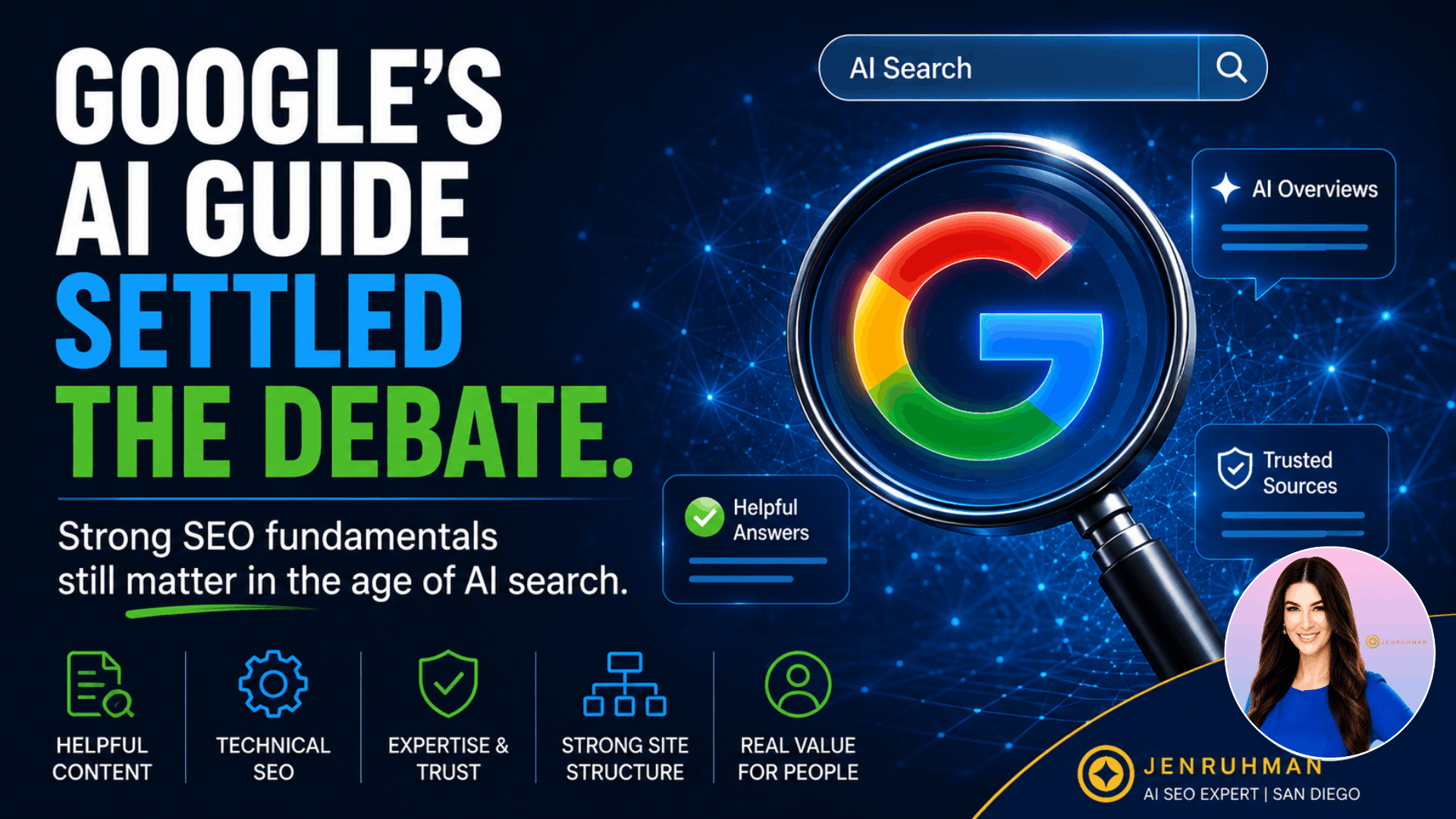
Google’s AI search experiences may change how information is displayed, but many of the fundamentals that help Google discover, understand and surface website content remain relevant.
Google specifically says that the same SEO best practices used for traditional search remain relevant for its AI features, including AI Overviews and AI Mode. Google also says there are no additional technical requirements, special schema or AI-specific files required to appear in these features.
You can read Google’s guidance directly here:
Google: AI features and your website
For small businesses, that’s important.
You don’t need to chase every new AI acronym.
You need a website that’s technically accessible, genuinely useful, easy to understand and built around the things your business actually knows and does.
Quick Answer: Do You Need a Different SEO Strategy for AI Search?
Not an entirely different one.
Google’s guidance for appearing in its AI search experiences continues to emphasize many familiar SEO fundamentals.
That means businesses should still focus on things such as:
- creating useful content for people
- making important pages crawlable and indexable
- maintaining strong technical SEO
- using internal links effectively
- providing a good page experience
- supporting important content with useful images and video where appropriate
- keeping business and product information accurate
- measuring performance through the tools Google provides
The biggest takeaway I see is this:
AI search isn’t a reason to abandon SEO. It’s another reason to get SEO right.
Google Isn’t Asking Businesses to Create a Second Website for AI
This is where I think a lot of the AI SEO conversation has become unnecessarily complicated.
Business owners sometimes come to me thinking they now need one strategy for Google, another for AI Overviews, another for ChatGPT, another for Gemini and another for every new AI platform that appears.
I don’t recommend approaching it that way.
Your first priority should still be building the strongest possible source of information about your business: your own website.
Your website should clearly communicate:
Who are you?
What do you do?
Who do you serve?
Where do you operate?
What experience do you have?
Why should someone trust you?
How do your services solve a customer’s problem?
If those basics aren’t clear, adding an “AI optimization” tactic isn’t going to magically solve the underlying problem.
Helpful Content Still Matters
One of the strongest principles behind Google’s search guidance continues to be creating content for people rather than creating pages primarily to manipulate search rankings.
That’s even more important now.
AI has made it incredibly easy to produce enormous amounts of generic content.
Anyone can ask an AI tool:
“Write 1,500 words about local SEO.”
And within seconds, there’s another article on the internet saying essentially the same thing as hundreds of others.
So what can make content genuinely useful?
Experience.
This is something I increasingly think about when creating SEO content.
Instead of simply explaining a topic, I look for opportunities to include:
real things I’ve seen working with clients
common mistakes I encounter
actual examples
case studies
before-and-after results
screenshots
original observations
local knowledge
and opinions based on professional experience.
That’s information another website can’t necessarily reproduce simply by targeting the same keyword.
Don’t Create Separate “AI Content” Just Because AI Search Exists
I wouldn’t start publishing dozens of articles about AI just because AI search is growing.
That’s exactly the kind of content expansion I’ve been cleaning up on my own website.
More content isn’t automatically better.
Every page should have a purpose.
Before publishing something, I want to know:
What question does this page answer?
Does another page already answer it?
Does this support one of my services or areas of expertise?
Is there a legitimate reason this page should exist?
That’s a healthier strategy than creating five slightly different articles around the same idea.
Sometimes the best SEO decision isn’t publishing another page.
It’s improving, consolidating or removing what you already have.
Your Website Still Needs to Be Crawlable
AI doesn’t eliminate technical SEO.
Your website still needs to be accessible to search engines.
That means I continue to pay attention to fundamentals such as:
Indexability
Internal links
Canonical tags
Robots directives
XML sitemaps
Mobile usability
Page performance
Site architecture
Duplicate content
Structured data where appropriate
You can create excellent content, but if Google can’t properly access or index the page, you’ve created an unnecessary obstacle.
Technical SEO isn’t glamorous.
But it remains part of the foundation.
Internal Linking Still Matters
This is something I’m paying even more attention to as websites accumulate content.
A site can have hundreds of useful pages and still become confusing if they’re poorly organized.
Internal links help users navigate between relevant resources and help search engines discover pages and understand aspects of website structure.
For example, this article is informational.
If you’re a business owner who wants professional help adapting your search strategy, my AI SEO services in San Diego page has a completely different purpose.
One page explains the subject.
The other explains how I can help.
That’s an important distinction.
Good internal linking isn’t about stuffing keyword-rich links everywhere.
It’s about helping people and search engines navigate the relationships between useful pages.
Your Most Important Information Should Be Available in Text
One practical consideration I wouldn’t overlook is how your important information is presented.
If essential information about your business exists only inside:
an image
a video
an animation
or a complicated interactive element
you’re making that information harder to access than necessary.
Visual content can absolutely improve a page.
But important information should also be clearly communicated in text.
For a service business, that includes basics such as:
What service do you provide?
Where do you provide it?
Who is it for?
What does it involve?
How can someone contact you?
Don’t make Google—or your customers—guess.
Structured Data Can Help Describe Your Content
Structured data is another area I continue to use where it makes sense.
Schema markup can provide explicit machine-readable information about certain types of content and entities.
Depending on the website, that might include supported structured data for:
organizations
local businesses
products
articles
breadcrumbs
events
videos
and other eligible content types.
But there’s an important distinction:
Schema isn’t a magic AI-ranking button.
Adding structured data doesn’t automatically make a business appear in an AI Overview.
Google explicitly says that businesses don’t need to add special schema or new machine-readable files just to appear in its AI search features.
I use structured data because it can help Google understand eligible information and can make content eligible for supported search features—not because I expect it to override weak content or poor SEO.
AI Search Makes Business Clarity Worth Paying Attention To
This is one area where I think small businesses should pay particular attention.
Your business shouldn’t look like five different companies depending on where someone finds you.
Your website, Google Business Profile, social profiles, business listings, reviews and other online references should accurately represent the same real-world business.
For a local company, I want potential customers to be able to understand:
Who is this business?
Where does it operate?
What does it specialize in?
Who are the people behind it?
Does the information elsewhere online support what’s being claimed on the website?
This isn’t some secret AI SEO trick.
It’s good brand building and good SEO.
If you want to understand the search concepts behind that more deeply, I explain them in my guide to semantic entities in SEO.
Local Businesses Still Have an Important Advantage
AI can generate generic information incredibly well.
But your business has something generic content doesn’t:
your actual experience.
A San Diego business can demonstrate things such as:
local projects
local customers
local reviews
real employees
real photographs
local case studies
community involvement
and genuine knowledge of the market.
Those are real differentiators.
If I’m optimizing a local business, I don’t want its website to sound like a generic national article with “San Diego” inserted every few paragraphs.
I want the local experience to be obvious because it’s real.
That’s one reason local SEO continues to matter even as search interfaces change.
Don’t Optimize Only for AI Overviews
Another mistake would be building your entire strategy around getting mentioned in an AI-generated answer.
Search behavior is becoming more diverse.
A potential customer might discover a business through:
traditional Google results
Google Maps
an AI Overview
ChatGPT
Gemini
YouTube
social media
reviews
a referral
or a branded search.
Your strategy should make your business easier to discover and evaluate across that entire journey.
That’s why I still care about rankings, links, service pages, Google Business Profiles, reviews, content, technical SEO, brand mentions and conversion optimization.
AI search is part of the ecosystem.
It isn’t the entire ecosystem.
If you’re particularly interested in Google’s AI-generated results, I’ve also written about how Google AI Overviews are changing local SEO for San Diego businesses.
What I Would Prioritize as a Small Business Owner
If I were running a small business and wondering what to do because of AI search, I wouldn’t begin by buying some mysterious “GEO package.”
I’d start with the fundamentals.
I’d make sure my most important service pages are excellent.
I’d fix technical problems that prevent Google from crawling or indexing important content.
I’d strengthen internal linking.
I’d remove or consolidate weak and overlapping content.
I’d publish genuinely useful information based on real expertise.
I’d continue earning legitimate reviews.
I’d make my business identity extremely clear.
I’d build authority around the subjects directly connected to what the business actually sells.
And I’d make sure the website turns visibility into inquiries.
That’s not as exciting as claiming there’s a secret formula for AI search.
But it’s a much stronger long-term strategy.
SEO and AI Optimization Aren’t Opposites
This is probably my biggest takeaway.
I don’t think businesses should view this as:
SEO vs. AI SEO.
The better question is:
How do we build a business and website that search systems can understand and people genuinely want to choose?
Good SEO already works toward much of that goal.
AI search gives businesses another search environment to consider, while many of the underlying SEO fundamentals remain relevant.
That’s why my approach to AI SEO in San Diego starts with the foundation rather than chasing gimmicks.
As a San Diego SEO expert, that’s also how I approach traditional SEO: build the strongest foundation first, then adapt as search evolves.
What Has Actually Changed?
That doesn’t mean nothing has changed.
Search absolutely is changing.
Users can now receive answers without clicking through a traditional list of search results.
AI systems can synthesize information from multiple sources.
Visibility can happen outside the traditional #1–#10 ranking model.
A business may also be mentioned or cited without immediately receiving a website click.
That means businesses increasingly need to think more broadly about search visibility, not simply rankings.
But that doesn’t invalidate SEO.
It expands the environments in which businesses may be discovered.
What About ChatGPT?
Google’s guidance applies specifically to Google’s search ecosystem.
I wouldn’t automatically assume that every recommendation Google makes tells us how ChatGPT, Claude, Perplexity or another AI platform chooses and presents information.
Different systems work differently.
That’s an important distinction.
The broader principles of having useful, accessible, accurate information still make sense, but I don’t claim that following Google’s guidelines guarantees visibility in another company’s AI product.
If you’re specifically interested in ChatGPT, I explain that separately in How to Get Your Business Recommended by ChatGPT and AI Search.
And if you’re wondering whether those AI platforms can actually produce measurable website visits, read Can ChatGPT Send Traffic to Your Website?.
Don’t Chase Every New AI SEO Tactic
AI search is moving quickly.
There will continue to be:
new tools
new terminology
new proposed standards
new optimization tactics
and plenty of confident predictions.
Some of them may become important.
Some won’t.
That’s why I try to separate experimentation from established SEO practices.
I’ll test new technology.
I’ll pay attention to how search changes.
I’ll adapt when the evidence supports it.
But I’m not going to tell a client to rebuild their entire strategy every time a new AI SEO acronym becomes popular.
My Approach to AI Search
When I work on AI search visibility, I don’t begin by asking:
“How do we trick an AI system into recommending this company?”
I begin with much more useful questions.
Is the website technically sound?
Are the important services clearly explained?
Does the company demonstrate genuine expertise?
Is the business easy to identify?
Is there original information worth finding?
Are important pages connected logically?
Does the company have a credible presence beyond its own website?
Can a visitor easily take the next step?
Those questions improve the overall digital presence rather than optimizing for one temporary interface.
Final Thoughts
If all the discussion around AI SEO has made you feel like you need to rebuild your marketing strategy from scratch, you probably don’t.
Start by getting the fundamentals right.
Create content worth finding.
Make your expertise obvious.
Keep your website technically accessible.
Build logical relationships between your pages.
Strengthen your brand.
Earn real-world trust.
And make it extremely easy to understand what your business does.
Google’s search experience will continue changing.
So will ChatGPT, Gemini and whatever comes next.
Your goal shouldn’t be to chase every interface change.
Your goal should be to become a source—and a business—worth finding.
If you’d like help figuring out where your website stands, learn more about my AI SEO services in San Diego or work directly with a San Diego SEO expert.
Get found. Get trusted. Get chosen.
— Jen Ruhman
San Diego SEO Expert
Frequently Asked Questions
Does Google say businesses need special AI SEO?
Google’s guidance for its AI search experiences largely points businesses back to established SEO fundamentals rather than requiring a completely separate optimization system. Google says the same SEO best practices remain relevant for AI features such as AI Overviews and AI Mode.
Do I need to optimize separately for Google AI Overviews?
You don’t need a separate website or special AI-only content strategy just for AI Overviews. Google says pages need to be indexed and eligible to appear in Google Search, while established SEO best practices remain relevant.
Does technical SEO still matter for AI search?
Yes. For Google’s AI search features, Google continues to recommend technical fundamentals that allow it to crawl, index and understand important website content.
Does schema markup help with AI search?
Structured data can help Google understand eligible information and support certain search features, but Google says no special schema markup is required to appear in AI Overviews or AI Mode. Structured data should accurately represent the visible content on the page.
Should small businesses create more content for AI search?
Not automatically. More pages can create duplication and overlapping search intent. I recommend publishing content when it fills a genuine information gap, demonstrates useful expertise or supports an important part of the business.
Is local SEO still important with AI search?
Yes. Local businesses still need accurate business information, strong service pages, genuine local relevance, customer reviews, a useful Google Business Profile and a website that clearly explains what they do and where they operate.
Is AI SEO replacing traditional SEO?
I wouldn’t view AI SEO and traditional SEO as opposites. AI-powered search is changing how information can be discovered and presented, but many established SEO fundamentals remain relevant.