Aug 28, 2025 | AI, SEO Tips
By Jen Ruhman SEO – Call/Text Me: (619) 719-1315
When I first started doing SEO years ago, the goal was simple: get to the top of Google’s organic results. Today, the game has changed. With Google AI Overviews, Bing Copilot, and AI-driven results, search is no longer just about links—it’s about answers.
If you’ve searched recently, you’ve probably seen AI Overviews appear at the very top of Google’s results. These summaries pull information from trusted sites and give users the answer instantly—without always clicking through to a website. This can feel scary for business owners, but here’s the good news: if you optimize correctly, your content can be the one Google cites in these AI Overviews.
That’s where Answer Engine Optimization (AEO) comes in. In this post, I’ll break down step-by-step how to optimize your content for answer engines like Google AI Overviews, using real-world strategies I use every day for my SEO clients here in San Diego.
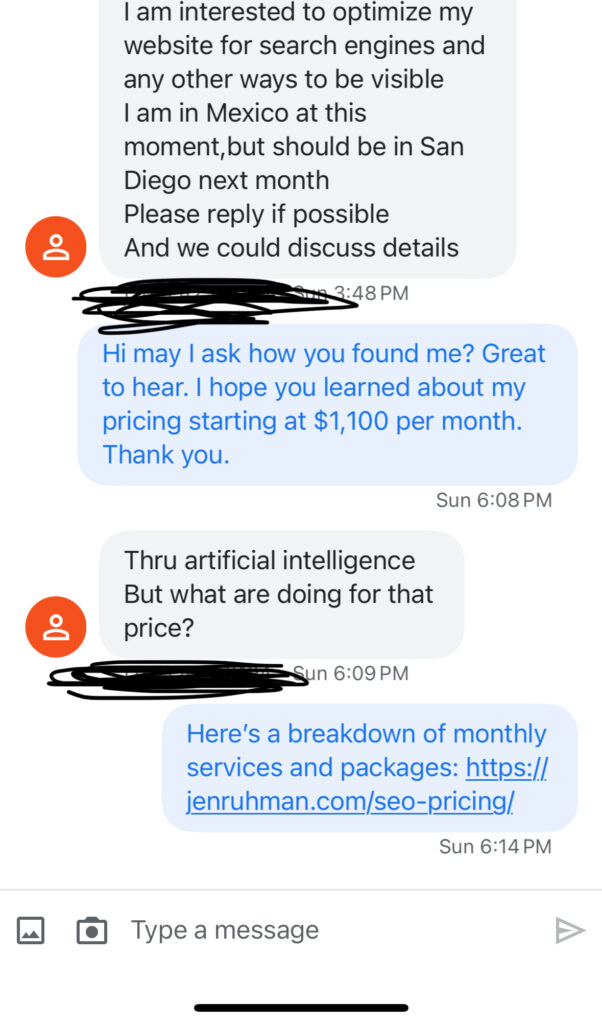
Here’s proof I get found all sorts of ways online.
Why Optimizing for AI Overviews Matters
Imagine this: A potential customer types in “What’s the best time to move in San Diego?” Instead of scrolling through ten blue links, Google’s AI Overview gives them a neat summary. If your moving company’s blog post is cited, your brand is now front and center in Google’s trusted answer.
That’s huge. It’s like being quoted by Google itself. And in my experience, when clients’ content shows up in these overviews, they see a noticeable bump in brand authority—even if clicks don’t always follow right away.
For me, it’s not just about traffic—it’s about trust and visibility.
Step 1: Write Concise, Direct Answers
AI Overviews love clear, structured answers. I always recommend writing a short, 2–3 sentence answer at the top of your article or under each subheading. (I like to stick with the first H tag on the page and have a short summary of the page)
For example, when I was helping a local med spa client rank for “How long do lip fillers last in San Diego?” we added a clear, one-paragraph answer at the top of their blog post. That answer got picked up in Google’s featured snippet and later in AI Overviews.
Pro tip:
Write your content as if you’re directly answering a customer’s question in person.
Avoid fluff—be clear, simple, and precise.
Step 2: Use Structured Data and Schema
Search engines love structure. Adding schema markup to your content tells Google what your page is about in a machine-readable way.
For example:
FAQ Schema can highlight your question-and-answer sections.
How-To Schema works well for step-by-step guides (like this one).
Organization Schema helps establish your brand authority.
When I first implemented FAQ schema for a real estate client, they not only started appearing in rich snippets, but I also noticed some of their answers being pulled into AI Overviews. Schema doesn’t guarantee inclusion, but it gives your content a better shot at being chosen.
Step 3: Focus on Snippet Targeting
AI Overviews often pull from the same content that would rank in featured snippets. So, if you’ve ever optimized for snippets, you’re already ahead of the game.
Here’s what I recommend:
Use question-based H2s and H3s. Example: “What is Answer Engine Optimization (AEO)?”
Provide bulleted or numbered lists. Google loves pulling lists into snippets.
Keep answers tight. 40–60 words often works best.
One time, I optimized a blog for a local dog trainer with Q&A sections formatted under H2s. Within a month, their answer showed up in a snippet, and guess what—later, it appeared in AI Overviews too.
That’s why I always say: if you aim for snippets, you’re also aiming for AI.
Related post: How Google’s AI Overviews Are Changing Local SEO — And How San Diego Businesses Can Adapt
Step 4: Prioritize Entity Clarity
AI tools rely heavily on entities—people, places, brands, and things clearly defined. If your content confuses Google about what you’re talking about, you won’t be chosen.
Here’s how to improve entity clarity:
Always define acronyms (e.g., AEO = Answer Engine Optimization).
Use internal links to related topics (for example, linking your “What is SEO?” page).
Mention relevant organizations, locations, and experts.
For example, when I write about SEO in San Diego, I don’t just say “local businesses.” I’ll say “San Diego businesses like med spas in Point Loma or moving companies in Encinitas.” That context helps Google connect my content to real-world entities.
Step 5: Optimize for Voice and Zero-Click Queries
AI Overviews aren’t just about text—they’re also powering voice search and zero-click results.
Think about how people talk when they ask questions:
That’s why I include conversational phrasing in content. If it sounds like something a person would ask Alexa, Siri, or Google Assistant, you’re on the right track.
One of my clients runs a fertility clinic, and we optimized content for questions like, “Can acupuncture help with fertility?” That exact phrasing showed up in AI-powered results.
Related post: Why People Still Click for Local Services (Even with AI)
Step 6: Build Recognized Authority Signals
AI Overviews lean heavily on trusted sources. If your site looks brand-new or low authority, it’s less likely to be cited.
Here’s what works:
Get high-quality backlinks. (Think local news, niche blogs, directories.)
Be consistent with your brand. Use the same name, phone number, and address everywhere.
Cite external sources. Google trusts sites that cite other trusted sites.
When I first launched my SEO company here in San Diego, it took time before my site was seen as an authority. But once I got local backlinks—like features in San Diego business directories—I started noticing more visibility in snippets and AI citations.
Step 7: Measure and Adapt
The tricky part? AI Overviews are still evolving. I always tell clients: treat this as an experiment.
Track your content with tools like:
I’ve had clients call me and say, “Jen, we’re showing up in Google’s AI summary, but we’re not seeing clicks.” And I’ll explain—that visibility is still powerful. It puts your brand in front of thousands of eyes. Sometimes that’s enough to earn trust before they ever click.
Bringing It All Together
Here’s the simplified formula I follow for AEO success:
Concise answers → Write short, direct answers to questions.
Structured data → Use schema markup to signal meaning.
Snippet targeting → Optimize with Q&A, lists, and summaries.
Entity clarity → Be crystal clear about what and who you’re talking about.
Conversational phrasing → Write for voice and natural queries.
Authority signals → Build trust with backlinks and citations.
Continuous testing → Track and adapt as AI evolves.
I apply this step-by-step process for clients every day, and I’ve seen the results firsthand. When you optimize for answer engines, you’re not just playing the SEO game—you’re staying one step ahead.
Frequently Asked Questions About AI Overviews & AEO
1. What is Answer Engine Optimization (AEO)?
Answer Engine Optimization (AEO) is the practice of creating content that’s designed to be picked up by AI-powered results, like Google AI Overviews, featured snippets, and voice search answers. Unlike traditional SEO that just aims for ranking, AEO makes sure your content is clear, structured, and authoritative so search engines can confidently cite it as the best answer.
2. How do I optimize my website for Google AI Overviews?
To optimize for AI Overviews, start by writing direct, concise answers to common questions your audience asks. Then, support those answers with schema markup, strong headings, and bullet lists where it makes sense. You’ll also want to make sure your site has entity clarity (be crystal clear about the people, places, and topics you’re talking about) and that your brand builds authority signals like backlinks, citations, and consistent business info across the web.
3. Does schema markup help with AI Overviews?
Yes—schema markup is one of the best ways to help search engines understand your content. While schema alone won’t guarantee your content shows up in AI Overviews, it gives your site a much better chance. For example, FAQ schema highlights your question-and-answer content, while How-To schema signals step-by-step guides. Schema adds that extra layer of clarity Google looks for when deciding which content to feature.
4. What’s the difference between SEO and AEO?
Traditional SEO is all about getting ranked on page one of Google. AEO, on the other hand, is about being chosen by Google (or Bing, or Perplexity) when they generate AI-driven answers. SEO focuses on traffic from clicks, while AEO is more about brand authority and visibility—making sure your business is the one people see at the very top of AI Overviews, even if they don’t always click through.
5. How can small businesses in San Diego benefit from AI Overviews?
If you’re a small business owner here in San Diego, showing up in an AI Overview can be a game-changer. Even if customers don’t immediately click, they still see your name, your brand, and your authority. For example, when one of my local clients was cited in Google’s AI Overview for a common service question, they started getting more calls from people who said, “I saw your business in Google’s answer.” That kind of visibility builds trust instantly—and trust is what drives future conversions.
Related post: AI SEO vs Traditional SEO: What San Diego Businesses Must Know in 2025
Final Thoughts about AI
AI search isn’t the future—it’s the present. Whether you run a med spa, a law office, or a moving company, optimizing for AI Overviews ensures that your business is the one people see first.
If you’re feeling overwhelmed or not sure where to start, don’t worry—that’s exactly why I do what I do. I’ve helped countless San Diego businesses adapt to Google’s changes, and I can help you too.
Call or text me today at (619) 719-1315 if you’d like me to personally review your site and create a custom Answer Engine Optimization strategy. I’m San Diego’s favorite SEO company and I’m just 1 text message or phone call away from ranking your business!
Because at the end of the day, it’s not just about being found—it’s about being chosen.

Jul 25, 2025 | AI, SEO Tips
If you work on SEO long enough, you’ll eventually hear people talk about topical authority and Domain Authority.
They sound similar, but they’re not the same thing.
And there’s an important distinction business owners should understand:
Neither is an official Google ranking score.
Topical authority is an SEO concept used to describe how thoroughly and credibly a website covers a particular subject.
Domain Authority is a third-party metric used by SEO tools to estimate the relative strength of a domain.
I’m Jen Ruhman, a San Diego SEO expert, and I use both concepts when evaluating websites—but in very different ways.
Here’s how I think about them.
Quick Answer: Topical Authority vs. Domain Authority
Topical authority describes the depth, relevance and credibility a website develops around a particular subject.
Domain Authority is a third-party SEO metric designed to estimate the relative strength of a domain, often based heavily on backlink-related data.
Google does not provide website owners with an official “topical authority score.”
Google also does not use third-party Domain Authority scores as its ranking metric.
That’s why I don’t build SEO strategies around trying to maximize either number.
The real objective is much more important:
Relevant rankings, qualified traffic, leads and revenue.
What Is Topical Authority?
Topical authority is a useful way of thinking about how thoroughly a website covers the subjects connected to its expertise.
For example, imagine two websites publish an article about retirement planning.
One website has that single article.
The other has useful resources covering:
- Retirement income planning
- Social Security
- Required minimum distributions
- Tax-efficient withdrawals
- Estate planning
- Long-term care
- Investment allocation
- Common retirement questions
Those pages aren’t simply keyword variations.
They’re different subjects and questions that naturally belong within a broader retirement-planning topic.
Together, they create meaningful depth.
I explain this concept—and how I build it without creating unnecessary duplicate content—in my full guide to topical authority in SEO.
What Is Domain Authority?
Domain Authority is different.
The term Domain Authority is most closely associated with Moz’s proprietary SEO metric. Other SEO platforms have their own authority metrics and scoring systems.
These tools attempt to estimate the relative strength or ranking potential of websites using their own data and methodologies.
That can be useful.
I may look at third-party authority metrics when I’m:
- Comparing competitors
- Evaluating backlink profiles
- Researching link opportunities
- Identifying suspicious backlink patterns
- Prioritizing outreach
But I don’t treat the score as the goal of an SEO campaign.
A business doesn’t make money because its authority metric increased from 25 to 40.
The business benefits when SEO produces more visibility for valuable searches and ultimately contributes to leads and customers.
Is Domain Authority a Google Ranking Factor?
No.
This is probably the most important misconception to clear up.
A third-party Domain Authority score is not a Google ranking metric.
SEO platforms calculate their own metrics using their own indexes and formulas.
That doesn’t make the data useless.
It simply means you shouldn’t confuse a third-party measurement with Google’s ranking systems.
I use authority metrics as diagnostic information, not as Google’s report card for a website.
Is Topical Authority a Google Ranking Factor?
Not in the simple way people sometimes describe it.
Google doesn’t give website owners a metric called:
Topical Authority Score: 87/100
When I talk about building topical authority, I’m using the term as a framework for creating a website with strong, relevant and useful coverage around the subjects that matter to the business.
I’m looking at whether the relationships between:
services → expertise → supporting content → internal links → external authority
make sense.
That’s very different from trying to manipulate an imaginary score.
Topical Authority vs. Domain Authority: The Main Difference
Here’s the easiest way I explain it.
| Topical Authority | Domain Authority |
|---|
| What it describes | Depth and credibility around a subject | Estimated relative strength of a domain |
| Official Google metric? | No | No |
| Where it comes from | SEO concept/framework | Third-party SEO tools |
| Often associated with | Content depth, expertise, relevance and site structure | Backlink/profile data |
| Useful for | Content and site strategy | Competitive and backlink analysis |
| Should you chase a score? | No official score exists | No |
| How I use it | Build meaningful subject expertise | Diagnostic/competitive research |
The distinction matters because a website can look strong according to an SEO tool while still having poor content for a particular subject.
And a smaller website can have excellent, highly relevant content even if its third-party authority metrics aren’t especially high.
What About Backlinks?
Backlinks still matter.
But “backlinks matter” and “you need the highest Domain Authority possible” are not the same statement.
When I’m evaluating links, I’m interested in things like:
- Relevance
- Credibility
- Editorial value
- Context
- Brand exposure
- Referral potential
- Authority
I’d rather earn a legitimate mention from a relevant publication, organization or industry resource than chase hundreds of low-value links simply to move a third-party score.
That’s why my approach to digital PR and link building focuses on building legitimate external authority rather than collecting links for the sake of a metric.
Can a Website Have High Domain Authority but Weak Topical Authority?
Yes.
Imagine a large established website with thousands of backlinks.
It publishes one article about a specialized subject it has barely covered before.
The strength of the domain doesn’t automatically mean that particular page is the best resource for that search.
Likewise, a smaller specialized website may have extensive first-hand expertise and excellent resources around that exact subject.
That’s why I don’t evaluate pages based on a single website-wide metric.
SEO is more complicated than that.
Can a Website Have Strong Topical Authority but Few Backlinks?
It can certainly have excellent topical coverage while having relatively little external authority.
But in a competitive search market, strong content doesn’t mean backlinks and external credibility become irrelevant.
This is why I don’t frame the strategy as:
Topical authority OR backlinks.
I want a website to develop useful depth and legitimate external authority.
The balance will vary depending on the business, competitors and search market.
Internal Links Connect Your Topical Content
Another important difference is that topical authority is heavily connected to how information is organized.
You don’t want dozens of related articles sitting in isolation.
Relevant pages should connect naturally.
Supporting content can link to important service pages.
Related educational articles can link to one another.
Case studies can connect to the services they demonstrate.
I explain the mechanics in my guide to internal linking for SEO.
The important point here is that good internal linking helps create relationships between your content instead of leaving every page on its own.
What About Topical Authority and AI Search?
AI-powered search has made topical authority a popular subject again.
But I would be careful with claims that businesses need a special “AI authority score.”
There isn’t a universal topical-authority score that guarantees your business will appear in ChatGPT, Google AI Overviews or another AI-powered search experience.
I focus instead on making a business and its expertise easy to understand through useful content, clear site structure, original information, internal linking and credible external signals.
That’s also how I approach AI SEO services in San Diego.
AI search changes some aspects of discovery, but it doesn’t make strong SEO fundamentals obsolete.
How Do I Measure Topical Authority?
Because there isn’t an official topical-authority metric, I don’t reduce it to one number.
I look at real search performance.
For example:
Are relevant queries gaining impressions?
Are supporting pages beginning to rank?
Are important commercial pages improving?
Is Google ranking the page I intended for a particular query?
Is the website gaining visibility across more of the relevant topic?
Are qualified organic leads increasing?
Those indicators tell me much more about whether the strategy is working than an arbitrary topical-authority score.
Are Domain Authority Tools Still Useful?
Yes.
The fact that Domain Authority isn’t a Google metric doesn’t make SEO tools useless.
Third-party authority metrics can be extremely helpful for competitive analysis, backlink research and identifying potential opportunities.
The mistake is turning the metric into the business objective.
If your authority score goes up but your qualified organic visibility, leads and revenue don’t improve, you haven’t necessarily accomplished much.
So Which One Should Businesses Focus On?
I don’t think businesses need to choose between them.
Instead, I focus on what each concept tells me.
Topical authority reminds me to build meaningful expertise and useful content around subjects that matter to the business.
Domain Authority and similar third-party metrics can give me additional information about the website’s relative external authority and backlink profile.
Neither should become the goal by itself.
For most businesses, the stronger strategy is to build:
useful topical depth + strong service pages + logical internal linking + relevant external authority + real expertise.
That’s much closer to how I approach SEO campaigns for clients.
Final Thoughts
Topical Authority and Domain Authority describe two very different things.
Topical authority is a framework for thinking about the depth and relevance of a website’s expertise.
Domain Authority is a third-party SEO metric used to estimate relative domain strength.
Neither is an official Google score.
And neither should distract you from what SEO is ultimately supposed to accomplish.
I care much more about whether Google understands what your business does, whether your website deserves to rank for the searches that matter, and whether that visibility produces qualified business.
If you want to learn how to build the content side of this strategy, start with my complete guide to topical authority.
And if you need help putting the entire strategy together, I work directly with businesses through my San Diego SEO company.
Get found. Get trusted. Get chosen.
— Jen Ruhman
San Diego SEO Expert
Frequently Asked Questions
What is the difference between topical authority and Domain Authority?
Topical authority is an SEO concept describing a website’s depth and credibility around a particular subject. Domain Authority is a third-party metric designed to estimate the relative strength of a domain.
Is Domain Authority a Google ranking factor?
No. Domain Authority is a third-party SEO metric, not an official Google ranking metric.
Is topical authority a Google ranking factor?
Google doesn’t publish an official “topical authority” score. It’s better understood as an SEO framework for building useful, relevant depth around subjects connected to a website’s expertise.
Can a low Domain Authority website outrank a high Domain Authority website?
Yes. Third-party authority scores don’t determine Google’s rankings. Google uses many signals when determining which pages to show for a search.
Do backlinks still matter?
Yes. Links remain an important part of SEO, but they should be considered alongside content quality, relevance, technical SEO, internal linking, site structure and other factors.
Should I focus on topical authority or Domain Authority?
Don’t treat either as the sole objective. Build useful topical depth while also developing legitimate external authority, and measure success using meaningful SEO and business outcomes.

Jul 22, 2025 | AI, SEO Tips
Search is changing again.
For years, SEO was largely discussed in terms of one goal: getting your website higher in Google’s search results.
That’s still important. But today, potential customers can discover businesses through Google Search, Google Maps, AI Overviews, ChatGPT, Perplexity, and other AI-powered search experiences.
That’s where Generative Engine Optimization, or GEO, enters the conversation.
I’m Jen Ruhman, a San Diego SEO expert, and I’ve watched search evolve for more than 20 years. I’ve seen businesses adapt to mobile search, local search, Google Maps, featured snippets, major algorithm updates, and now AI-powered search.
I don’t see GEO as a replacement for SEO.
I see it as another evolution of search optimization.
The underlying goal is still remarkably familiar: make it easy for search systems and potential customers to understand who you are, what you do, where you do it, and why your information is useful and trustworthy.
Here’s what San Diego business owners should know.
What Is Generative Engine Optimization (GEO)?
Generative Engine Optimization is a term used to describe efforts to improve how content, brands, products, services, and expertise are represented in AI-generated search experiences.
Instead of optimizing exclusively for a traditional list of search results, GEO considers how information may be discovered, interpreted, summarized, cited, or surfaced by AI-powered systems.
That can include experiences such as:
- Google AI Overviews
- AI-powered search features
- ChatGPT
- Perplexity
- Other generative AI search and answer systems
There isn’t one universal GEO algorithm.
Different platforms use different models, indexes, retrieval systems, data sources, and methods for generating answers.
That’s why I’m cautious whenever I hear someone promise that a particular tactic will “rank you #1 in ChatGPT.”
AI search doesn’t work exactly like a traditional Google results page.
There are, however, things businesses can do to make their websites and overall digital presence easier to discover, understand, and verify.
That’s where GEO overlaps heavily with good SEO.
Related: AI SEO vs. Traditional SEO: What San Diego Businesses Need to Know
GEO vs. Traditional SEO: What’s the Difference?
Traditional SEO focuses heavily on helping webpages appear prominently in search engines for relevant searches.
That includes things such as:
- Keyword and topic research
- Search intent
- Website architecture
- On-page optimization
- Technical SEO
- Internal linking
- Backlinks
- Local SEO
- Google Business Profile optimization
- Content quality
- User experience
Those things haven’t suddenly become obsolete.
GEO expands the conversation.
Instead of asking only:
“How do I get this page to rank in Google?”
we can also ask:
“Does the web clearly communicate what this business is known for?”
“Can AI-powered systems understand the relationship between this business, its services, its expertise, and its location?”
“Is the information easy to extract and interpret?”
“Are important claims supported by trustworthy information?”
“Does the business have a consistent presence beyond its own website?”
That’s why I don’t separate GEO completely from SEO.
There is substantial overlap.
For businesses that want professional help building that broader search visibility, my AI SEO services in San Diego focus on strengthening the same core foundation while adapting it for the changing search landscape.
From Keywords to Concepts
Traditional keyword research still matters, but modern search isn’t limited to matching an exact phrase on a page.
Search systems can also use context and relationships between concepts to better understand what a page—and a business—is about.
For example, if a website discusses local SEO, related concepts might naturally include Google Business Profile, Google Maps, reviews, service areas, local search intent and location-specific service pages.
That doesn’t mean keywords have stopped mattering.
It means I don’t optimize a page by asking only:
“How many times did I use my target keyword?”
I also ask:
“Does this page clearly explain the subject and its relationship to the rest of the website?”
That’s one reason site structure, internal linking and topical organization matter. A strong website creates clear relationships between its services, supporting information and the business behind them.
For GEO and AI-powered search, I think that’s a much more durable approach than trying to find a special list of “AI keywords.”
Does GEO Replace SEO?
No.
I wouldn’t recommend abandoning traditional SEO to chase AI search.
In fact, many of the things that make a website strong for traditional search also make the business easier to understand across other search experiences.
You still need clear service pages.
You still need useful content.
You still need internal links.
You still need a technically accessible website.
Local businesses still need accurate business information.
Google Business Profile still matters.
Reputation still matters.
Authority still matters.
And customers still need a compelling reason to choose your business once they find you.
GEO adds another layer to that foundation rather than replacing it.
Why GEO Matters for San Diego Businesses
The way people search is becoming increasingly conversational.
Someone might traditionally type:
med spa San Diego
But someone using an AI assistant might ask:
What are some med spas in San Diego that specialize in natural-looking Botox?
A homeowner might traditionally search:
roofing company San Diego
An AI-style search could look more like:
What should I look for when choosing a roofing company near me?
Or someone looking for my services could search Google for:
SEO company San Diego
while another person could ask an AI assistant:
Who helps small businesses in San Diego with Google SEO and AI search?
The underlying need may be similar.
The way the question is expressed is different.
That’s why businesses need more than exact-match keywords scattered throughout their websites.
Your website needs enough context for people and machines to understand what your business actually does.
The Foundation of a Strong GEO Strategy
I don’t believe there’s a secret GEO checklist that guarantees inclusion in an AI-generated answer.
Instead, I focus on strengthening the overall information environment surrounding a business.
Here are the areas I consider especially important.
1. Make Your Business Extremely Easy to Understand
This is one of the first things I look at when auditing a website.
Can I immediately tell:
What does this business do?
Who does it help?
Where does it operate?
What services does it provide?
Who is behind the company?
You’d be surprised how many websites make these questions difficult to answer.
Businesses often replace clear descriptions with vague marketing language.
For example:
Innovative solutions designed to elevate your future.
It sounds polished.
But what does the company actually sell?
Clear language helps potential customers understand your business, and it also creates stronger context for search systems.
2. Build Strong Service Pages
Your homepage shouldn’t have to explain every service your company provides.
Important services usually deserve dedicated pages with enough information to establish:
- What the service is
- Who it’s for
- What problem it solves
- How your company approaches it
- Relevant expertise
- Frequently asked questions when useful
- What someone should do next
This also helps create a logical website structure.
For example, I have a dedicated AI SEO service page because that’s a service I want potential clients and search engines to clearly understand.
I don’t need every AI article on my website competing for the same commercial phrase.
The service page owns the commercial intent.
Supporting articles provide additional depth.
That’s the same architecture I recommend for clients.
3. Build Topical Depth Without Creating Duplicate Content
One article can answer one question well.
A collection of useful, distinct articles can explain an entire subject.
That’s topical depth.
But there’s an important distinction between depth and duplication.
Publishing ten articles that essentially answer the same question doesn’t necessarily strengthen your website.
It can make it harder for Google to determine which URL deserves to rank.
I’ve been consolidating content on my own website for exactly this reason.
I’d rather have a smaller collection of strong pages with clearly defined jobs than hundreds of pages repeating one another.
For GEO and AI search, useful supporting topics might cover:
- AI SEO versus traditional SEO
- Google AI Overviews
- AI search and local SEO
- How AI systems access websites
- Structured content
- ChatGPT referral traffic
- Entity clarity
- Search intent
- Trust and authority
Each page should contribute something different.
4. Structure Content Clearly
Good content doesn’t need to sound complicated.
In fact, clear content is usually better.
I like pages with:
- Descriptive headings
- Direct answers
- Short, readable paragraphs
- Logical sections
- Useful examples
- Supporting details
- Clear relationships between topics
If a section asks:
What is Generative Engine Optimization?
I want the answer to appear immediately beneath it.
I don’t want readers to scroll through six paragraphs before getting the definition.
This isn’t about writing for robots.
It’s about organizing information well.
Humans appreciate that too.
5. Use Structured Data Appropriately
Schema markup can help search engines understand certain information on a webpage.
Depending on the content, appropriate structured data might describe an organization, person, article, product, event, local business, or other supported entity or content type.
But schema is not a magic AI visibility switch.
Adding FAQ schema doesn’t guarantee that ChatGPT will recommend your company.
Adding LocalBusiness schema doesn’t guarantee an AI Overview citation.
And adding every possible schema type to a page isn’t a GEO strategy.
I use structured data where it’s appropriate and accurately reflects what’s actually on the page.
Think of schema as another way to clarify information—not a shortcut around creating a strong website.
6. Strengthen Your Business as an Entity
One of the concepts I think business owners should understand as search evolves is entity clarity.
Your business isn’t merely a collection of keywords.
It’s an entity with relationships.
For my own business, for example, I want the web to consistently reinforce relationships such as:
Jen Ruhman → SEO → San Diego → Local SEO → Google Search → AI Search
That connection shouldn’t exist only because I repeated “San Diego SEO expert” a certain number of times.
It should be reinforced through my website, service pages, About page, professional profiles, Google Business Profile, interviews, articles, books, mentions, reviews, and other legitimate sources.
The clearer and more consistent your online presence becomes, the easier it is for people—and potentially machines—to understand what you’re associated with.
7. Show Who Is Behind Your Content
AI has made generic content incredibly easy to produce.
That makes real experience more important.
I want visitors to know who wrote an article.
I want them to know why that person understands the subject.
That can mean adding:
- Author information
- Relevant experience
- Professional credentials when applicable
- First-hand examples
- Case studies
- Original observations
- Real business experience
I’ve worked in SEO for more than 20 years.
That context matters when I’m writing about SEO because I’m not simply summarizing something I read yesterday.
I’ve watched the industry change.
I’ve worked on real websites.
I’ve watched strategies succeed and fail.
I’ve dealt with ranking changes, migrations, technical problems, content issues, local SEO, Google Business Profiles, client expectations, and algorithm changes.
That’s the kind of experience I want reflected in my content.
8. Earn Relevant Mentions Beyond Your Website
Your website is one source of information about your company.
It shouldn’t be the only one.
Legitimate third-party mentions can help strengthen your overall digital footprint.
That might include:
- Local media coverage
- Industry publications
- Business associations
- Podcasts
- Interviews
- Professional directories
- Community organizations
- Relevant websites
- Customer reviews
I don’t recommend manufacturing hundreds of low-quality links simply to make your backlink count bigger.
I’d rather earn a handful of meaningful mentions from sources that make sense for the business.
That’s good digital PR.
It’s also good brand building.
9. Don’t Write for AI Instead of People
One mistake I expect businesses to make with GEO is trying too hard to “feed AI.”
Don’t forget who ultimately pays you.
Humans.
If someone reaches your website from Google, an AI Overview, ChatGPT, a recommendation, social media, or anywhere else, the website still has to convince that person that your company is worth contacting.
Your content should be:
Clear.
Useful.
Accurate.
Easy to navigate.
Trustworthy.
Specific.
Written for real customers.
If optimizing for AI makes your website awkward for people, something has gone wrong.
10. Publish Information Worth Referencing
This may become increasingly important as generic AI-generated content floods the web.
Ask yourself:
Why would anyone reference my website instead of the thousands of other websites discussing this topic?
That’s where original expertise becomes powerful.
Publish things other businesses can’t easily copy.
That could include:
- Original case studies
- First-hand experience
- Your own data
- Experiments
- Local knowledge
- Customer questions
- Professional observations
- Before-and-after examples
- Unique processes
- Research
- Strong expert commentary
You don’t need to invent a revolutionary SEO theory every week.
You need to contribute something useful.
What About Google AI Overviews?
Google AI Overviews can provide generated responses directly within Google Search.
That creates both opportunities and challenges for businesses.
A searcher may get part of the answer without clicking a traditional organic result.
At the same time, AI-powered search experiences can expose users to sources, businesses, products, and ideas they may not have discovered through a traditional ranking alone.
There is no guaranteed formula that makes a webpage appear in an AI Overview.
That’s important.
I would be extremely skeptical of anyone promising guaranteed AI Overview placement.
My approach is to strengthen the same fundamentals that make information easier to discover and understand:
Clear content.
Strong SEO.
Useful information.
Logical site architecture.
Authority.
Technical accessibility.
Relevant internal links.
Accurate business information.
Real expertise.
Then we monitor how search continues to evolve.
Is Schema Required for GEO?
No.
Schema can be useful, but I wouldn’t call it a requirement for being surfaced by AI systems.
That’s an important update from the way GEO was sometimes discussed when AI search first started gaining attention.
Structured data can help describe certain information to search engines.
Use it where appropriate.
But don’t mistake structured data for authority, expertise, relevance, or content quality.
You can’t schema-markup your way around a weak website.
Does GEO Guarantee ChatGPT Will Recommend Your Business?
No.
Neither I nor any other SEO professional can legitimately guarantee that ChatGPT, Google AI Overviews, Perplexity, or another AI platform will recommend a particular business.
These systems change.
Responses can vary.
Their sources can vary.
Different prompts can produce different results.
What businesses can do is improve the clarity, accessibility, authority, and consistency of their online presence.
That’s a much more sustainable strategy than chasing a supposed AI loophole.
If you’re specifically interested in this topic, I wrote a separate guide on how to get your business recommended by ChatGPT and AI search.
Is GEO Just Another Name for AI SEO?
You’ll see several terms used as this area develops:
GEO — Generative Engine Optimization
AEO — Answer Engine Optimization
AI SEO — AI Search Optimization
People don’t always use these terms in exactly the same way.
I don’t think business owners need to become obsessed with the terminology.
The larger question is more important:
Can customers find and understand your business wherever they’re searching?
That’s what matters.
For my clients, I increasingly think about visibility across a broader search ecosystem rather than treating Google rankings, Google Maps, AI Overviews, and AI assistants as completely unrelated worlds.
Does My San Diego Business Need GEO?
You probably don’t need to throw away your current SEO strategy and start over.
If your website already has strong SEO fundamentals, you’re starting from a much better position.
I would first evaluate:
Is your website technically accessible?
Are your services clearly explained?
Is your local presence strong?
Does your Google Business Profile accurately represent the business?
Do you have useful content?
Does your website demonstrate real expertise?
Are important pages internally connected?
Does information about your company remain consistent across the web?
Are you earning legitimate reviews and mentions?
Those are foundational questions.
Once those pieces are strong, adapting to AI-powered search becomes much more logical.
Frequently Asked Questions About Generative Engine Optimization
Is GEO replacing traditional SEO?
No. I view GEO as an extension of search optimization rather than a replacement for SEO. Traditional fundamentals such as technical accessibility, strong service pages, relevant content, authority, internal linking, and local SEO remain important.
Can GEO get my business into ChatGPT?
There is no guaranteed method for getting a business recommended by ChatGPT. Businesses can improve how clearly and consistently they’re represented online, but individual AI-generated responses can’t be guaranteed.
Do I need to redo my entire website for GEO?
Usually not. In many cases, the better starting point is improving existing pages, strengthening site structure, clarifying services, improving internal links, adding appropriate structured data, and creating genuinely useful content where gaps exist.
Do I need schema for AI search?
Schema can help search engines interpret certain information, but it isn’t a guaranteed AI visibility tactic. Use structured data when it accurately describes content on the page.
How long does GEO take?
There isn’t a universal GEO timeline. Search engines and AI platforms change continuously, and visibility depends on many factors. I prefer treating AI-search optimization as an ongoing extension of a strong SEO strategy rather than promising results within a fixed number of days.
Can local businesses benefit from AI search?
Potentially, yes. Consumers increasingly use conversational searches when researching businesses and services. Having clear services, location information, expertise, reputation signals, and a strong overall online presence can help a local business adapt to these changing search behaviors.
The Future of Search Isn’t SEO vs. GEO
I don’t think businesses should choose between SEO and GEO.
The distinction will probably become less important over time.
Customers don’t care what acronym brought them to your company.
They care whether they found the right business.
That’s why my strategy continues to center around something simple:
Make the business easy to find.
Make the business easy to understand.
Give people reasons to trust it.
Create useful information worth finding.
Build authority around what the business actually does.
Google Search may change.
AI search will change.
ChatGPT will change.
New platforms will appear.
But building a clear, useful, authoritative digital presence gives your business a much stronger foundation for adapting to whatever comes next.
Want Your San Diego Business to Be Ready for AI Search?
I help San Diego businesses improve their visibility across traditional Google search, local search, and emerging AI-powered search experiences.
My approach doesn’t rely on tricks, guaranteed AI citations, or mass-produced content.
I combine proven SEO fundamentals with strategies designed to make your business easier to understand across today’s changing search landscape.
If you’d like to learn more, visit my AI SEO services in San Diego page.
Or call/text me directly at (619) 719-1315.
Get found. Get trusted. Get chosen.
— Jen Ruhman
San Diego SEO Expert

Jul 17, 2025 | AI, ChatGPT, SEO Tips
Hi, I’m Jen Ruhman, a San Diego SEO expert who helps local businesses stay ahead of Google’s changes. One thing I’ve noticed in 2025? There are a lot of myths floating around about AI SEO. I hear them all the time during my consultations. Many San Diego business owners are confused about what AI SEO actually is — and it’s costing them traffic and leads.
In this blog, I’ll clear up the biggest myths about AI SEO, explain what’s actually working, and show you how to get ahead with real strategies that bring results.
Myth #1: “AI SEO Is Just a Buzzword”
The Reality:
AI SEO is very real and it’s here to stay. Google’s new AI Overviews (SGE) are changing the way search results look. AI tools now play a major role in search rankings — from how Google pulls answers to how content is ranked.
What Works:
Combining AI-powered insights with human strategy. I use tools like Surfer SEO and Frase.io to speed up research, then apply my personal expertise to customize your SEO strategy. AI SEO isn’t hype — it’s a tool to make smarter decisions.
Related post: Why AI Overviews Are Actually Good News for Smart Local SEO in San Diego
Myth #2: “AI SEO Will Replace Traditional SEO Completely”
The Reality:
I get it — the term “AI” sounds like robots will do everything. But in SEO, it’s not about replacing proven strategies like good content, backlinks, and local SEO. It’s about making them stronger and faster.
What Works:
AI helps me identify opportunities and optimize content, but traditional SEO foundations are still crucial. Things like optimizing your Google Business Profile and getting good reviews are just as important as ever.
Myth #3: “AI SEO Is Only for Big Corporations”
The Reality:
This one drives me crazy because I work mainly with small businesses in San Diego — med spas, dentists, plumbers, realtors. AI SEO works wonders for local businesses! You don’t need a huge budget to benefit.
Related post: How Google’s AI Overviews Are Changing Local SEO
Myth #4: “AI SEO Means You Can Just Auto-Generate Content”
The Reality:
\I’ve seen websites tank in rankings after pumping out unedited AI content.
What Works:
Smart use of AI. I use AI to suggest outlines, keywords, and FAQs, but every piece of content I create for my clients is human-reviewed, edited, and optimized to meet Google’s E-E-A-T standards (Experience, Expertise, Authoritativeness, Trustworthiness).
Myth #5: “AI SEO Results Take Just a Few Days”
The Reality:
AI tools make SEO faster, but it’s not instant. Good SEO — AI or not — takes time to build authority, earn trust, and climb rankings. Anyone promising overnight success is selling snake oil.
What Works:
What I’ve seen with my San Diego clients is faster progress than old-school SEO, but realistic timeframes.
Related post: AI SEO vs Traditional SEO
Quick Recap: What San Diego Business Owners Should Actually Focus On
- Use AI to help with research and content optimization.
- Keep creating quality, helpful content with human input.
- Optimize for local search with neighborhood-specific keywords.
- Update your Google Business Profile regularly.
- Be patient but proactive — AI can help you adapt faster.
Want Help Cutting Through the SEO Myths?
If you’ve been confused by SEO advice online, you’re not alone. I make it simple. You’ll work directly with me, Jen, and I’ll show you what actually works to grow your business in 2025 using AI SEO — without the fluff or false promises.
Call or text me today at (619) 719-1315 and let’s see how we can boost your San Diego business together.
— Jen Ruhman Your local San Diego SEO company | AI SEO Specialist Call/text: (619) 719-1315

Jul 17, 2025 | AI, ChatGPT, SEO Tips
Hi, I’m Jen Ruhman, a San Diego SEO expert who has been working in search engine optimization for more than 20 years.
I’ve watched SEO change many times.
Google has changed. Search results have changed. Local search has changed. And now AI-powered search experiences are changing how people discover and research businesses.
That’s led to a new question I hear from business owners:
What’s the difference between traditional SEO and AI SEO?
The simplest answer is that they aren’t two completely separate strategies.
Traditional SEO focuses primarily on improving visibility across search engines such as Google, including organic and local search results.
AI SEO expands that thinking to include how a business, brand, expertise and content may be discovered, understood and represented across AI-powered search experiences.
There’s a lot of overlap.
And I don’t recommend abandoning traditional SEO to chase AI.
Quick Answer: AI SEO vs Traditional SEO
Traditional SEO and AI SEO share many of the same foundations.
Both benefit from:
useful content
clear service pages
technical accessibility
strong website architecture
internal linking
authority
accurate business information
original expertise
and a trustworthy online presence.
The difference is largely in where we’re thinking about visibility.
Traditional SEO has historically focused on search engine results.
AI SEO considers a broader search environment that can include Google AI Overviews, AI-powered Google experiences, ChatGPT and other AI-assisted discovery tools.
For a San Diego business, I don’t see this as:
Traditional SEO OR AI SEO.
I see it as:
Build excellent SEO first, then make sure your strategy accounts for the way search is evolving.
What Is Traditional SEO?
Traditional SEO is the process of improving a website’s ability to be discovered through search engines.
That includes familiar areas such as:
Keyword research — understanding what potential customers search for.
Search intent — understanding what the person behind the search actually wants.
On-page SEO — improving titles, headings, content and page structure.
Technical SEO — making sure important pages can be crawled and indexed properly.
Internal linking — connecting related pages and helping users navigate the website.
Content strategy — creating useful pages around topics connected to the business.
Link building and authority — earning legitimate mentions and links from other websites.
Local SEO — improving visibility for geographically relevant searches.
Google Business Profile optimization — helping local customers find and evaluate the business.
Conversion optimization — making it easy for visitors to become leads or customers.
These things still matter.
AI hasn’t made them obsolete.
What Is AI SEO?
AI SEO is a newer term, and people don’t always use it to mean exactly the same thing.
When I talk about AI SEO, I’m referring to improving how clearly a business and its information can be discovered, understood and represented across AI-powered search and discovery experiences, while maintaining strong traditional SEO foundations.
That might include environments such as:
Google AI Overviews
Google’s other AI-powered search experiences
ChatGPT
Gemini
Perplexity
and whatever new search interfaces come next.
This doesn’t mean there’s one universal “AI ranking algorithm” that businesses can optimize for.
There isn’t a single checklist that guarantees your company will be recommended or cited by an AI system.
That’s why I’m careful about claims like:
“We’ll rank you #1 in ChatGPT.”
That’s not how I approach AI SEO.
AI SEO Isn’t Just Using AI to Do SEO Faster
This is probably the most important distinction I want to make.
Using ChatGPT to write an outline isn’t AI SEO.
Using AI to analyze keywords isn’t necessarily AI SEO.
Using an AI tool to write title tags isn’t AI SEO.
Those are examples of using AI tools while doing SEO.
AI SEO, as I use the term, is about the search environment itself.
I’m thinking about questions such as:
Can search systems clearly understand what this business does?
Is its expertise represented clearly on its website?
Is important information accessible?
Are services and locations clearly explained?
Is the business consistently represented across the web?
Does the company have useful information worth finding or citing?
Can important claims be supported or verified?
Does the business have a credible presence beyond its own website?
That’s a very different conversation from simply asking whether I used AI software while performing SEO work.
Traditional SEO Is Still the Foundation
If a business asks me whether it should stop investing in traditional SEO and move its budget to AI SEO, my answer is no.
I wouldn’t abandon:
Google rankings
local search
Google Maps
Google Business Profile
service pages
technical SEO
backlinks
reviews
website content
or conversion optimization
because ChatGPT exists.
Those channels still matter.
In fact, many of the things that make a website strong for traditional search also make the business easier to discover and understand more broadly.
That’s why my AI SEO services in San Diego build on SEO rather than replace it.
The Biggest Difference: Search Visibility Is Expanding
For years, SEO conversations were heavily focused on:
Where do I rank in Google?
That’s still an important question.
But it’s no longer the only question I want businesses asking.
A potential customer might now discover a company through:
Google organic results
Google Maps
an AI Overview
ChatGPT
Gemini
Perplexity
YouTube
social media
reviews
another website
or a branded search after encountering the company somewhere else.
That means I increasingly think about search visibility, rather than only traditional rankings.
Rankings still matter.
But discovery can happen in more places.
How AI Search Changes Content Strategy
One of the biggest mistakes I see is assuming AI search means businesses should publish more AI content.
I don’t agree.
AI has made producing content incredibly easy.
That means businesses can also create duplicate, generic and unnecessary pages incredibly easily.
I would rather publish one genuinely useful article than ten articles that all answer approximately the same question.
Before publishing a page, I ask:
What job does this page have?
What search intent does it satisfy?
Does another page already serve that purpose?
What original information can I add?
How does this support the rest of the website?
Does it help the actual business?
This is something I’ve been applying to my own website.
I’ve consolidated older articles, redirected overlapping pages and strengthened the pages that deserve to remain.
AI has made content creation easier.
It hasn’t eliminated the need for content strategy.
Keywords Still Matter
Another misconception is that AI search means keywords no longer matter.
I wouldn’t throw keyword research away.
Keywords still tell us a lot about:
what people search for
how they describe problems
which services have demand
local modifiers
commercial intent
and the language customers actually use.
But modern SEO isn’t about repeating an exact keyword a certain number of times.
I also want the page to make sense as a whole.
If I’m optimizing a page about local SEO, for example, I’d naturally expect related concepts such as Google Business Profile, Google Maps, reviews, location relevance and local search intent to appear when they’re genuinely relevant.
That’s not keyword stuffing.
It’s explaining the subject properly.
AI SEO Makes Business Clarity More Important
One of the areas I pay particular attention to is business clarity.
Your website shouldn’t make people—or search systems—work hard to understand your company.
It should be clear:
who you are
what you do
which services you provide
where you operate
who you serve
who is behind the company
and how someone can work with you.
The same business should also be represented accurately across important places online.
Your website shouldn’t describe one business while your Google Business Profile, social profiles and other references make it look like another.
This connects closely with the concept of semantic entities in SEO—how search systems can understand identifiable things and relationships between them.
AI SEO and Google AI Overviews
Google AI Overviews are one of the clearest examples of why the search experience is changing.
A user may now receive an AI-generated response directly within Google before deciding whether to visit another page.
That changes how we think about visibility.
But I wouldn’t create an entirely separate website strategy just for AI Overviews.
Google’s own guidance continues to point website owners toward established SEO best practices for its AI search features rather than requiring some entirely new AI-specific optimization system.
There isn’t a guaranteed formula that makes a website appear in an AI Overview.
That’s why I focus on building strong pages rather than chasing an “AI Overview hack.”
I’ve written more specifically about how Google AI Overviews are changing local SEO.
What About ChatGPT?
ChatGPT creates another type of discovery opportunity.
Someone might ask:
“Who are some SEO experts in San Diego?”
or:
“How do I choose a local SEO company?”
or:
“What should I look for when hiring someone to improve my Google rankings?”
Depending on the product experience and question, ChatGPT may provide information, mention companies, search the web or provide citations and links.
That doesn’t mean there’s a secret “ChatGPT ranking factor.”
And it doesn’t mean I can guarantee a business will be recommended.
Instead, I work on making the company easier to find, understand and verify across its website and broader online presence.
I explain that process in How to Get Your Business Recommended by ChatGPT and AI Search.
Can ChatGPT Actually Send Website Traffic?
Yes, it can.
When an AI platform provides a clickable citation or link and a user follows it, the website can receive referral traffic.
That’s another reason I want businesses thinking beyond traditional Google rankings.
But a mention isn’t automatically a click.
A click isn’t automatically a lead.
And a lead isn’t automatically a customer.
That’s why measurement still matters.
I explain the distinction in Can ChatGPT Send Traffic to Your Website?.
Does Structured Data Matter for AI SEO?
I use structured data where it makes sense.
Schema can provide search engines with explicit machine-readable information about certain types of content and entities.
But I don’t treat schema as an AI SEO shortcut.
Adding schema does not guarantee that a page will appear in Google AI Overviews or be recommended by ChatGPT.
Structured data should accurately represent what’s actually visible on the page.
It’s a supporting layer—not a substitute for good content, strong SEO or a credible business.
Does Topical Authority Matter?
I prefer to think about this practically rather than turning “topical authority” into another SEO buzzword.
If I say I’m an expert in SEO, I’d expect my website to contain substantial useful information demonstrating that expertise.
But that doesn’t mean I need 100 nearly identical SEO articles.
Depth is useful.
Duplication isn’t.
The goal is to build a coherent body of useful information around the subjects genuinely connected to the business.
Original Experience Matters More to Me Now
This is one of the biggest changes I’ve made in my own content strategy.
AI can generate a generic explanation of almost anything.
What it can’t independently provide is my actual professional experience.
That’s why I increasingly want my content to include:
real client examples
case studies
Search Console observations
analytics screenshots
SEO tests
problems I’ve actually fixed
before-and-after results
local experience
and lessons I’ve learned from more than 20 years working in SEO.
AI can help organize those ideas.
It can’t manufacture the underlying experience.
That’s one reason I believe original experience is becoming increasingly valuable as generic content becomes easier to produce.
Do San Diego Businesses Still Need Local SEO?
Absolutely.
If you’re a local San Diego business, people still search for businesses based on location and service.
Google Maps and Google Business Profile remain important parts of local discovery.
I still care about:
accurate business information
appropriate Google Business Profile categories
services
reviews
strong local service pages
website and GBP consistency
local relevance
and a good customer experience.
AI search adds another layer to the discovery process.
It doesn’t erase local SEO.
I’ve written more about that relationship in How AI Search Is Changing Local SEO.
Is AI SEO More Expensive Than Traditional SEO?
Not necessarily.
But I also wouldn’t price AI SEO based on the idea that “AI makes everything faster.”
The work a business needs depends on the website and its competitive environment.
One company might need:
technical cleanup
better service pages
stronger local SEO
content consolidation
better internal linking
more authority
or clearer business information.
Another might already have those foundations and need help adapting its strategy to broader AI-powered discovery.
The right scope depends on what’s actually missing.
Should You Switch From Traditional SEO to AI SEO?
I wouldn’t think of it as a switch.
Think of it as an evolution.
Traditional SEO remains the foundation.
AI-powered search expands the environments we’re considering when building visibility.
So instead of:
Traditional SEO → STOP
AI SEO → START
I’d think:
Traditional SEO + Local SEO + AI Search Visibility
working together as part of one broader search strategy.
What I Would Prioritize for a San Diego Business
If a San Diego business came to me today worried that it was “behind on AI SEO,” I wouldn’t start by selling it an AI trick.
I’d look at the foundation first.
Are its primary service pages strong?
Does Google understand what the company offers?
Is the website technically healthy?
Are important pages being indexed?
Is the Google Business Profile optimized?
Does the site have overlapping or competing content?
Are there meaningful internal links?
Does the company demonstrate real experience?
Are there credible third-party mentions?
Is the business represented consistently online?
Does the website convert visitors into inquiries?
Once those fundamentals are strong, we can think more broadly about AI-powered discovery.
AI SEO vs Traditional SEO: Which One Do You Need?
For most businesses, I don’t think this is an either/or decision.
You need a strong SEO foundation.
And your SEO strategy should evolve as search evolves.
Traditional SEO helps your business compete in established search environments.
AI SEO expands the strategy to consider newer AI-powered discovery experiences.
The strongest approach is to connect the two.
My Approach to SEO in 2026
I’ve been doing SEO long enough to know that chasing every new trend usually isn’t the best strategy.
Search changes.
Algorithms change.
Platforms change.
Terminology changes.
The fundamentals tend to move much more slowly.
Build a technically healthy website.
Clearly explain what you do.
Create genuinely useful information.
Demonstrate real expertise.
Earn trust.
Build authority.
Make your business easy to find and understand.
And make it easy for customers to take the next step.
Then adapt those fundamentals as the search environment evolves.
That’s how I approach both traditional SEO and AI SEO.
If you’re looking for a San Diego SEO company that works across traditional Google SEO, local search and emerging AI-powered discovery, I can help.
You can also learn more specifically about my AI SEO services in San Diego.
Call or text me directly at (619) 719-1315.
Get found. Get trusted. Get chosen.
— Jen Ruhman
San Diego SEO Expert
Frequently Asked Questions
What is the difference between AI SEO and traditional SEO?
Traditional SEO primarily focuses on improving visibility in conventional search results and local search. AI SEO broadens the strategy to consider how a business and its information may also be discovered, understood or represented across AI-powered search experiences. The two approaches overlap significantly.
Is AI SEO replacing traditional SEO?
I don’t see AI SEO as a replacement for traditional SEO. Technical SEO, useful content, service pages, internal linking, local SEO, backlinks and other established practices remain important. AI search adds new discovery environments to consider.
Is using ChatGPT to write content considered AI SEO?
Not by itself. Using ChatGPT to create an outline or assist with writing is using an AI tool during the SEO process. AI SEO, as I use the term, is about visibility and representation across AI-powered search and discovery experiences.
Can AI SEO make my business appear in ChatGPT?
There is no optimization that guarantees a business will be recommended or cited by ChatGPT. Businesses can work on making their information easier to find, understand and verify across their website and the broader web, but I wouldn’t promise a particular ChatGPT placement.
Do keywords still matter for AI SEO?
Yes. Keywords remain useful for understanding demand, customer language, search intent and the services people are looking for. But modern SEO goes beyond repeating exact phrases and also considers context, related concepts, page purpose and overall usefulness.
Do San Diego businesses still need local SEO?
Yes. Local search, Google Maps, Google Business Profile, reviews, service pages and genuine local relevance continue to be important for businesses serving San Diego customers.
Should I choose AI SEO or traditional SEO?
For most businesses, I recommend thinking about them together. Build a strong traditional and local SEO foundation, then account for how AI-powered search is expanding the ways customers can discover businesses.

Jul 17, 2025 | AI, ChatGPT, SEO Tips
By Jen Ruhman, Owner of Jen Ruhman SEO
Quick Answer: What Do Google AI Overviews Mean for Local SEO?
Google AI Overviews are changing the way people find and evaluate information in Google Search.
Instead of always clicking through a traditional list of search results, users may see an AI-generated response that summarizes information and includes links to supporting sources.
For San Diego businesses, this does not mean traditional SEO is disappearing.
It means businesses need to think beyond simply ranking a webpage.
Your website should make it easy for Google to understand:
- who your business is
- what services you provide
- where you provide them
- which topics you have expertise in
- and why your business and content should be trusted
The fundamentals of SEO still matter. But clarity, authority, helpful content, local relevance, and a well-structured website are becoming increasingly important as Google Search evolves.
I’m Jen Ruhman, owner of a San Diego SEO company, and this is one of the biggest changes I’m watching for my own website and my clients.
What Are Google AI Overviews?
Google AI Overviews are AI-generated responses that can appear within Google Search results.
Rather than simply giving users a list of webpages, Google can generate an overview of a topic and provide links to sources where users can learn more.
This changes the search experience.
Someone searching for a question may get useful information directly from Google before visiting a website.
But that does not make websites irrelevant.
Google still needs information from the web to understand topics and connect users with useful sources.
For business owners, I think the more useful question is no longer:
“How do I get the #1 organic position?”
It is also:
“How do I make my business one of the sources Google understands and trusts around this topic?”
That is a much better way to think about SEO as AI becomes a bigger part of search.
How Are AI Overviews Changing SEO?
I don’t believe AI Overviews have created an entirely separate form of SEO.
Instead, they are changing where and how search visibility can happen.
Traditional organic rankings still matter. Google Maps still matters. Your Google Business Profile still matters. Service pages, backlinks, reviews, technical SEO, and useful content still matter.
But businesses now have additional opportunities to be discovered through AI-generated search experiences.
That means I increasingly think about SEO as search visibility, rather than just rankings.
Your potential customer might discover your business through:
- a traditional Google result
- Google Maps
- an AI Overview
- a featured snippet
- a local result
- a branded search
- or another AI-powered search experience
The goal is to build a business that is consistently understandable and discoverable across those different environments.
AI Overviews May Change Which Searches Generate Clicks
One of the biggest changes is that some informational searches may no longer require an immediate website visit.
If someone searches:
“What is local SEO?”
Google may be able to answer much of that question directly in the search results.
But compare that with:
“SEO company San Diego”
That person isn’t simply looking for a definition.
They’re potentially evaluating a company.
That distinction is important.
I’ve written before about why more website traffic isn’t necessarily better.
I’d rather have the right people discover a business than chase thousands of low-intent informational visits that never become customers.
AI Overviews make that distinction even more important.
Local SEO Is Still Extremely Important
If you own a local business, I would not abandon your local SEO strategy because of AI.
People still need businesses in the real world.
Someone may need:
- a dentist in La Mesa
- a med spa in Point Loma
- an attorney in Downtown San Diego
- an auto repair shop in Santee
- a financial advisor in San Diego
- or a hair restoration specialist near them
AI can help someone research those services, but the person still eventually needs to choose a business.
That’s why your local search presence matters.
Your website, Google Business Profile, reviews, location information, service pages, and reputation all contribute to the larger picture of your business online.
AI Search Makes Business Clarity More Important
One of the biggest things I focus on with SEO clients is clarity.
Google shouldn’t have to guess what your business does.
A visitor shouldn’t have to guess either.
When I review a local business website, I want it to be very clear:
Who are you?
What do you do?
Where do you provide the service?
Who do you serve?
What makes you qualified?
How are the pages on your website related?
This was important before AI Overviews.
It’s even more important now.
Strong Service Pages Still Matter
I would not respond to AI search by publishing hundreds of new AI-focused blog posts.
For most local businesses, I’d first make sure their core service pages are excellent.
If you’re a San Diego business offering several services, each important service should generally have a page that clearly explains:
- what the service is
- who it’s for
- the problem it solves
- where it’s available
- what someone should expect
- why they should consider your business
- and what they should do next
Supporting articles can then answer related questions and internally link back to those important service pages.
This creates a much clearer website structure than publishing disconnected articles simply because a keyword has search volume.
Topical Authority Becomes More Valuable
Another important part of this strategy is topical authority.
If you want Google to understand that you’re knowledgeable about a subject, one page usually isn’t the entire story.
Your website should demonstrate meaningful depth around the services and topics that actually matter to your business.
For example, an SEO website might have resources covering:
- local SEO
- Google Business Profiles
- keyword research
- technical SEO
- content strategy
- internal linking
- AI search
- Google AI Overviews
Those subjects are connected.
When they’re organized correctly and internally linked, they help create a much clearer picture of the site’s overall expertise.
I explain this concept further in my guide to topical authority.
Experience, Expertise and Trust Still Matter
AI did not suddenly make experience and credibility irrelevant.
If anything, I think demonstrating real experience has become even more valuable as producing generic content has become easier.
Google uses the concept of E-E-A-T:
- Experience
- Expertise
- Authoritativeness
- Trustworthiness
For a local business, that can be reflected through things such as:
- detailed service information
- accurate author information
- real examples
- original photos
- customer reviews
- testimonials
- case studies
- professional credentials where applicable
- clear contact and business information
- useful content based on actual experience
I have a complete explanation of E-E-A-T and SEO if you want to understand how I approach this.
Your Google Business Profile Still Matters
For a local San Diego business, I would absolutely continue investing time in your Google Business Profile.
Keep your information accurate.
Make sure your primary category makes sense.
Add your actual services.
Upload good photos.
Earn legitimate customer reviews.
Respond to reviews.
Keep your website and business information consistent.
AI Overviews may change parts of Google Search, but local businesses still need strong local search signals.
I’ve put together a separate guide explaining how to rank higher in Google Maps.
Internal Linking Helps Google Understand Your Website
Internal linking is another area I consider especially important.
Think of your website as a network of information rather than a collection of unrelated URLs.
Your pages should connect naturally.
For example, this article discusses AI Overviews.
It makes sense for me to connect it to my information about AI SEO, topical authority, E-E-A-T and other related SEO concepts.
Those connections help visitors discover additional information.
They also help search engines crawl your website and understand relationships between pages.
That’s one reason I’ve been very deliberate about consolidating overlapping content rather than continuing to create multiple articles that essentially answer the same question.
More pages aren’t automatically better. Better-organized pages usually are.
Does Schema Help With Google AI Overviews?
Schema markup can help search engines understand specific information on a webpage by providing structured, machine-readable data.
Depending on the page, appropriate structured data might identify things such as:
- an organization
- a local business
- an article
- a person
- a product
- an event
- or other supported information
However, I would not tell a business owner that adding schema will make them appear in an AI Overview.
It doesn’t work that way.
Schema is one part of helping search engines understand a website. It should accurately represent information that actually exists on the page.
It is a supporting SEO tool — not an AI Overview shortcut.
Do You Need “AI SEO” Now?
This is where there’s a lot of unnecessary confusion.
You’ll hear terms such as:
AI SEO.
AEO.
GEO.
LLM optimization.
Answer engine optimization.
Some of these terms can be useful for describing how search is evolving, but I don’t believe San Diego business owners need to throw away everything they know about SEO and start over.
In fact, Google’s guidance continues to emphasize many familiar fundamentals.
Create useful content.
Make your website accessible to search engines.
Give visitors a good page experience.
Make important information easy to find.
Build a business and website worthy of trust.
I’ve covered this in more detail in what Google’s AI optimization guidance means for small businesses.
What About ChatGPT and Other AI Search Platforms?
Google isn’t the only place where people are searching anymore.
Potential customers can also ask questions in ChatGPT, Gemini, Perplexity and other AI-powered tools.
That’s one reason I don’t think businesses should become obsessed with optimizing for one individual AI feature.
The bigger opportunity is creating a strong digital presence that clearly establishes:
who you are, what you do, where you operate, and what you know.
That’s the approach behind my AI SEO service2s in San Diego.
What Should San Diego Businesses Do About AI Overviews?
If you’re a local business owner, I wouldn’t panic and completely change your SEO strategy.
I’d strengthen the foundation.
Start by looking at whether:
- Your primary services have strong dedicated pages.
- Your website clearly communicates your San Diego or service-area relevance.
- Your Google Business Profile is accurate and complete.
- Your content answers questions potential customers actually ask.
- Related pages are internally linked logically.
- Your website demonstrates genuine experience and expertise.
- Your business has strong reviews and other trust signals.
- Your website is technically accessible and easy to navigate.
- You’re consolidating overlapping content instead of creating unnecessary competing pages.
- You’re measuring leads and business results — not just traffic.
If you want the implementation side of this, I’ve created a separate Google AI Overview optimization checklist specifically for that purpose:
How to Get Your San Diego Business Featured in Google AI Overviews: 2026 Checklist
That’s where I go deeper into what you can actually work on page by page.
AI Overviews Don’t Mean SEO Is Dead
I’ve heard versions of this argument every time Google makes a significant change.
Featured snippets didn’t kill SEO.
Google Maps didn’t kill SEO.
Zero-click searches didn’t kill SEO.
AI isn’t eliminating the need for businesses to be discoverable.
It’s changing how discovery happens.
People still need products.
They still need local services.
They still compare businesses.
They still look at websites.
They still read reviews.
And they still need a way to decide who they trust enough to contact.
I’ve also addressed the larger question in Will AI Replace SEO?.
My Approach to AI SEO for San Diego Businesses
My approach isn’t to chase every new acronym or AI optimization trick.
I focus on building the strongest search presence possible.
That means combining:
- traditional SEO
- local SEO
- useful content
- strong service pages
- technical SEO
- internal linking
- topical authority
- Google Business Profile optimization
- reputation and trust signals
- and an understanding of how AI is changing search behavior
The technology will continue changing.
A strong business with a clear, authoritative and technically sound web presence is much better positioned to adapt when it does.
Final Thoughts: AI Overviews Are Changing SEO, Not Replacing It
Google AI Overviews are an important evolution in search.
They can change how people consume information, which websites receive clicks, and where businesses can earn visibility.
But I wouldn’t build an entire SEO strategy around trying to “game” AI Overviews.
I’d build a website Google can crawl, people can trust, and search systems can clearly understand.
For San Diego businesses, that means continuing to invest in the fundamentals while adapting your content and website structure to the way search is evolving.
That’s a much more durable strategy than chasing the latest SEO trick.
If you’re unsure whether your website is prepared for AI-driven search, I can take a look at what you’re currently doing and identify where the biggest opportunities are.
Get a free SEO analysis from Jen Ruhman
Or call/text me directly at (619) 719-1315.
— Jen Ruhman
San Diego SEO Expert
FAQs
What are Google AI Overviews?
Google AI Overviews are AI-generated responses that can appear within Google Search results. They summarize information related to a search and may include links to webpages that provide additional information.
Are Google AI Overviews replacing traditional SEO?
No. Traditional SEO fundamentals such as crawlability, useful content, site structure, authority, local relevance and user experience still matter. AI Overviews create another way information can be presented within search.
Can a local San Diego business appear in Google AI Overviews?
Local businesses can be included as sources or otherwise gain visibility within AI-powered search experiences when their content is relevant to the query. There is no guaranteed method for earning inclusion.
Does schema markup help a business appear in AI Overviews?
Schema helps search engines understand structured information on a website, but adding schema does not guarantee inclusion in Google AI Overviews.
Is local SEO still important because of AI Overviews?
Yes. People still use Google to find nearby businesses and services. Strong service pages, accurate business information, reviews, Google Business Profile optimization and geographic relevance remain important parts of local search visibility.
How should I optimize my website for Google AI Overviews?
Start with solid SEO fundamentals. Create useful original content, clearly explain your services, demonstrate experience, improve internal linking, maintain technically accessible pages and make your business information easy to understand. For the tactical steps, use my Google AI Overview optimization checklist.
Are AI Overviews reducing website traffic?
AI-generated answers can satisfy some informational searches without requiring an immediate click. The impact varies by query, which is one reason businesses should measure qualified traffic, leads and conversions rather than judging SEO success only by total visits.